




CHINA DRIVES SALES
With so much coal and iron ore nowadays going into China, it is not surprising to find that manufacturers of grabs and grab cranes are reporting buoyant sales. Indeed, as Alex Hughes reports, were it not for China, this market sector might currently be experiencing problems.
Margins on grabs have never been great, while demand beyond China has rarely been anything more than steady.
Yet competition between manufacturers remains cutthroat and companies contacted by PS declined to reveal even basic details of their sales operations in China, so worried were they of being undercut by rivals.
The major exception to this is Konecranes, which during the 1990s, delivered around 20 grab unloaders to China, initially as part of turnkey contracts, although increasingly confined to the basic crane design and supply of the main components, including the cranes’ electrical systems. Nowadays, domestic manufacturers ZPMC, DHI-DCW, SPMP and Huaxin dominate this market, although will still buy in innovative new technology from abroad as this becomes available.
As an example, in 2004, Konecranes, after several years of active marketing, received orders for five of its AGD control systems which it will supply in partnership with China Huadian Engineering Company (CHEC). CHEC will be the main contractor of the grab unloaders, which are required by domestic electricity generating plants.
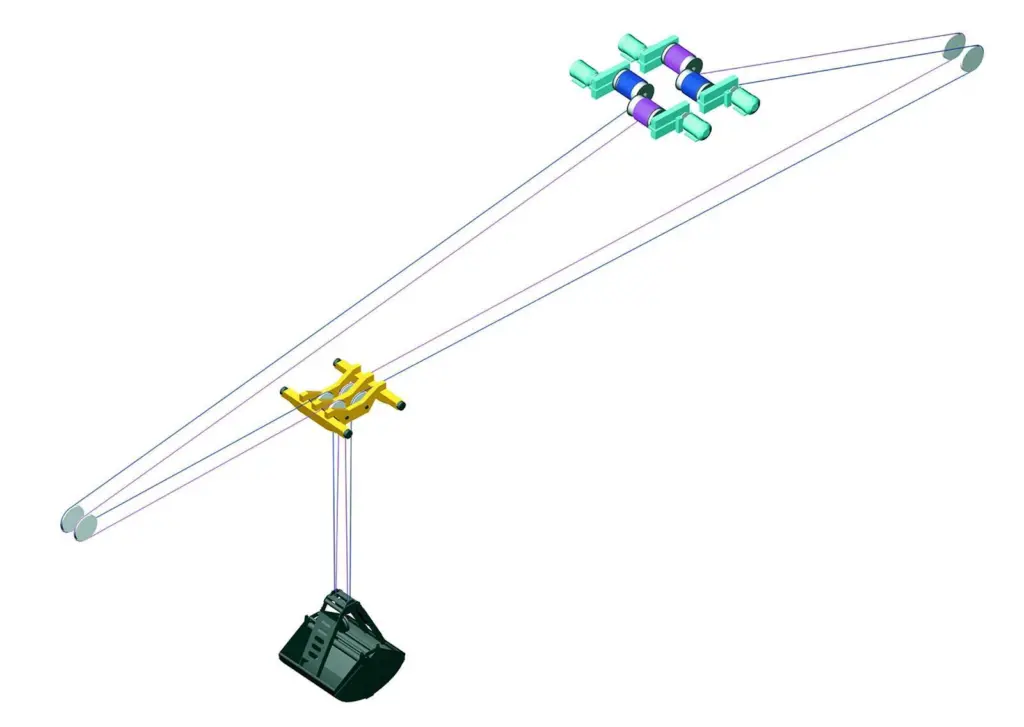
Essentially, the technology allows four winches to be electrically connected to one another with no need for a separate auxiliary trolley.
The company’s first AGD-equipped unit was acquired by the Finnish port of Pori in 1999. Three more units are in operation at the ports of Le Havre, Koper and Comalco.
Given the paucity of global sales for grab crane unloaders, which amounts to around 25 units annually, of which 70%-80% are accounted for by China, Konecranes nevertheless participates in most available projects, concentrating much of its efforts in Europe and China.
However, while China remains a huge market for all manufacturers, Europe is also healthy. Riny Stoutjesdijk, sales manager of grab manufacturer Nemag, notes that 80% of its current turnover is export related, although ports such as Rotterdam and Amsterdam remain a key market for the manufacturer given that they are importing large quantities of both coal and iron ore as domestic production in Germany tapers off.
“Business is buoyant at the moment, although this has never been a market sector where prices have been anything other than ‘keen’, ” he laments, whilst pointing out that Nemag has reported good results over the last couple of years as power generating and steel manufacturing industries have boomed.
CSU OR GRAB: WHICH WOULD YOU CHOOSE?
“Although price is important, grab unloaders are always highly customised. We offer the most modern and reliable technology, which is vital in terms of operation and maintenance, ” notes Konecranes’ Kimmo Nyman. “Konecranes manufacturers all components in house, whilst both the mechanical and electrical design is undertaken by the crane supplier.”
Comparing grabs with continuous ship unloaders, he dismisses arguments that suggest dusty materials like cement and clinker should only be unloaded by CSUs for environmental reasons, pointing out that today’s grab unloaders can easily be equipped with efficient dust collection systems to minimise dust emissions.
“Wharfs deploying CSUs suffer from spillage since shore-based conveyor systems create dust. Grab unloaders equipped with modern dust suppression or collection systems produce similar levels of dust emissions, ” emphasises Nyman, adding that grab unloaders are always cheaper to buy than CSUs. In addition, CSUs have higher operational and maintenance costs as well as suffering from slower lead times following the placement of an order, while grabs are easier to maintain and operate.
Nyman insists too that certain animal feedstuffs can become compacted during shipment or form a hard surface which CSUs find difficulty to break. In these circumstances, grabs have a clear advantage. On the other hand, he concedes that because grab unloaders bring together technology and components from crane, electrical and bucket suppliers, there is a risk of there being almost too much choice and perhaps problems if, for example, the electrical drive supplier is not the same as the crane supplier.
“Grab unloaders will not disappear. Indeed, those with capacities over 1,000 tonnes per hour will remain as the main unloading machines in bulk terminals. This year, we have sold seven of our AGD grab unloaders, while the annual market for all high capacity CSUs is limited to no more than five to ten units per year, ” concludes Nyman.
COUNTING LIFE-CYCLE COSTS As with other handling equipment nowadays, most customers for grabs look beyond the immediate sticker price when assessing the feasibility of a purchase and it is mainly this group that Nemag views as its core market. “Stevedoring companies are nearly always interested in the whole-life cost of a grab. In order to make a profit, they have to balance the initial cost against the productivity that can be achieved from operations. This, in part, is linked to maintenance issues, such as loss of income during downtime.”
Riny Stoutjesdijk concedes that Nemag does offer guarantees covering either tonnes handled or working hours, but such is the confidential nature of this information that he declines to go into further detail. Nevertheless, the average grab should be able to handle at least 10m tonnes during its front-line working life. But, to reach these levels of performance, good maintenance is key. “We work very closely with those Dutch stevedores who have Nemag grabs, advising them on repairs and helping them to anticipate future problems, ” he stresses.
Nemag is now trying to move this kind of help to a new level, having introduced a pilot electronic monitoring device on grabs being used by the European Bulk Handing Installation (EBHI) at the northern Spanish port of Gijon. The device counts the cumulative tonnage handled by each grab, which helps management decide when routine maintenance should be undertaken.
“Using this new device, a manager can monitor the performance of each grab from an office. By being able to analyse the quantity of work that a grab is doing, not only can you tie in maintenance schedules, but you are also highly aware when a grab might be reaching the end of its working life and may need replacement. This, of course, will help reduce unnecessary downtime and therefore boost profitability.”
PERCEIVED GAP NARROWED With this latest breakthrough in electronic surveillance, the perceived gap in performance between grabs and CSUs has been considerably narrowed. Furthermore, Stoutjesdijk confirms that environmentally, advances in grab design have all but eliminated the advantages that CSUs once had in this area, although he does concede that, for very powdery substances such as alumina, CSUs do perhaps hold the upper hand still.
“CSUs will continue to enter the market in applications requiring the handling of a single material. However, from what I have seen in Europe, CSUs deployed in handling more than one material, for example coal and iron ore, have not lived up to expectations. They require more maintenance and, when they go wrong, the downtime is longer. A grab, on the other hand, can be easily changed within ten minutes!”
Materials such as scrap metal can only be handled by grabs, while those bulks which compact during long voyages do pose a significant threat to the efficiency of CSUs.
“CSUs really have niche applications, while grabs are universal. The proof can be found in any major bulk handling operation where a stevedoring company has to cope with more than one material. In those types of situations, grabs are virtually always preferred, because they are cheaper to operate and much more flexible.”
Related Articles
 TERMINAL OPERATIONS
 CONTAINER & CARGO HANDLING
 NEWS
NEWS