



Black Sea ports are being chilled by uncertainties. Stevie Knight and Petar Pajevic report
The further east you go around the Black Sea, the more economies you see that have been deeply affected by their proximity to the troubles in Ukraine and Russia.
“Volumes are down, people simply have no money to buy consumable goods,” says Steve Wray of Ocean Shipping Consultants. In some places he’s seen wages being slashed by as much as 90% and “enormous struggles” to keep the economy moving: “The cargo has simply plummeted.”
He adds : “In many places there’s no spare money to support investment, so most things are in a holding pattern.” It’s not just hardware that suffers, other kinds of port development are blighted: Ukraine, for example, may well be considering a privatisation programme but the moment’s not right – at least from the state’s point of view.
On the other hand he points out that operators with nerves of steel may find there’s a good deal on offer. Despite Novorossiysk’s spot at the heart of the troubled area and the loss of something like 10% of its volume since the beginning of the year, DP World obviously sees medium to longer term potential. It has gone ahead with a 49% stake in the port’s NUTEP terminal, and more, it’s also probably got a hand in a $60m investment aimed at bringing capacity up to 700,000 teu by 2018, the injection bringing welcome relief for the cash strapped authorities.
Certainly it seems costly Crimean chickens are coming home to roost, knocking a big hole in Russia’s budget.
However you view it, it’s been necessary to underpin the dramatic transfer of a such a significant portion of coastline from Ukrainian to Russian stewardship with an influx of capital.
Deferred loss
Unfortunately, while upgrading the ports and connecting Crimea to mainland Russia by building the 19km Kerch bridge serves to bring the two together socially and economically, it has come at the expense of other planned developments.
Alexander Ignatov of Ignatov Group explains that with low hydrocarbon prices depressing the oil and gas-dependent Russian economy and targeted European sanctions affecting the rouble, there isn’t enough money to go round. He points out that although Crimean ports are benefiting from state-run programmes “due to the financial crisis investments have been shifted from ports in southern Russia - like Novorossiysk, Anapa and so on”.
One of the biggest losses arguably involves Taman, which was to handle Novorossiysk’s ‘dirty’ cargo such as coal and fertilisers. Russian Economic Development Minister Alexei Ulyukayev justified pulling the development back in 2014 by pointing to “existing deepwater ports” but these Crimean facilities themselves require significant investment: “Feodosia, Yalta and Kerch are weak as they have been suffering from under-investment during Ukraine ownership,” says Mr Ignatov.
Even with all the upgrades, it seems unlikely that Crimean ports will be able to service Russian cities better than ports which don’t need a land bridge to do the job.
However, given Russia’s need to make sure Crimea remains Russian and the Black Sea Fleet remains supplied it’s an understandable choice; port capacity may well seem to be worth less than the political capital.
However, Ukraine has fallen jaw-droppingly far and so the loss of the under-functioning Crimean ports hasn’t really been felt.
According to Alexander Kifak of law firm ANK, Ukraine’s port infrastructure was scaled for servicing the old Soviet bloc but now the country’s old cargo streams have all but dried up, a situation not helped by the current political and economic crisis. Mr Ignatov explains that Russia put up barriers to Ukrainian business after it signed a free trade agreement with Europe - which unfortunately hasn’t replaced the volumes. Further, Russia itself is improving its port infrastructure up in the Baltic area and this is also drawing cargo away.
Stuck in the past
It’s not just Russian cargo that’s fallen flat: although ‘functional’, Mr Kifak says the Soviet era ports are looking more and more outdated.
This isn’t helped by state-regulated tariffs: “Ukrainian port duties are three times more expensive than, for example, their Turkish counterparts, and twice as expensive as the Romanian ports for the same vessel”. He adds that it isn’t surprising Ukrainian ports are losing the cargo battle to their foreign competitors, especially Constanta and Novorossiysk.
On top of this – and possibly a more central issue - is the conflict ridden downward spiral in the eastern Donbas region. This has resulted in a massive loss of infrastructure in what used to be Ukraine’s industrial heartland.
Taken together, Mr Ignatov says the effect has been to cut the freight passing through Ukrainian ports by more than half. Mr Kifak estimates that transit cargo turnover has plummeted even further, with current figures at barely a quarter of its 2007 peak.
However, Ukraine’s previous core steel and raw materials business has been replaced by agricultural products “and now over 35% of Ukraine’s export is grain,” says Mr Kifak. Some of this is down to intensive farming, but also down to the fact that Ukraine is estimated to hold around a quarter of the best agricultural land in the world.
This has the big grain producers swarming all over the country’s ports.
Big names
Mr Kifak says that massive international agribulk players like Cargill, ADM, Louis Dreyfus and CHS have shown interest in establishing entire logistic chains, complete with waterside loading and storage facilities.
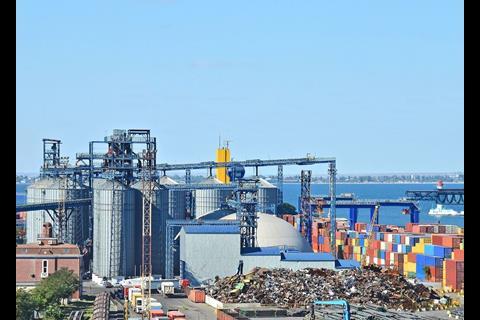
Recently Noble (Cofco) Agri completed a 2.5m tonnes per year grain and oilseed complex in Nikolayev Commercial Seaport. The terminal includes 16 grain silos with total storage capacity of 100,000 tonnes. Odessa too has started to upgrade its 2m tonnes a year terminal with a grain drying and purification plant and will probably soon need to look at expansion.
Overall, Ukraine’s grain production is rising at stunning pace. From less than 17m tonnes a couple of years ago, this year it’s set to export a record 37m tonnes of grain, mostly to the Middle East, China and Egypt. More recently a $100m joint venture between Cargill and Ukraine’s MV Cargo was announced. This will see a 5m tonne capacity grain terminal at Yuzhny built by early 2018 with depths increased to 16m in order to allow the terminal to accommodate vessels up to 100,000 dwt. It won’t necessarily end there as capacity can be expanded by another 50% if demand calls for it.
But despite all this frenetic activity – and even more plans on the table – Mr Kifak says “the bureaucracy is not business friendly”. He points out that to maximise the return from this kind of trade you need to run capesize ships: this in turn demands ‘big infrastructure’, silos for the storage, dredging for the necessary depth as well as some fairly sophisticated loading and handling kit, all of which need a firm legal underpinning. Unfortunately despite attempts to sort it out this still isn’t Ukraine’s strongest suit.
Mr Kifak is blunt: state-private partnership is overcomplicated by bureaucracy, and more, it has numerous shortcomings from the investor’s point of view. He explains: “Determined investors manage to jury-rig legal solutions with lease, easement or service provision agreements.” Moreover, he explains they actively hamper collateralisation of assets for onward finance.
But there's a glimmer of light: if occasionally voiced privatisation plans result in anything concrete they could help push Ukraine onto an international 'best practice' footing. However, Mr Kifak admits he doesn’t yet know if that's really on the cards.
GEORGIA AND ROMANIA ON THE SIDELINES
Georgia’s attempt to join China’s ‘Great Silk Road’ hinges, it seems, on Anaklia’s promise of providing China with a deepwater Black Sea exit backed up by a number of alternative routes.
However Ignatov Group's Alexander Ignatov explains China’s state investors are still not ready to put money on the table for the project, so at present there’s only a limited amount of participation from smaller, private Chinese sources. Further, there’s not much chance of much local input as everyone is broke: “There’s no money in Georgia itself, and while Turkey and Ukraine ‘politically' support the Anaklia project as an anti-Russian endeavour, there’s no money there either."
Even on the Black Sea’s western edge, Mr Ignatov sees “no significant shifts, no drivers for future development, now or in the next three to five years”.
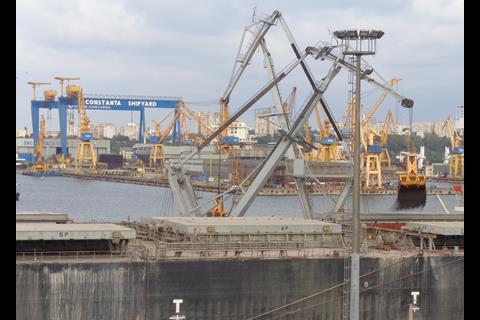
Sitting at the mouth of the Danube, state-owned Constanta is Eastern Europe’s biggest port – and the closest thing Romania has to a Mediterranean opening, offering an easy, multimodal transit point for Eastern and Central Europe.
But even this isn’t giving it much leverage. In 2015, container throughput was just under 700,000 teu putting it under half its 2007 levels. Liquid bulk was likewise below capacity and dry bulk cargo has been hampered by tensions between Russia and Europe.
Although Constanta gathered a substantial amount of investment from European and local government initiatives on EU entry, according to Mr Ignatov it’s exhausted this element as the principal business interests from Germany and France have now got what they want. “Counting the limited size of the market... nobody will fund further," he predicts.
TURKISH TRAGEDY PLAYS OUT
The Western end of China’s ‘Silk Road’ initiative might be getting a little frayed by market crosswinds.
Not that long ago China Merchants Holding International and Cosco Pacific, together with State Fund CIC Capital, completed a $940m acquisition of a 64% stake in the Kumport facility at Ambarli. It seemed reasonable: the port had seen a growth in volumes of about 200,000 teu a year since 2009, and 2014’s 1.415m teu throughput was likely a major part of the decision for the buyout.
But despite the fanfare, a large bump was felt last year, when volumes dropped. However, Neil Davidson of Drewry points to a rather more complicated and possibly less dramatic picture than sometimes reported.
He places the real loss in volume at Kumport at 17%, with Ambarli down by 11% against the Turkish container shipping’s overall 3% contraction.
He explains that the fall is not inconsistent with the region’s overall performance: “Ambarli is used as a transhipment hub for the Black Sea, and we know that Black Sea volumes, especially to and from Russia and Ukraine have been hit by unrest and sanctions.”
Further, he believes that Kumport’s extra contraction could be due to more local competition, sparked by the opening up of Aysaport, a little way down the coastline and a direct competitor for Marport’s MSC volumes. “Marport will have lost some transhipment traffic to Asyaport and may well be trying to fill the gap by competing harder for market share within Ambarli, with Kumport being the obvious target.”
On another politics-meets-commerce note, there has been trouble with Russia as the two countries’ respective involvement on opposing sides of the Syrian conflict has resulted in sanctions and counter-sanctions, souring relations and dampening trade especially in the ports of Istanbul and Samsun, says Ignatov Group's Alexander Ignatov.
It proved to be the final nail in the coffin for the Turkish Stream project – a huge 63bn m3 per year capacity gas pipe under the Black Sea. Running between Russia’s Anapa port and Kiyikoy in Turkey the idea was to continue it right up to the Greek border. It had been seen as a vital link in the chain to keep Russian gas exports pumping out to Europe after its predecessor, the South Stream pipeline, was abandoned under pressure from the EU, but it’s possible that deflated market expectations has as much to do with it as the political strife.
Possibly more interesting from the ports’ perspective is the Istanbul Kanal, which could link the Sea of Marmara and the Black Sea. Though nicknamed the “crazy plan”, it’s been surprisingly hard to dismiss and while recent political turmoil put it on hold, there are signs it’s on the move again.
The idea is it will stimulate new business and residential centres, generating money from the 150 or so vessels a day presently transiting the Bosphorus that might want a faster alternative route. It can’t be avoided that it may also give Turkey a better chance of controlling the passage of ships - including the Russian Navy vessels that have recently been seen a stone’s throw from the Bosphorus' bank.
Even here the region’s issues have a political rather than purely commercial edge. So, although there could be some winners from the fall out, these certainly won’t make up for the losses and it’s worth bearing in mind that in this climate, allegiances can be made or unmade with dizzying speed, certainly much faster than a financial deal can be brokered.
So – for the foreseeable future at least – it’s far from ‘business as usual’.