



Decarbonisation pressure on
The recent Coastlink Conference saw wide-ranging discussions on energy and future fuels, sustainability, resilience and the ‘new normal.’ Felicity Landon presents the highlights
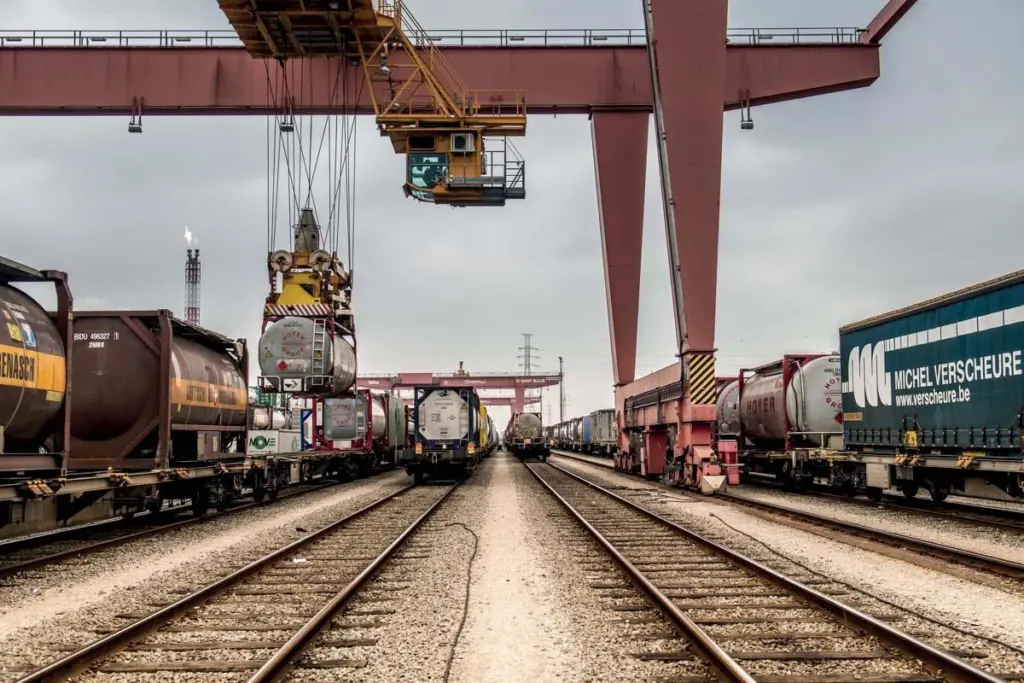
The pressure to decarbonise comes not only from current and future regulation but also from across the global supply chain – including industry, business, customers and end consumers. This was a key ‘takeaway’ from the 2023 Coastlink Conference, held in Liverpool, UK, 3-4 May, where, whatever the topic, sustainability and decarbonisation were never far from the discussions.
“Customers are already seeking to see freight operators reduce their emissions,” said Michelle Gardner, Deputy Director, Policy, at Logistics UK. “Our members tell us their customers are coming to them and wanting answers on how they are seeking to reduce emissions today and on the long journey to Net Zero. That is really focusing minds at the moment.”
The industry is under huge pressure, said Maurice Delattre, Area Manager, Port of Amsterdam International. Explaining Amsterdam’s ambitions as a hub for alternative energy production, with 80 hectares earmarked for the development of bio/synthetic fuel and the circular economy, he said: “Why are we focusing on these activities? Because the key characteristics of our region mean an urgency to accelerate the energy transition.”
The region’s strong industrial clusters – energy- demanding steel production, port activities including bunkering, and the massive aviation operations at Schiphol – are all completely dependent on fossil fuel, said Delattre.
“With this in mind, we as a port work on how we can make sure to get rid of those dependencies in the future, together with our partners.”
Every port needs to have a clear strategy and vision in place for sustainability and energy transition, said Delattre, who noted that the Port of Amsterdam “is not about generating double digit growth anymore – it is about generating value for society”.
We can and must decarbonise logistics, said David Browne, General Manager of Maersk. Opening the session on Sustainability and the Energy Transition, he challenged the International Maritime Organization’s Marine Environment Protection Committee, due to revise the IMO’s GHG Strategy in July, to be more ambitious.
Describing the IMO’s Net Zero plan towards 2050 as a bit ‘sketchy’, Browne said: “I hope to see much greater ambition than the initial GHG strategy and a strong recommendation of what milestones need to be achieved, then supported and approved by governments.”
However, he said: “That will not stop us [Maersk] going forward and taking our own actions and ramping it up, because we have to deliver our goal of Net Zero across our whole business by 2040.”
The fleet is the right place to start, but Maersk is taking it a step further and looking to decarbonise across the whole end-to-end supply chain, taking in all the products and services it offers through the supply chain, said Browne – and that includes the use of other lines’ vessels for some shipping.
He gave details of Maersk’s green methanol fuelled 2000TEU feeder vessel now being built and due to enter operations later this year, to be followed by a series of 16,000TEU capacity vessels powered by green methanol joining the fleet.
Because of the size of its fleet, Maersk is in a position to assist the industry in moving forward on decarbonisation and future fuels, noted Browne. Other operators with smaller fleets which don’t have the opportunity to run a test case, “might be able to learn from our successes or failures”, he said.
Grant Hunter, BIMCO’s Standards, Innovation and Research Director, focused on a different type of regulation – the charter party agreements created by BIMCO which are central to the way the global shipping industry works.
Some of the standard bi-party contracts go back 100 years and are not fit for today’s industry, said Hunter,
“They can create inefficiencies in our industry that we need to iron out,” he said. “We need to work with the entire supply chain pipeline, not just between shipowner and charterer. There is no point in having an agreement if it is not aligned with what’s in the sales contract.”
Using just-in-time arrival can deliver decarbonisation, “but when you get to Net Zero, do you just go back to the Wild West, speeding around again? No, because there are going to be more expensive fuels. We need a smooth and efficient industry.”
More joined-up thinking was needed to make shipping more efficient, said Hunter. “We cannot reduce emissions from shipping if it is just left to the owner. We have to think about a brand-new model for shipping and move away from the charter parties of old.”
A new ‘holistic’ business model is needed for the 21st century, providing efficient and inclusive shipping, he concluded.
INLAND SOLUTIONS
As well as shortsea and feeder shipping, Coastlink’s partners focus on the intermodal transport networks through the ports that support the sector.
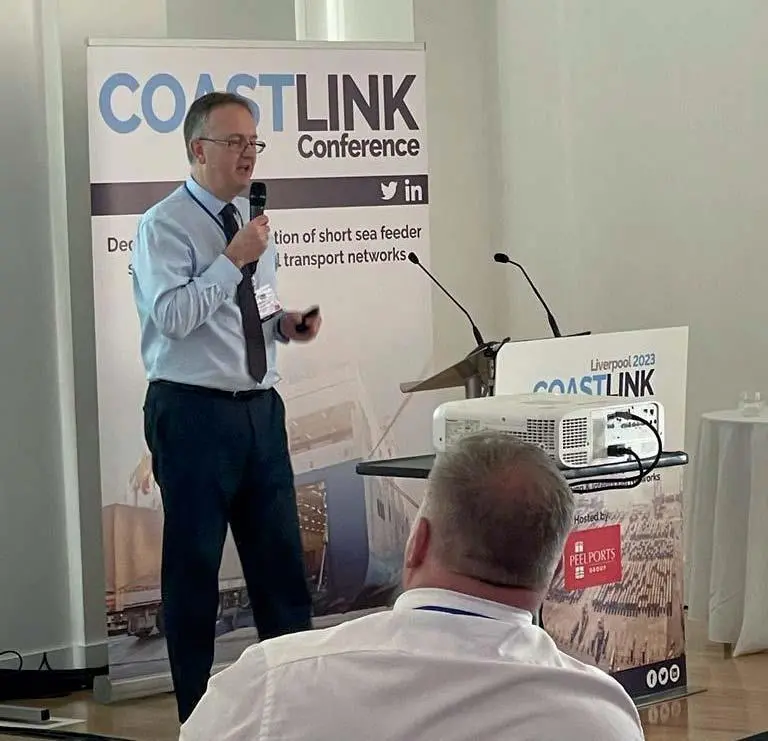
Stephen Carr, Group Commercial Director, Peel Ports, discussed the role of trucks in ports and shortsea/coastal shipping where the distance being covered is so small it doesn’t justify using rail. With the worsening shortage of haulage drivers, “surely the answer is to let the maritime leg do most of the work and let truck do the final miles delivery”, he said.
Challenging the audience on some stats, he explained that 12 per cent of containers coming into Liverpool never leave the port estate; 25 per cent never travel outside Merseyside; and 62 per cent never travel more than 50 miles. Given the age profile of drivers, people leaving the sector, and difficulty in recruiting people, the haulage industry is a ticking time bomb, he said. “But remember the 50-mile radius. Proximity drives driver productivity gains.”
Shorter distances make truck driving more attractive – a day’s job instead of being on the road – and each driver can cover several deliveries a day instead of driving hundreds of miles to and from southern ports, said Carr.
Geoff Lippitt, Group Commercial and Strategy Director, PD Ports, analysed how intermodal, shortsea shipping, ro-ro, lo- lo and last-mile delivery road haulage can create resilience and improve capacity for ports and operators.
Outlining PD Teesport’s strategies to promote resilience, he said: “The problems of tomorrow have to be dealt with well in advance of them being on your immediate horizon. Ports are about coping with change. In the last 50 years, Teesport has seen the rise and fall of oil – exploration, oil from the North Sea and decommissioning; the rise and fall of steel, twice; offshore wind; the chemical industry fragmented; and the rise of container business, all as a result of the UK changing its markets.”
These changes were not affected by Covid or Brexit but by market and global economic factors, said Lippitt. He highlighted how the use of rail can make a port more competitive in areas larger than would be the case when using road transport.
Justin Atkin, UK & Ireland Rep’ for the Port of Antwerp- Bruges, also emphasised the importance of connectivity. “Every berth in Antwerp is rail connected – there are more than 1000 kilometres of rail in the port that we own and maintain,” he said. “We have 250 weekly container shuttles to 70 destinations in 17 countries and have seen new shuttles introduced and services expanded this year.”
While acknowledging that the scale of the UK means a different picture for inland waterway freight, he explained that Antwerp-Bruges handles 230 weekly container barges to more than 90 destinations in six countries.
GOVERNMENT INTERVENTION?
A question from the audience: should the government mandate that goods only be delivered from their local regional hub port, making use of transshipment? There was some debate about how much government intervention was required to drive more sustainable logistics.
Claudio Veritiero, CEO of Peel Ports Group, said: “We are fortunate in the UK to have a model, compared to a number of other areas of UK infrastructure, where we are relatively deregulated. I think as an industry it works and the government has taken a relatively hands-off approach.
“However, I think there are areas where we could do with more help – for example, the role of ports in regional economies and how you facilitate that. Port connectivity would be a key area, which the government could do more around.”
Mike Garratt, Chairman, MDS Transmodal, noted the relative independence of the ports industry – “but the flip side is that the government doesn’t always understand what the ports and shipping industry can contribute”.
During his analysis of freight and modal trends, he pointed out that in the UK 62 per cent of shortsea traffic landed south of Ipswich, despite the great majority being bound for the Midlands and North. In developing the case for better connected ports within a green agenda, the government should look not just at user benefits but also at non-user benefits, such as reductions in emissions and congestion, said Garratt.
Analysis shows that unit load cargo is switching to northern ports and to unaccompanied modes, according to Garratt. “That itself encourages planning policy and infrastructure investment to facilitate that. Warehouse capacity generally is also driving north and expanding. Shortsea shipping has the capacity to support a green agenda by switching to alternative fuels.”
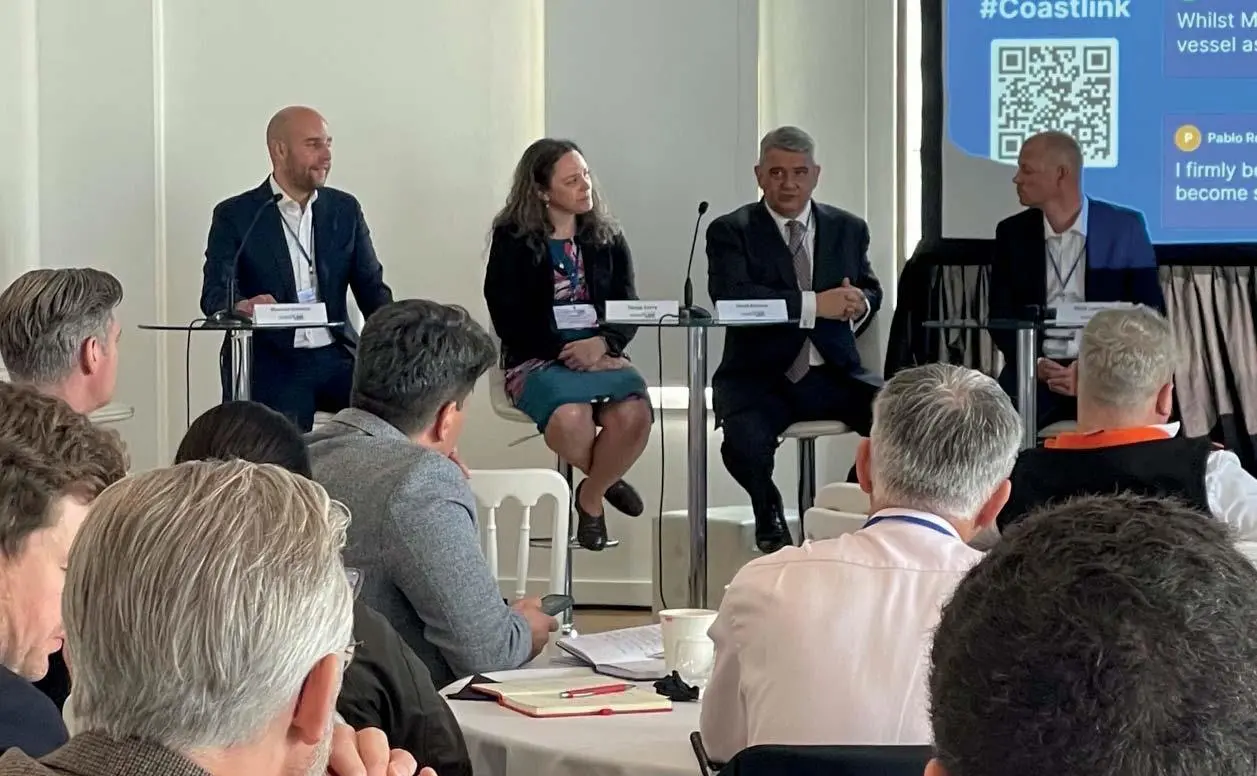
However, he noted a distortion in UK: “The railway industry does get grants for routes that would otherwise not be viable. It is sort of available to shipping but in practice not. It is extremely difficult to introduce and not distort the market – because it is not easily defined and the other end is likely outside the UK.”
The discussions also touched on government’s role in the provision of on onshore power in ports. Claudio Veritiero said: “If the demand is correct, we will put the investment in – but we need parallel investment in energy infrastructure.”
The British government policy is to facilitate some of the innovation and investment through grants, he said, rather than a clear and robust “this is the way you are all going to go as port operators and shipping lines”.
Stephen Carr said: “I don’t think the government should interfere in the market in terms of dictating along which route goods should flow. What the government should do is tax those elements of transport that are not socially good: a way of nudging the market to a solution instead of forcing the market to a solution.”
Ultimately, carbon is going to be taxed in the supply chain, “because ultimately we want to drive sustainability”, said Justin Atkin. “Some are doing more than others in terms of a decarbonisation target. I think in the end, the EU and the UK government will end up adding carbon costs to the supply chain. That is why we are making the effort to make first and last mile more efficient, by taking the long haul on to rail and coastal shipping.”
Geoff Lippitt said government intervention was required in some form. “They already intervene where, for example, large project cargoes come into UK – these have to come to the nearest port for delivery.”
He suggested that there should be some sort of mechanism that recognises where the nearest port is (relative to the cargo’s origin/destination). “Shipping companies don’t always know that. It is very much getting into the mind of the shipper/ end users.”
UK: NEED FOR SPEED
Logistics UK is concerned generally about the UK falling behind on decarbonisation, noted Michelle Gardner. “Other countries are moving ahead in terms of driving change. We have got policies from government, but don’t feel we are moving fast enough.”
The UK government must set a growth target for water freight and have the right policies to help businesses go faster and further towards Net Zero, she said. “Certainty of policy is essential for businesses to invest in long-term capital assets. We have been calling for a water freight target to be set and this must come with a coherent plan to make sure it can be delivered.”
Gardner also said there was a need to protect land for wharves and access, “as access to wharves and development of ports is a direct obstacle to expanding water freight inland”.
She called for a coordinated and integrated approach to infrastructure planning, investment and delivery that supports a UK-wide freight network and modal shift and said the government must work with planning authorities to raise awareness of the logistics sector. “Innovation funding should be focused on the delivery of a green, efficient and integrated logistics sector. We want to make sure government delivers.”
Related Articles
 OPERATIONS
 OPERATIONS
 COASTLINK