



DP World Sokhna enters trilateral partnership
DP World Sokhna recently entered into a trilateral partnership to serve as the hub for all construction material imports needed to build the central business and financial district of Egypt’s new administrative capital.
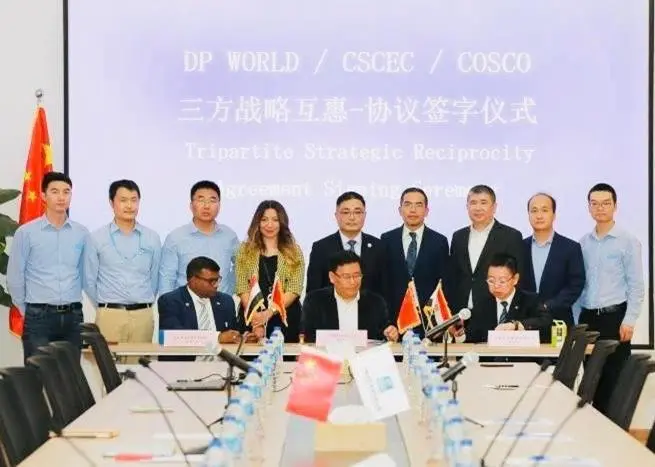
The partnership with the China State Construction Engineering Corporation (CSCEC), and the China Ocean Shipping Company Ltd (COSCO) will enable CSCEC, the largest construction conglomerate in China and the company in charge of developing the central business and financial district in the new capital, to benefit from Sokhna’s proximity to the new capital and its advanced road and rail links.
DP World Sokhna’s strategic location just below the southern entrance to the Suez Canal, on the Red Sea, also serves as a key gateway for Asia, Europe and other international markets.
Suhail Al Banna, CEO and managing director of DP World Middle East and Africa, said: “Our strategic partnership with the China State Construction Engineering Corporation and China Ocean Shipping Company provides the opportunity for DP World Sokhna to expand its role in supporting Egypt’s economy by serving as the exclusive port for all of the central business district’s cargo, and ultimately, companies who will be setting up their operations in the new capital.”
DP World Sokhna already has a dedicated facility for catering existing and future business of CSCEC. The Upcoming Basin 2 facility will support the business of CSCEC.
DP World Sokhna recently marked its 10th year anniversary by announcing a major expansion through Basin 2, a move which brought DP World’s total investment in Egypt to US$1.6bn.
When completed in the second quarter of 2020, Basin 2 will nearly double capacity at the port to 1.75m teus per year.
Located approximately 50km east of the current capital Cairo, Egypt’s US$45bn new administrative capital will cover an area of 700km2 and will be capable of accommodating 6.5 million people, when completed.
Related Articles
 PORT & TERMINAL NEWS
 PORT & TERMINAL NEWS
 PORT & TERMINAL NEWS