

The ports of Duisburg and Rotterdam have reinforced their goal of jointly developing sustainable transport corridors via waterways as well as future initiatives for the energy transition.
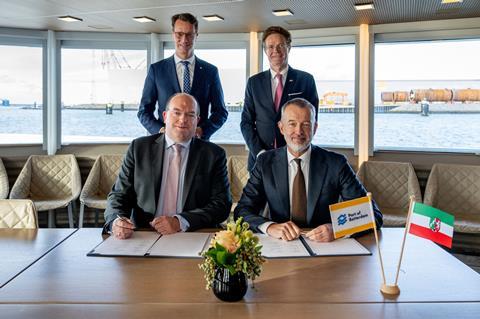
A central new element of the cooperation is the export of CO2. This is crucial for ‘hard to abate’ industry, since decarbonising these sectors using carbon capture, utilisation and storage (CCU and CCS) is not possible without strong ports and high-performance transport chains.
”We face great challenges which we can overcome much more quickly, efficiently and intelligently together,” said Markus Bangen, CEO, duisport.
”It is crucial for us to bundle our expertise and develop collective cross-border solutions, especially in sustainable logistics and the sectors surrounding the energy transition. Logistics is a team sport – and the Port of Rotterdam is our ideal partner.”
Cross-border partnership
The ports of Duisburg and Rotterdam are looking to create the conditions for better cross-border CCU/CCS activities, that is, the targeted capture, storage and utilisation of carbon dioxide.
Another large focus in the agreement between the two ports lies in strengthening the Rhine corridor as a sustainable cross-border logistics hub.
The Rhine corridor forms the backbone of European energy supply and enables efficient, sustainable access for the production sites to international markets. As the most important waterway in Europe, it secures the security of supply and the competitiveness of a vast array of companies along the entire value chain.
”13 percent of Europe’s energy demand is imported by way of Rotterdam’, said Boudewijn Siemons, CEO of the Port of Rotterdam Authority.
”This is still primarily made up of fossil fuels, but our long-term aim is to become Europe’s port for importing renewable energies. Inland shipping – and thus our cooperation with duisport – is especially important in the onward transport of these energy sources.”
The two ports previously signed a letter of intent in 2022 on cooperation in the fields of rail and inland land development, digitalisation and the energy transition.
Examples of past successes include the partnership with the Brazilian port in Pecém for transporting green energy to Europe, the advancements made in the cooperation of digital port community systems RheinPorts and Portbase and the pilot of the first low carbon ammonia transport when the Dutch king visited in November 2023.