Increasingly, eco-friendly rubber tyred gantries are helping ports to raise efficiency levels while lowering emissions. John Bensalhia reports.
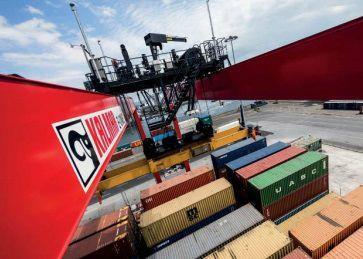
The RTG crane is a fine example of modern eco-friendly port equipment and machinery. Developments in environmentally friendly technology offer up benefits such as lower emission rates and quieter operations. Crane manufacturers are providing new RTG products that help ports manage high demands of work while helping the environment.
“We are currently delivering a fleet of Konecranes hybrid RTGs to the Port of Houston,” says Svend Videbaek, Marketing Specialist, Konecranes Port Solutions. “Nine units are already onsite, with eight more scheduled for delivery by year-end. Hybrid operation is, of course, a large eco-efficiency improvement, but the overall performance of the RTG in terms of container load control and efficient movement is the determining factor.
“The Konecranes Active Load Control system is also a prerequisite for fully automated operation, since Konecranes RTGs equipped with this system can handle yard surface fluctuations with ease.”
Videbaek adds that the Konecranes Core of Lifting is an important factor with respect to eco-efficiency as a whole. “This refers to how Konecranes designs and manufactures the core crane components in-house – the motors, the gear reducers and the control system (inverter drives) – to work together as a seamless whole in our cranes, specifically for crane motions. This covers all the cranes that Konecranes makes, not just our container cranes.”
MINIMISING ENERGY LOSS
Kalmar is investing heavily in optimising RTG control software to minimise energy loss while controlling crane movements. “A good example of this is the Kalmar SmartPower RTG,” says Petri Vuorenpää, Director, Product Management, Intelligent Crane Solutions. “It is equipped with an intelligent power management system, enabling a considerably smaller diesel engine and thus, much lower energy consumption and emissions than with traditional RTGs.”
A notable issue with energy consumption increase is using lighting with traditional floodlights. Vuorenpää explains that LED lights have been in Kalmar’s offering for some time. “Instant full brightness of the LEDs when switched on also allows automatic shutdown of the lights, when general lighting levels are considered adequate for the operation. In addition to the lower energy consumption, this makes the lifespan of the LEDs even longer.”
ZERO EMISSION RTGs
In addition, in late 2019 Kalmar also launched a battery pack for the Zero Emission RTGs, to enable stack changes without need for an auxiliary diesel generator, therefore eliminating all local exhaust emissions.
Liebherr RTGs are offered with a number of different configurations, offering many environmental benefits. These include Liebherr ERTGs, which are available with cable reeling drum or busbar power source.
“Both configurations offer zero local emissions and an active front end allowing for energy regeneration back to the grid,” says Trevor O’Donoghue, Marketing Manager, Liebherr Container Cranes Ltd. “As a genset is not required, hence noise pollution, emissions and waste lubricants are eliminated."
Another eco-friendly Liebherr product is the Hybrid RTG, which typically uses energy recovery and storage systems, allowing the installation of lower power diesel engine models.
“Energy is recovered from the lowering cycle, which is in turn stored and recycled during the hoisting cycle, allowing for significant reductions in fuel consumption and emissions,” says O’Donoghue. “The reduction in engine size with noise dampening installation features allows ports/terminals to operate diesel powered RTGs in compliance with strict emission and noise level restrictions.”
Petri Vuorenpää says that Kalmar has a selection of ecofriendly process automation solutions that help move containers more efficiently. “Solutions of the SmartPort product family are able to track containers and container handling equipment all the way from the gate to the quay. Productivity, equipment utilisation rate and eco-efficiency are increased by optimising travel paths and waiting times by triggering dispatching and job instructions based on the location of the container handling equipment.”
HEADS-UP POSITION
RTG crane cabins are being designed with the operator’s environment in mind. The Konecranes BOXHUNTER is not only made for operator ease, but also for use in challenging inland locations. The BOXHUNTER enables the operator to sit and work in a comfortable heads-up position with direct visibility of any loading and unloading of the truck. The operator is able to climb into the cabin in a matter of seconds, saving valuable operation time.
Kalmar’s RTG cabins concentrate on the ergonomics and environment of the operator. “All the eco-friendly features are an integrated part of the RTG design, not just some add-ons to the cabin,” says Petri Vuorenpää. “To minimise energy consumption, air conditioning systems are temperaturecontrolled. This ensures suitability for both hot and cold climates. A special sun protection roof is applied to prevent direct sunlight to heat up the cabin, minimising the need for air-conditioning."
The same climate principles apply to Liebherr’s RTG cab designs, with low emissivity glass used to reduce solar heating and subsequent air-conditioning requirements. “The operator’s console is ergonomically designed with additional driver aids to ensure optimum driver focus and productivity,” says Trevor O’Donoghue. “Liebherr Operator Cabins feature an integrated heating and cooling system allowing for operation in climate conditions from – 40 °C to 55 °C.”
REMOTELY-OPERATED RTGS
Remotely operated RTGs can be controlled through a local belly box arrangement or through the Liebherr Remote Operator Station (ROS) desk. “With the ROS-controlled execution, the need for a driver’s cabin on the RTG is eliminated and by default, the energy demand from heating or air-conditioning in the driver’s cabin,” says O’Donoghue. “Multiple Liebherr RTGs can be operated by one remote operator, further reducing energy demand.”
Maintenance procedures are an important part of the product development process, with new RTGs requiring less maintenance than old cranes. Maintenance intervals of Kalmar cranes are typically 1000 operating hours, optimising usage of oil, grease and spare parts.
“Our customers like Exolgan in Buenos Aires in Argentina are very happy with the maintainability of our new RTGs,” says Petri Vuorenpää. “In addition, Kalmar eases maintenance by retrofitting conventional power units with eco-friendly solutions like electrification and hybrids or by converting power units with more fuel-stingy technologies.”
O’Donoghue further explains that maintenance features such as hydraulically operated gantry steering and trim/skew systems have been replaced with electrically operated equivalents, which help to streamline maintenance procedures. “Likewise, in the Liebherr ERTG designs, and in the hybrid machines with smaller engines, maintenance requirements are optimised further.”
He explains these benefits. “Maintenance intervals can be extended through monitoring individual drive and component usage rather than adhering to predefined monthly intervals.”
Ports are retrofitting and upgrading existing RTGs with new systems in order to boost levels of efficiency and sustainability. “One of the biggest opportunities to improve the ecoefficiency of RTG cranes lies in retrofitting to fully-electric operation,” says Videbaek. “This is a new possibility for operators of diesel-driven RTGs.”
The Port of Valencia’s container terminal, MSC Terminal VLC has recently seen busbar retrofitting of its extant Konecranes RTG cranes. The busbar retrofit converts operations to an all-electric method, with a power supply coming from a low electrified fence that provides the physical contact.
It’s a method that has reduced CO2 emissions at the terminal by around 20 per cent. The fully electric system also reduces noise levels, and from an efficiency point of view, there’s no need for refuelling or spending extra time on maintenance, which in turn boosts productivity levels.
SCSPA Investing for Environmental Efficiency
For RTG drivers at South Carolina Ports Authority (SCSPA), operations are assisted with the port’s newest generations of 42 RTGs. “These are outfitted with GPS autosteer,” explains Stephen Brisben, S.C. Ports’ mechanical technical specialist, crane and equipment maintenance. “This allows the operator to traverse the container stacks with no steering inputs. This helps to reduce operator fatigue, as well as the potential for collisions.” All of SCPA’s RTG cabs feature air-conditioning with filtration and sound dampening features to reduce operator fatigue.
SCSPA is investing to ensure efficient operations and maximum environmental benefits at all terminals, including the Port of Charleston. “Our newest generation of RTGs (39 in total) are powered by a variable speed Tier 4 Final diesel genset,” says Brisben. “These gensets use a ‘fuel saver’ feature where the diesel only runs at a speed required to support load demand, resulting in an approximate 25% fuel savings. They also use exhaust after-treatment components to greatly reduce emissions.”
Brisben adds that all of the flood and walkway lights on these RTGs are LED, reducing power consumption. The fully electric spreader bars on the newer RTGs increase efficiency, while eliminating maintenance costs and enhancing environmental benefits.
SCSPA is also upgrading 12 older RTGs with hybrid battery/genset engine systems, replacing the hi-power diesel engines, at the Wando Welch Terminal, the state’s busiest container terminal. “The new engines will reduce emissions and fuel consumption,” says Brisben. “This was made possible through a $2 million grant awarded by the U.S. Environmental Protection Agency to both S.C. Ports Authority and the S.C. Department of Health and Environmental Control.”
Later this year, SCSPA will receive 25 new hybrid RTGs for the Hugh K. Leatherman Terminal, a new container terminal at the Port of Charleston, which is set to open in March 2021. “These new RTGs have hybrid battery/genset engine systems, which reduce emissions and fuel consumption,” says Stephen Brisben, “To increase maintenance efficiency and reduce down time,” he concludes.
Related Companies
- Previous
- Next