


Green superhighway
Felicity Landon reports on the dramatic increase in cargo volumes on the River Thames
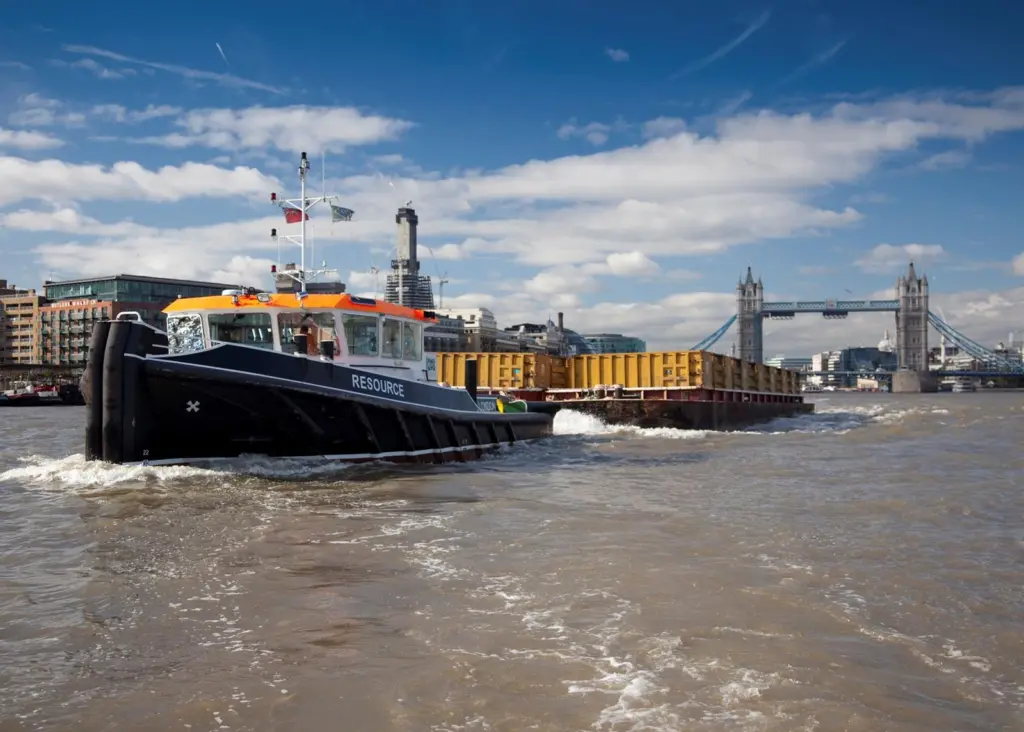
If any proof is needed of the importance of the River Thames in London’s transport infrastructure, recent figures from the Port of London Authority make it clear: while overall port trade was stable at 43m tonnes last year, the amount of freight moved between terminals on the Thames increased by 2m tonnes to 5.3m tonnes – a 62% increase between 2012 and 2013.
That, says Jim Trimmer, the PLA’s director of planning and environment, equates to 265,000 lorry loads. “More than a quarter of a million lorry journeys saved – it’s good for the environment and communities, with less pollution and noise,” he says.
The majority of the increase was an extra 1.8m tonnes of spoil being transported from construction projects, particularly the UK capital’s Crossrail scheme. This £15bn, 118 km rail link, from Maidenhead and Heathrow in the west to Shenfield and Abbey Wood in the east, includes 21 km of twin tunnels being bored under London, generating more than 4.5m tonnes of spoil to be removed by water. Most of the spoil is heading to Wallasea Island, where the RSPB is creating a nature reserve – and without the river, it’s hard to imagine how that movement could have been achieved without total gridlock on the capital’s streets.
“We are putting a lot of material, particularly excavated material from the tunnels and station boxes, on the river,” says Simon Phillips, construction logistics manager for Crossrail. “The PLA has been very helpful to us in terms of planning and finding suitable sites and suitable operators.”
Crossrail is also using the river to bring in the concrete tunnel segments, which are being transported by barge from Chatham, via the River Medway and Bow Creek.
Spoil channel
This, however, is just one of a number of major infrastructure projects under way in the capital, where the river is taking (or will take) a central role.
Thames Water’s £4.1bn Tideway Tunnel sewer project involves boring a tunnel 7 metres diameter for more than 20 km from Acton to Abbey Mills – it has already moved more than 1m tonnes of excavated material on the Thames from the Lee Tunnel, the first stage of the scheme, and although the major scheme has yet to start, Thames Water is committed to moving more than 4.3m tonnes of spoil on the river.
The Northern Line extension, a new London Underground spur from Battersea to Clapham, will involve more tunnelling and more spoil to be taken out of London by river, and other major construction projects included the Battersea Power Station redevelopment.
John Lovett, commercial director of quarrying and aggregates company J. Clubb, says: “Using the river is a much more economical and efficient way of moving bulk materials. It was done many years ago and we sort of reinvented the wheel.”
Cement is being moved upriver from Clubb’s Gravesend wharf to Battersea by Thames Shipping’s vessels, which can load up to 1,200 tonnes, making them the largest ships seen in central London for years. Mr Lovett points out: a vessel loading 800 tonnes at Gravesend heads upriver and reaches Battersea in three-and-a-half hours. “That would take 50 lorries two hours each to reach the same destination. Using the river cuts congestion and is better for business and the environment.”
Modern revival
Historically, of course, the River Thames has always acted as a vital artery for moving freight – in more recent times including scrap, household refuse, aggregates, petroleum products and containers – and the fact that some of Europe’s largest ever engineering schemes are going ahead has pushed up the volumes.
But this isn’t something that just ‘happens’. The PLA has worked closely with the Mayor of London, contractors and operators to encourage and make possible ‘freight by water’ and it has pushed hard to promote the merits of the river as an integral part of the capital’s transport network. With the pressure on for highly desirable waterfront apartments, that hasn’t been easy.
“Wharfs need to be kept open for the movement of goods and the PLA been instrumental in keeping them open,” says Mr Lovett.
The PLA has championed the Mayor of London’s ‘safeguarding’ policy which protects 50 wharfs along the tidal Thames for freight operations, keeping them out of the hands of developers. Safeguarding isn’t enough, however – the PLA is looking to force the hands of some site owners who seem content to sit tight on their investment and hope that eventually they will get their way with the planners.
A ‘reactivation strategy’ has involved compulsorily purchasing Peruvian Wharf in Newham, for example, to be used by aggregates company Bretts. If the Thames is a ‘green superhighway’, then the wharfs are the ‘slip roads’ on to that highway, says the PLA.
“The River Thames is by far the UK’s busiest inland waterway for freight, and it’s clear that volumes will continue to increase,” says Mr Trimmer. “In general we are seeing increasing demand for wharfs upriver – particularly for bulks and recycling materials for export.”
Beynd green
It is, however, far more than a question of being ‘green’.
“We translate what the river can do,” he says. “A lot of the contractors are used to the roads and they might even be used to the railway, but the river is different for them. The river offers 5 miles per hour of energy for free when you run with the tide, there is no congestion and it also offers a consistency that they can never get on the roads.”
Thames Shipping’s operations director, Lewis Brown, says: “Moving freight on the river is an ‘old’ opportunity that people are reviving. They are recognising that the Thames is a key motorway into London. Perhaps while London rapidly expanded, people forgot that there was this economic powerhouse of the river that runs all the way through it. With a little bit of investment, innovation, care and attention, it is a sustainable solution for ever.”
He adds: “The future is looking very good. I personally would like to see more companies get involved and looking at the River Thames as a sustainable transport mode, because there really are some great benefits to be had.”
However, he also emphasises the need to protect and improve the infrastructure. “There is no point in having the river unless we can actually access it,” he says. There is a point on the river where you see the change from industrial to highly residential use, but he believes it doesn’t have to be that way, and forward-thinking architects could look at integrating wharfs into developments. “We need to get across the message to both industry and residents that the river is essential – it is a liquid highway.”
Related Articles
 EUROPE
 ALTERNATIVE FUELS GREENPORT