![GreenPort[PortStrategy]](https://www.portstrategy.com/greenport/wp-content/uploads/sites/4/2026/09/GreenPortPortStrategy.svg)

The role of inland ports in urban logistics: back to basics
We all learned it in our history lessons that medieval towns were set up on the river banks or at the crossing of two waterways. This is not without any reasons, at that time, water was the only way to bring goods to the town and the only way to run a trade with other towns and regions. These medieval towns still exist and are the big urban agglomerations and European capitals of today. But what was centuries ago a fact, isn’t any longer. For a long time, urban citizens were turning their backs to the water and river banks became abandoned areas. Only in recent years, rivers and their banks were rediscovered, and not for logistics purposes however.
Urban riverbanks have become the dream location for exclusive housing, luxury offices and leisure parks. Old warehouses have been turned into fashionable lofts and party venues. However, is this sustainable? Should we continue to ignore the importance of waterways crossing European towns? Has the time not come to use this untapped potential?
In 2050, 8 out of 10 Europeans will be living in cities
By the middle of the century, 80% of Europe’s citizens will be living and consuming in cities. Urban areas will be increasingly congested, while space and public acceptance for new infrastructure will be running out fast. Without a radical change of policy, traffic in densely populated parts of Europe will be at a virtual standstill and quality of life will be suffering accordingly.
Citizens do not only move around but purchase, consume, produce and dispose goods. Moreover, if cities want to be and to remain prosperous places that attract people, companies, investments and jobs, they must show that they have the infrastructure to supply production sites and guarantee smooth delivery of goods.
Europe’s Transport policy is not stopping at the city gates
Europe aims at reducing the dependence on imported oil and cut carbon emissions in transport by 60% by 2050. To achieve this goal, the Commission wants to develop amongst others a strategy for urban freight transport and puts forward a quantified policy goal: CO2-free city logistics in major urban centres by 2030.
Urban logistics through the port: more than just an idea
Recently, different urban inland ports have been actively working on developing green urban logistics projects using the water. Steadily, urban inland ports are claiming a role for inland ports in the field of urban logistics.
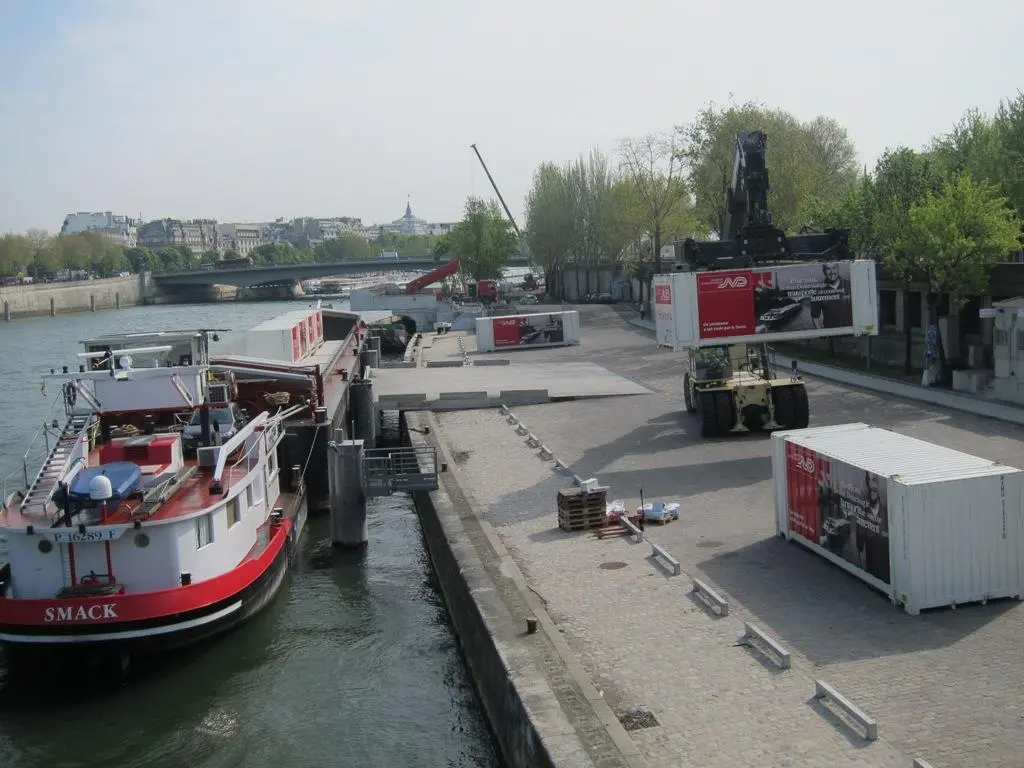
Paris has set the “Seine”. Since September 2012, 26 containers (or 450 pallets) are coming by barge, on a daily basis, from the inland terminal of Bonneuil-sur-Marne to the Bourdonnais port at the foot of the Eiffel Tower to be distributed to one of the 100 Franprix supermarkets located within a few kilometres of the quay. The “urban last mile” is done with clean trucks (euro 5). At this moment, the use of inland waterway transport is still a little more expensive than trucks. In the longer term, it is expected that the daily transhipment of containers will go up to 48. If fully operational, the project will result in a modal shift of 450.000 tonnes-km and a decrease of CO2 of 37%.
Another Parisian example is from the French company “Vert chez vous”. This company anticipates the ecotax that will be levied as from October this year on >3.5 t trucks. The Vert-chez-vous barges operate like floating warehouses. Goods are first loaded at the Tolbiac Port together with tricycles. During the navigation on the Seine, the goods are being sorted by delivery zone and tricycles are loaded on board. At the arrival at one of the ports, the tricycles are unloaded and start their round by distributing parcels up to 30 kg. Empty tricycles are then loaded and the barge continues to a next drop off point.
Nevertheless, Paris is far from being an isolated case. The constant movement of noisy boats between the 17th and 19th century exasperated the inhabitants of Amsterdam, leading to a ban of inland waterways freight transport for different centuries. It took until 1997 before the Dutch Ministry of Transport allowed DHL to launch the “Floating Distribution Centre”, through which DHL is providing express delivery service for their customers in the heart of the Dutch capital. The boat stops at specific locations of major channels, which form the walls of the downtown. Every morning the boat loads DHL parcels and letters that are going to be distributed in the next hours at a dock in the northern part of the city. As a result, each day, only two instead of ten delivery vans have to find their way through the narrow and congested streets of Amsterdam.
The logistics service group Mariteam Mokum is also active in “intramural” freight transport in Amsterdam. Both Mariteam Mokum barges, the City-Supplier and the Power Supplier, are “clean” with hybrid engines (electric and biodiesel), “smart” because of their lack of idle rotation and “stylish” through their silence and odourless. The City-Supplier is equipped to meet different sorts of deliveries including urban containers, pallets, gas tanks, etc. and this thanks to a hydraulic crane. For hotels and restaurants for example, the tour includes the delivery of goods and clean linen as well as the collection of dirty linen and waste. The waste is then forwarded to a combustion plant located in the port of Amsterdam, which transforms them into clean fuel.
The Power Supplier is a multifunctional barge with two generators equipped with telescopic pillars also allowing it to dock in the “middle of the water”. This boat is designed to carry heavy materials, like building materials, but can become a floating platform for construction and even a stage for cultural events.
Other interesting examples can be found in Utrecht. The alleys and narrow canal streets of Utrecht are not made for accommodating big deliveries. Moreover, loading and unloading lorries in the streets create nuisance of noise or CO2 emissions and ruins the view of beautiful historical buildings. For these reasons, the city of Utrecht introduced an electric ‘beer boat’, which delivers goods via the canals. The boat is operating since early 2010. By supplying shops and restaurants along the historical canals of the inner city via the water, the emission-free beer boat goes back to old traditions. This system requires the presence of two persons on board: an agent of the city leading the barge and crane operation, while the driver serves the clients on the dock. The barge can carry up to 20 tonnes and can accommodate refrigerated and frozen products.
Time for cities to reconnect with their waterways and inland ports
Looking at these projects, one can say that the waterways crossing our city centres are being re-discovered. However, this process needs the support of local authorities. If cities want to face the challenges of further urbanisation, growing freight transport demand (+80% by 2050) and increasing road congestion, they will have to use the water to have goods delivered to the town, to remove the waste and to export goods produced within the congestion barrier surrounding urban agglomerations.
It is clear that the political will to work on sustainable urban logistics and to give the urban ports a role in the organisation of these green logistics is growing. In September 2011, five European capitals including Brussels, Paris, Berlin, Budapest and Vienna, supported by their port authorities, commit themselves to use the water for urban distribution and to take into account the waterway when developing urban mobility plans. One year later, the Italian city of Pisa followed their example. We hope that others will sign the charter that formalises the engagement. It is time to realize that the presence of water in a city is much more than just a nice city view!
Related Articles
 EUROPE
 ALTERNATIVE FUELS GREENPORT