


BANANA: A SLIPPERY ROAD
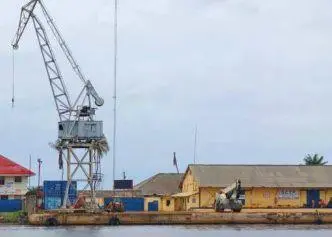
It was the source of some controversy as a result of the actions of a whistle-blower and now DP World (DPW) is again experiencing troubled times with its plan to establish a deep-water multi-purpose port at Banana port located on the north bank of the Congo River’s mouth.
The DR Congo’s President, Felix Tshisekedi, who came into power in January 2019, is actively working to revise the terms of the contract with DPW, with the objective of removing what it sees as elements that work against the national interest and to open up the project to other investors.
Under the revised terms, DPW would be eligible to continue with its proposed container terminal development, should it choose to do so, and other parties be invited to develop and operate oil, grain, mineral and other terminals.
It has been reported there is a belief in Tshisekedi’s team that there is scope for a larger port project overall, although this does not appear to be a point of view substantiated by demand studies.
Indeed, this issue of accurately matching supply to demand is one that has come up on several occasions in conjunction with the proposed Banana container terminal – is it really needed given current and foreseeable container traffic growth levels and factoring in the realities that overland transport costs from Banana to Kinshasa, the capital city and main demand centre, are much higher than those from Matadi, located 92 miles upstream on the left bank of the Congo River?
Here modern container terminal facilities are operated by International Container Terminal Services Inc. (ICTSI) with these currently undergoing a second phase expansion. Further, the idea of transhipment traffic finding a home at Banana and contributing to a positive return on investment also does not appear realistic.
Capacity for this activity along the West African coast has recently climbed significantly, including at the port of Pointe-Noire in The Congo, located just 71 nautical miles away. CONTRACT PROBLEMS A number of structural problems are identified by the current DRC Government with the Banana contract forged with DPW by the former administration headed up by President Joseph Kabila. As reported by Africa Intelligence they include:
A government equity stake in the project which at 30% is seen to be too low. There are concerns about the right of veto – that this level of equity participation is too low to be able to exercise a veto.
Also seen as a negative is the fact that while DPW’s shares are transferable the DRC’s shares are not. There are concerns that DPW may be playing a speculative game and that DRC would be the loser in the event of any subsequent sale by DPW.
Sovereignty is another issue. A clause that bars the National Assembly from legislating against DPW’s interest for the full term of the 30-year concession is seen as onerous. So too are the contract clauses that establish an exclusive access zone 80km around the Banana port site and grant the company police powers across the whole area.
The suggestion is also levelled that DPW may have tried to get around public procurement rules that necessitate projects costing over a billion dollars to be put out to competitive tender. The initial investment scheduled by DPW is said to be in the region of US$350/USD400 million with this rising to over US$1 billion once phase one profitability is assured.
DEADLINE LOOMS
There is a clause in the contract with DPW that states the deal will be terminated on the 23 March 2020 – two years on from the signing – if no state agent has been appointed to the concession company by that time. No such appointment has been made. It is this ‘leverage’ that Tshisekedi’s team has been employing to enter renegotiation talks with DPW.
There is no news yet on these but for sure the outcome promises to be interesting, not least because in the eyes of various informed observers the Banana project is a high risk one where cargo volume and thus returns are not assured.
Related Articles
 POST SCRIPT
 POST SCRIPT
 POST SCRIPT