


Big future ahead
It’s not often the terminal operating sector is presented with the opportunity to acquire a brand new terminal operating site, where all the hard work has been done in terms of infrastructure development, and which is basically ready to commence operations on takeover.
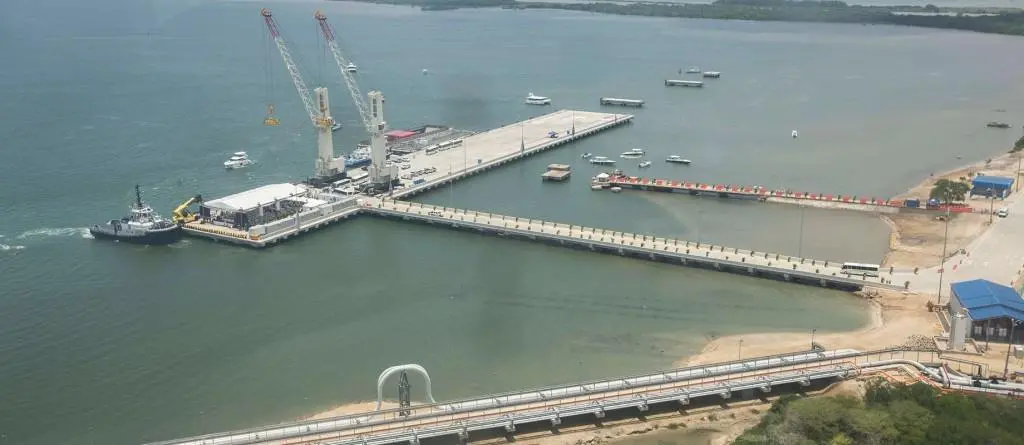
This is the case in Puerto Bahia, Cartagena, Colombia and it will be interesting to see who takes up this interesting opportunity.
The Puerto Bahia dry cargo port has been developed alongside a liquid bulks storage facility also developed by Puerto Bahia, a subsidiary of Pacific Infrastructure Ventures. The dry cargo port site has many possibilities; with a huge land bank it is an obvious choice for auto operations and wheeled cargo in general.
Puerto Bahia has already taken some steps in this direction forming an alliance with NYK Logistics to handle any available auto business prior to the sale of the Puerto Bahia dry cargo port to an independent operator or an operator working in concert with financial investors.
The development format of Puerto Bahia and the current situation in Cartagena Bay, however, point increasingly to a container role for Puerto Bahia.
There are only two sites in Cartagena Bay that are able to accept the larger containerships that are now being seen in East Coast South America trades and which will progressively be seen with the opening of the new Panama Canal locks later this year. One is Contecar, a developed container terminal, and the other is Puerto Bahia. Both these facilities have deep draught access provided by a recent dredging programme which they helped sponsor financially.
Puerto Bahia has a draft capable of accepting the largest containerships alongside its new 300m quay which has been purpose designed so as to be able to accept super post panamax container cranes. It has no such cranes in place at the moment but it does have two heavy duty mobiles which allows for some container handling and other cargo handling duties to take place.
Foundations in place
The Puerto Bahia dry cargo port quay already has essential ‘foundation’ work in place to realise an extension to over 600m in length. With 300m of quay the terminal is certainly able to service the requirements of regional/short-sea operators – it is a ‘walk-in’ for this today. With 600+m and specialised container cranes in place then Puerto Bahia would enter the big league of container operations in Cartagena Bay. Factoring in the average time it takes to order and install such cranes it would do so at precisely the right time.
Contecar has recently upped its ship-to-shore container crane capacity but with the pace of cargo growth being achieved by its principal customer, Hamburg Sud, then it won’t be long before the breathing space provided by this step is exhausted. It is understood that Hamburg Sud realised cargo growth in the order of 25% over its 2014 volume in 2015 with this following on from its global co-operation agreement with UASC and the acquisition of Chile-based liner operator Compañía Chilena de Navegación Interoceánica. Furthermore, Hamburg Sud has reportedly told Contecar that it needs all of the terminal’s capacity for its own purposes and that other parties using the terminal, independent of Hamburg Sud activities, should be cleared out as available capacity declines.
With the average vessel size deployed in East Coast South America container trades progressively climbing and set for a further growth when the new Panama Canal opens, then the logic of Puerto Bahia as a fully-fledged container terminal is manifestly clear. The site is the future of container handling in Cartagena Bay, and the short term future at that. Independent market analysts confirm this, stating that with a fully built-out container quay the terminal can handle a 1m teu, made up of gateway and transhipment traffic, by 2023.
The forecast 50:50 split of transhipment and gateway cargo by 2020 also make Puerto Bahia an interesting investment opportunity (out of a total volume of 4.26m teu handled in Cartagena Bay as a whole). Cartagena is expected to consolidate its role as an import gateway for Asian goods once the new Panama Canal opens up allowing greater economies of scale on the larger ships.
Related Articles
 POST SCRIPT
 POST SCRIPT
 POST SCRIPT