Remarkable growth in container trade has focused minds on the need for massive investment in the region''s ports. Nick Elliott reports.
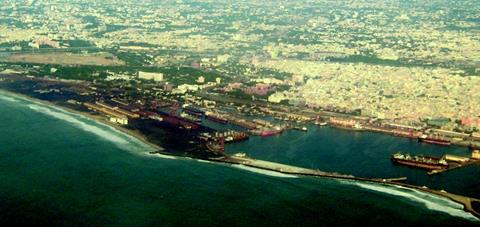
As readers of PS will have noticed, South Asian port development projects - India in particular - almost warrant their own news department in the magazine. Nevertheless, berth congestion appears to be on the increase at major ports throughout India. For the nine months ending December 2005, the average vessel turnaround time was 3.53 days compared with 3.41 days (2004-05) and 3.45 days (2003-04). In addition, pre-berthing times at major ports have gone up from 4.86 hours (2003-04) to 6.03 hours (2004-05) and thence to 9.16 hours in April-December 2005. During the last calendar year, cargo handled by major ports grew by 12.4%, perhaps explaining the increasing congestion.
Shipping Corporation of India director Sudhir Rangnekar, speaking at the TOC Asia conference in Busan recently, added more numbers.
Container volumes in India alone are forecast to grow by up to 18% a year by 2022. India's ports are handling some 3.9m TEUs a year, with Chennai and Mumbai's Jawaharlal Nehru accounting for 71% of that.
This is forecast to rise by 14.4% annually to 11m TEUs by 2011-12 and 42m TEUs in 2021-22. More bullish forecasts put growth rates at 16-18% which would mean 53-71m TEUs by 2022.
Rangnekar said his government's National Maritime Development Programme has set aside US$12.9bn for the expansion of the 12 federal ports in response to these forecasts. The funding will be spent on 276 projects including 76 terminal and jetty construction schemes worth US$7.57bn and 25 dredging projects worth US$1.47bn. Much of this investment would be sourced by private sector developers and operators. "New projects are being developed to give ocean carriers and shippers more choice, " Rangnekar said.
That may be so but by way of warning, a further delay in placing the contract to build and operate the new container terminal at Mumbai seems inevitable given delays in obtaining security clearance for Hutchison Port Holdings (HPH) which is bidding in partnership with Indian company L&T. Security clearances are required given that the new container terminal will be close to a proposed naval base at the port. The initial process began in August 2005, although not all bids were received by the agreed deadline. However, this has since been put back several times. 10 of the 11 bidders who have pre-qualified have already been cleared, with Evergreen Marine the last to be given the go-ahead. Other groups getting the green light are Mitsui OSK/L&T/P&O Ports with United Liner Agencies of India/SSLA;
Gammon India/Gammon Infrastructure/Dragados-SPL; ABG Heavy Industries/ILFS; DP World; Adani Exports; and APM Terminals.
The project, which will involve an investment of US$278m, encompasses the construction of two offshore container berths totalling 700m in length capable of handling up to 6,000TEU vessels.
PLANS SOUGHT Meanwhile, the Indian Shipping Ministry has requested development plans from the country's 12 leading ports outlining their long-term vision and identifying their core strengths. The aim is to produce world-class facilities, albeit funded either by the ports themselves or by private sector partners. 95% of India's foreign trade is maritime-based which has prompted the Ministry to propose the seven- year development plan.
Whilst the government is keen to promote construction of new infrastructure, it also emphasises that existing facilities must be put to best use, whilst stressing that management needs to be more responsive to customer requirements. Already, at Chennai, Cochin Port Trust has brought in external consultants to prepare a business plan covering the period up to the 2012-13 financial year.
And 14 companies have submitted tenders to produce a business development plan for the port of Chennai. The idea is to establish seven-year goals and to identify the strategy needed in order to reach these. In addition, sources of finance will have to be identified as part of the overall plan.
Several international companies are bidding. Rotterdam Maritime Group has teamed up with India's Tata Consultancy Services, whilst BMT Asia Pacific of Singapore is in partnership with Mumbai-based Stratagem Inc. Other non-domestic companies in the frame are the UK's Portia Management Services, Arthur D. Little of Malaysia and Germany's Rogge Marine Consulting.