
Stevie Knight comments on the latest red tape wranglings in Indian port operations
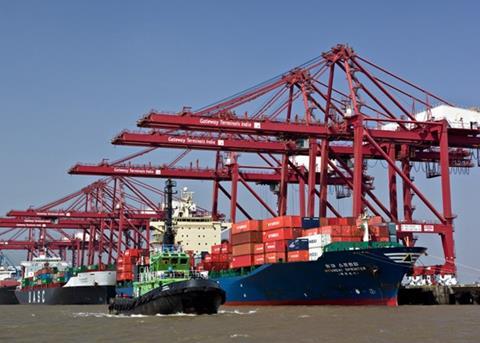
There must have been quite a few people holding their breath in India recently. Firstly, India’s Tariff Authority for Major Ports (TAMP) has been making things difficult for the private terminal operators lodged in India’s major ports for quite some while.
Up until now TAMP has set tariffs at major (that is, government-owned) ports and the body has had the express right to force terminal operators to implement lower rates if the port is doing well in order to ‘share profits with port users’ explains Mohan Bhambhani, the managing partner of Global Positioning Advisory. According to TAMP’s guidelines only half of the revenue accruing from volumes in excess of their projected levels can be retained.
This meant despite an across the board request by port operators for an increase in tariff rates earlier this year, TAMP instead set significant reductions. Nhava Sheva International Container Terminals and Gateway Terminals India were ordered to reduce tariffs by 27.85% and 44.28% respectively.
Clearly, the operators felt this was unfair: Mr Bhambhani points out that although TAMP was adhering strictly to the guidelines, “it hurt the private terminal operators" and predictably they pulled back on increasing volumes and efficiency investments.
Unfortunately the Indian Supreme Court felt it had to uphold TAMP’s position – it was in TAMP’s official guidelines after all. In a way this might have actually helped the sentiment for reform, as by this point it’d been becoming clear for some time that it was needed.
Backing off
It reached a head when the PSA International and ABG consortium decided not to go ahead with the agreement to build the fourth Rs 6,700 crore ($1.2bn) container terminal at Nhava Sheva and finally walk away from this project, despite the Jawaharlu Nehru Port Trust threatening to make sure they were banned from any further concessions in the country.
So, it was with a sigh of relief that many heard on the market grapevine that TAMP was going to be disbanded. Well, all apart from the non-major port operators which has creamed in a cool 39% of the market while the major port’s troubles let their share drop from a high of 90% to 61%.
But then a draft Port Regulatory Bill suggested that what was needed was a “level playing field” between the government and private or state-run ports. It sought to create a national Major Ports Regulatory Authority plus a set of regulatory authorities for coastal states: these would determine rates and monitor performance standards. In other words, even more tariff setting via one central and one devolved authority which would, the idea went, at least give everyone the same kind of headache.
Two recommendations, one from an inter-ministerial task force headed by BK Chaturvedi and another, very recent report from a financing infrastructure committee headed by banker Deepak Parekh outlined the strength of feeling about getting even more tangled in red tape.
The Chaturvedi headed committee said the proposed draft Bill “seeks to establish excessive regulation", while the inter-ministerial task force headed by Parekh’s committee pointed out tariff setting had resulted in “various anomalies” such as excessive price differentiation between berths in the same port.
Revised role
Both agreed that market forces should be allowed to determine tariffs as sufficient competition already exists in the sector to allow deregulation, with one suggestion being that the Ports Act could be amended and TAMP could carry on in a role of regulating quality and performance plus becoming a check against “predatory pricing” at the major ports.
So, what’s likely to happen? India is concerned about its business reputation: in a recent interview with the Hindustan Times, Indian Prime Minister Manmohan Singh said his government will work towards making the country a "more business-friendly place", adding that he wants "the world to know that India treats everyone fairly and reasonably and there will be no arbitrariness..."
India is aware it has some catching up to do, so there’s a good chance the red tape will, at least in this instance, be unravelled a little, if not burned. But the entrenched nature of this kind of thing in the subcontinent shouldn’t be underestimated either: 2,500 years ago one of the most serious challenges to the great Buddhist leader, Shakyamuni, came wrapped up in an apparently reasonable request for ‘more rules’.