![PortStrategy[GreenPort]](https://www.portstrategy.com/wp-content/uploads/2026/09/PortStrategyGreenPort.svg)



Conditions for port business ecosystem development
DP World, the developer of London Gateway, made two recent announcements, signaling the steady development of the London Gateway port business ecosystem.
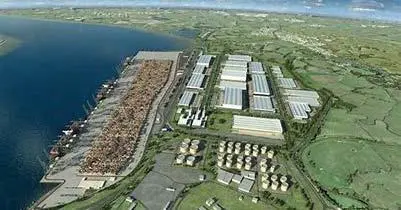
First, it will invest around £350 million in a fourth berth project, which will increase London Gateway’s capacity by a third.
This will enable London Gateway to continue increasing volumes and expanding its share of the UK market. Second, DPW announced that work has begun on a new speculative 119,000 ft2 green warehouse at London Gateway’s port-centric Logistics Park. DPW stated that demand for premium warehousing space in the South East of England reached ‘unprecedented’ levels in 2022 and various new tenants have taken leases at London Gateway’s Logistics Park.
These announcements are relevant for a couple of reasons. First, they show that DPW really is developing a ‘port business ecosystem’ not just a container terminal. The development of the logistics park of around 400 hectares, is an important mechanism to capture the value that is created through the investment in the container terminal.
Second, they show that developing such an ecosystem is a long-term endeavour. The building permission for London Gateway was granted in 2007, building started in 2010 and the first ship was handled in 2013. The fourth berth will become operational in 2024, and after that there is still room for expanding the terminal with two more berths. The logistics park is currently around 50 per cent utilised.
Third, this case shows that in specific instances, if the conditions are right, a commercial developer (albeit a state owned one) is willing to take the risks associated with building a port business ecosystem from scratch, even in a fairly mature market like the UK. Other countries may be interested in replicating this approach.
However, this success case may be fairly unique in the sense that the development took place in a privileged location (which became available after the closing down of a refinery) in a competitive market. This aspect is critical from the perspective of a policy maker, as a private initiative port development is an especially attractive policy option if the market is sufficiently competitive (else there is a huge risk of rent seeking and unattractive service and price levels). These conditions for private port development (an attractive location and sufficiently high competition levels) may not be met in most markets where there is space for a new port business ecosystems.
Related Articles
 CONTAINER & CARGO HANDLING
 INSIGHT & OPINION
 INSIGHT & OPINION