




Market share versus profits
Mature markets today bring new challenges in delivering major new port capacity, especially in a competitive climate. The issue is how to reconcile the economic impact-orientated agenda of port landlords with the profit motive of terminal operators? Andrew Penfold investigates.
As the port market begins to approach some degree of normality post-COVID-19, the question of capacity expansion is once again coming to the fore. Large scale investment plans by port authorities in mature markets have been dusted down again and it seems certain that major investment in Europe and North America will once again proceed.
However, a major question remains in conjunction with this: will capacity match demand? Local vested political interests have quite different concerns from terminal operators. The horizon of the former may well be 30 years plus, whilst the terminal operator will only be looking either at the concession period he has or, quite often, just the loan payback period. There is a frequent mismatch between the two.
This matter of perspective is well known, but bigger challenges emerge when two – usually state-owned – ports are competing for the same or significantly overlapping hinterlands. The motive for the port authority is primarily market share and the resulting economic spin-off benefits from anchoring significant business locally. There’s an extensive literature on the magnitude of these benefits but a conservative view is that a factor of at least three needs to be applied to the basic revenue generated by simply handling a container. This is all very well but if localised overcapacity results from these state-backed policies then it becomes very difficult for the concessioned operator to define accurately a unit revenue for their activities. This is a major problem when bidding for a new concession, with the position made worse by the frequent presence of non-industry infrastructure investors.
Port authorities have always been swayed by these considerations and various policies have been suggested to try to mitigate some of the grossest resulting over-capacities. The saga of the EU’s Seaport Policy has been running for years and remains basically unresolved. The need to demonstrate ‘commercial’ terms is all very well, but always difficult to define in the real world.
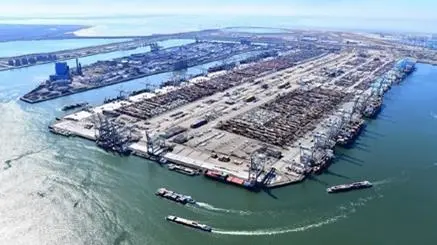
The situation in Antwerp is interesting with long term planning once again focusing on development of the Saeftinghe Dock which would provide massive new deepsea capacity at the port. At the same time, although the Maasvlakte II project infrastructure at Rotterdam is now in place, the actual pace of expansion for the current operators – APM and DP World – remains unclear. How the commercial return from the current two terminals can be squared with the enormous costs of the entire project remains unclear. Both locations are (essentially) covering the same hinterlands. Adding to the capacity equation is the recently announced plan by MSC in association with Hutchison to develop a major new container terminal in the Europahaven, Rotterdam. Specifically, the terminal will be developed where the north side of the Hutchison Ports ECT Delta terminal and Hutchison Ports Delta II (the former APMT-R site) are located.
There are plenty of other locations where ports share overlapping hinterlands and where expansion plans may generate the problematic effect of too much capacity too soon. Another prime example in the Europe zone is the ports of Gdansk and Gdynia, both pursuing large scale expansion plans. On the other side of the world, the port of Newcastle, New South Wales has just had restrictions removed from participating in the container handling business which could see overall capacity issues arise between it and the Botany Bay container handling centre.
Superimpose on this capacity issue the question of defining the actual markets that are being served and the stability of the major line customers over time and you have a very difficult investment argument for the terminal operator. If the premiss for investment involves a high share for transshipment, then yields will be weak and place great pressure on potential scale of investment.
Similarly, the current shipping line alliance structure has been in place for some time with only limited adjustments. Over the timeframe of these large-scale investments, we can’t be sure of this remaining the case. Factoring all of this into an effective bid is always complex, but if other interests are focused on market share at the expense of commercial returns the position leans towards untenable.
The days when an investor (port or private) could rely on continued container trade growth may well have passed – time to take a serious look again at these issues. Its true that ‘a rising tide lifts all boats’, but what is the state of the ocean at present?
Related Articles
 INSIGHT & OPINION
 INSIGHT & OPINION
 INSIGHT & OPINION