![PortStrategy[GreenPort]](https://www.portstrategy.com/wp-content/uploads/2026/09/PortStrategyGreenPort.svg)






Shape of things to come?
French automotive giant, Renault, has commenced shipping brand new cars in containers to avoid the current high costs associated with the usual method of moving vehicles, using car carriers.
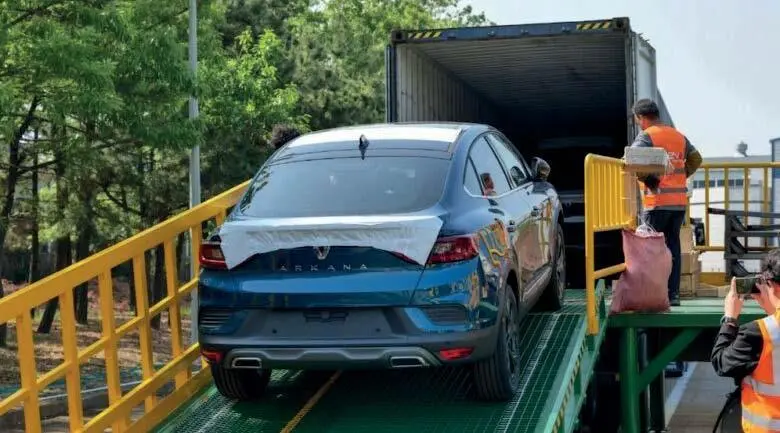
Renault Korea Motors has stated that it is moving its compact SUV XM3 Arkanas model from its Busan plant in South Korea by using 40ft containers. The vehicle manufacturer says that it is planning to ship between 1500 and 1700 units to Le Havre on a monthly basis, with plans to also ship new cars in containers to other destinations including the US, Belgium, Italy, Mexico and Australia.
Through an ability to tilt the middle vehicle upwards, it is possible to squeeze three of these vehicles into a 40ft container, instead of the more traditional process of just two cars per box.
According to Clarksons Research, a one-year time charter rate for a 6500 CEU car carrier is currently at US$105,000 per day (double the previous high seen in Q2 2008), with fixtures regularly being signed for what it terms as “multiple years.” The company also states that the car trade is expected to grow by eight per cent this year, to 20.3 million cars, emphasising that the industry is back to pre-COVID-19 levels.
As such, it is no surprise that the results of car carriers have been setting records over the past 15 months, just as container operators are seeing a slide in the opposite direction.
So, with a strong container ship orderbook bringing capacity to fill, are Renault stealing a march on many rivals by utilising containers for new car shipments? Quite possibly, but there is one big issue.
In mid-2022, Japan’s Mitsui OSK Lines (MOL) joined a growing list of car carrier shipping lines refusing to transport second-hand battery-powered cars. The news followed MOL’s 6,400 CEU vessel, Felicity Ace, catching fire and sinking – resulting in a subsequent cost according to law firm, Vinson & Elkins, in the region of $500m.
Crucially, this was (at the time) the fourth largescale car carrier blaze involving electric vehicles since 2019. While an electric vehicle might not always start a fire, they do act as a significant accelerant because lithium-ion batteries which catch fire can reach temperatures of more than 2700 degrees Celsius.
Indeed, aware of the rising risks from electric vehicle fires, the International Maritime Organization (IMO) has already said that firefighting equipment and measures in existing ships carrying cars needed to be reassessed.
Yet it is not just the shipment of new cars that gets pulled into the conversation. In February 2023, Norwegian shipping company Havila Kystruten confirmed it will no longer allow electric cars on board its ships. The company says that the “consequences of an electric car fire are considered too severe” for its Hurtigruten coastal route between Bergen and Kirkenes (operated in conjunction by the two shipping companies Hurtigruten and Havila).
MORE TO FOLLOW
The decision from Renault is likely to be followed by other vehicle manufacturers and it will be appealing news to container shipping lines needing to fill new tonnage coming on stream. The move also takes the pressure off the car carriers too, although they will be watching carefully in case it becomes a more serious issue involving loss of cargo.
Yet despite this potential new trend, it remains to be seen whether the electric vehicles are welcomed as warmly as the traditional cars from the same manufacturers. It seems unlikely and once again brings into focus the process that sees the enormous financial costs associated with electric vehicle manufacturing, not to mention the base raw materials needing to be mined to support the production of the batteries powering these cars.
Related Articles
 CONTAINER & CARGO HANDLING
 INSIGHT & OPINION
 INSIGHT & OPINION