

Inspiring crane power – Three priorities
Crane power systems need to take inspiration across three key areas to supportport requirements, as John Bensalhia identifies.
In providing crane power delivery, today’s equipment system manufacturers and providers need to take inspiration from three main watchwords. Environment. Strength. Speed.
All three of these aspects combined can then give a stronger foundation for bigger and better crane power usage in ports. Specifically, this facilitates products such as cable reels and festoon systems getting the job done in a fast, efficient and cost-effective manner.
ENVIRONMENTAL
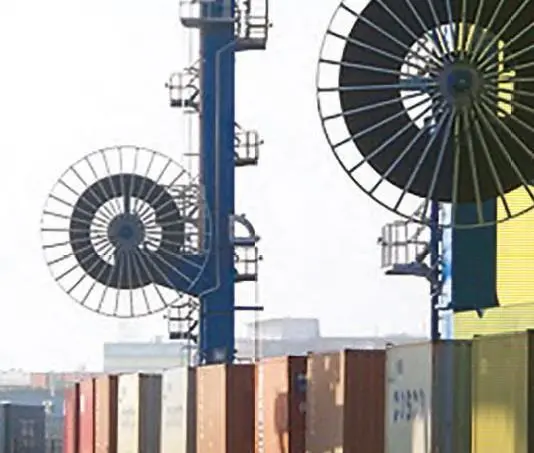
Taking the first factor into consideration, the crane systems of the 21st century are putting the environment at the forefront of their design and power delivery. A good example is Hartmann & König’s motorised cable reels. These help to provide a far healthier alternative to, for example, diesel power.
The use of motorised cable reels provides cranes with a source of electrical power, which is ideal when, for example, it comes to retrofitting Rubber Tyred Gantry (RTG) cranes. With more RTGs using electricity rather than diesel, the Hartmann & König motorised cable reels aim to reduce the levels of fuel consumption but not lower power delivery. This process can also deliver the positives of optimising the available work time by avoiding the need for refuelling and reducing the time spent on maintenance.
REGENERATIVE ENERGY
The concept of regenerative power provision plays an important part in Magnetek’s AC Line Systems. The principle works by taking unused energy from the motor and then restoring it to the AC power source. For crane usage that involves adjustable speed applications such as high demand braking, the AC Line Regenerative System can be seen as a good option for boosting power efficiency levels with lower rates of total energy consumption.
Larger scale and heavy-duty cranes can benefit from this system because it eliminates the need to use wire dynamic braking resistors. This also means that it can deliver smooth and consistent power when being used in conditions that involve a high concentration of dust or during adverse weather, Magnetek’s IMPULSE* range of units are said to help significantly with efficient power solutions, with the IMPULSE*R+ designed to add line regeneration to overhead cranes. The company maintains that this system is easy to use and can be retrofitted to replace extant controls’ dynamic braking units and resistors.
Also, in the power-provision range, the IMPULSE*D+, offers active front end regeneration technology to ensure stronger and consistent performance. The application of the technology involved means the IMPULSE*D+ has the ability to keep line harmonics to a minimum and ensure that the IEEE 519 requirements are easily met (IEEE 519 being a system guideline for introducing limits on voltage and current distortion).
Magnetek recommends the combined use of IMPULSE*D+, IMPULSE*G+ and VG+ Series 4 variable frequency drives in order to maintain the best power provision in an energy efficient system.
SPEED
The second of the three key factors will operate on two different levels. Crane systems not only add extra strength and power, but also have to withstand tough weather conditions and environments without loss of power or
performance.
Crane power and equipment usage can potentially succumb to factors such as dust or damage caused by salt water. Therefore, many crane power system products are made with extra strong materials such as stainless steel or galvanised sheet steel.
A good example is the Hartmann & König reel assemblies, which are made to endure more challenging conditions over a longer period of time. System suppliers also use special coatings to ensure that crane system components avoid the risk of wear and tear and thus of causing diminishing power returns.
Magnetek has also designed its crane system products to withstand challenging environments. Its range of I-Beam festoon systems include a trolley made from low carbon steel and hot-dipped, galvanised material, along with urethane coated wheels. Another initiative devised is to utilise cable protectors that shield the festoon cables from impact and acceleration forces to ensure consistent and smooth power supply.
Conductix-Wampfler’s range of cable festoon systems also features materials designed to offer maximum protection. The company’s C-Rail cable trolleys, for example, are available in a choice of material formats – zinc coating or stainless steel, which offer tougher resistance.
The Conductix-Wampfler power supply system found on square rail cable trolleys is reported to be designed with maximum strength in mind, using galvanised or stainless steel material for the square rails. This arrangement aims to ensure efficient operation in dusty environments, both indoor and outdoor. Moreover, in operating conditions where cargoes yield high levels of dust, such as coal, aggregates or cement, the system is claimed to offer protection from breakdowns or loss of power due to the aggressive environment.
STRENGTH
Due to the expansive nature of the festoon system, the design must also take strength into account. Cables transfer data and electrical energy, while hoses will be used for the likes of air, fluids and gases. Products like the Conductix-Wampfler system are said to be specifically designed using modern, innovative technology to ensure that the equipment and parts last for as long as possible – even when regularly used in difficult environments and/or poor weather.
Simbal’s range of products similarly focuses on the need for strength without any loss of power. The Spreaderflex cable, for example, is manufactured to deal with high levels of mechanical stress in vertical basket incidents lifted by container spreader beams. Consequently, the drum reeling cables provide a higher standard of strength without loss of any operating flexibility. This system is designed to withstand the bending and flexing that comes with drum reeling and is provided with a rubber outer sheath for extra protection.
Stemmann-Technik (part of Wabtec) offers a range of cable festoon systems that are also designed with a high degree of resilience in mind. Its collection targets a high degree of flexibility, with systems that can be used either for indoor or outdoor cranes.
One of the products available is a cable festoon system for T-Beams, using a cable trolley run on a steel girder. These trolleys are built to safely handle higher levels of weight, up to 1000 kg. This design allows ports to easily transport lengthy power or data lines and heavy hoses.
Another of the Stemmann-Technik systems – the KW 1100 – was created as a response to the burgeoning need for both the loading capacity and efficiency of port cable festoon systems. The process uses a motor-driven cable trolley that provides strong control motion and precise acceleration, with no loss of power. Between each of the trolleys are tension relief ropes, which avoid the risk of cable strain, thanks to a created damped start. The design also targets speed of operation and a reduction in the time needed for maintenance work.
Hartmann & König’s motorised cable reels supply both power and data to ship-to-shore cranes, to help terminal operators achieve efficient cycle times through higher lifting capabilities and trolley speeds.
CUSTOM DESIGNED
As well as addressing the current challenges of environment, power and strength in standard designs, a growing number crane power systems are being custom designed to meet a terminal’s specific needs. Depending on the environment, application and a range of other specified criteria companies such as Magnetek or Conductix-Wampfler all offer a bespoke approach to meeting specific needs.
Related Articles
 TERMINAL OPERATIONS
 DIGITAL
 DIGITAL