



Minimising oil waste
Port operators can minimise oil waste and maximise fuel savings with smart truck technology.
Konecranes’ TRUCONNECT Premium+ enables ports and terminals using Konecranes lift trucks to better manage oil condition monitoring and reduce environmental impact.
“Hydraulic oil is a costly resource and harmful to the environment, so changing it only when needed can dramatically reduce maintenance costs and ultimately increase uptime, benefits that grow with the size of your fleet. And you can do it with TRUCONNECT Premium+,” said Bertrand Marion, Director, Business Development and Digitalization at Konecranes Lift Trucks.
Intelligent oil monitoring
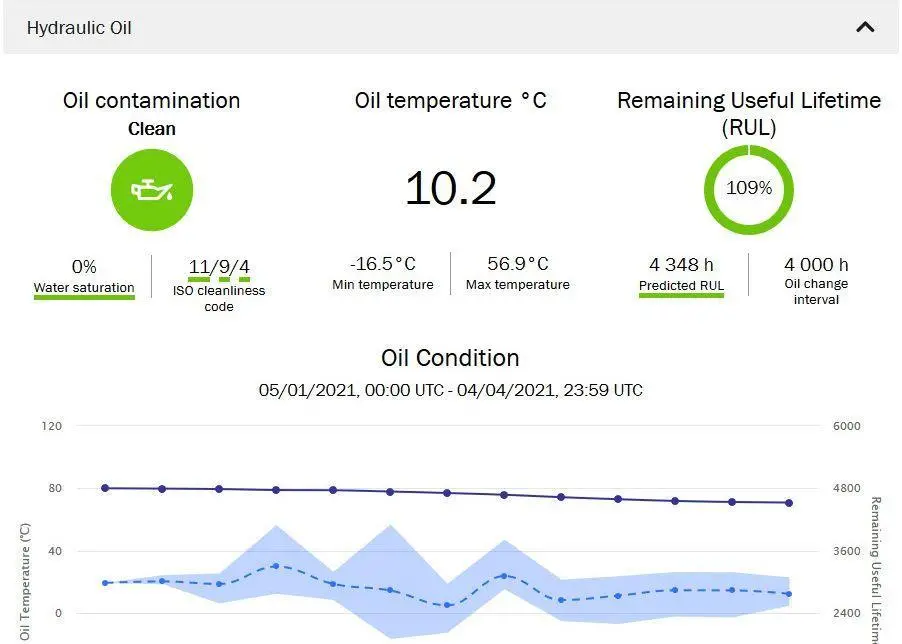
TRUCONNECT Premium+ offers oil contamination and condition monitoring for hydraulic oil cleanliness (as per ISO 4406) and water saturation level. It also verifies the oil quality and ageing, estimating its remaining useful lifetime.
The oil monitoring works by sensors that check the oil temperature, because a higher temperature speeds up aging and oxidation, degrading of the quality of the oil.
An algorithm embedded with Artificial Intelligence (AI) and Machine Learning (ML) combines temperature and other oil parameters changes (such as operating hours, relative permittivity, conductivity, and relative humidity) to continuously predict the remaining useful lifetime of the hydraulic oil as the lift trucks are being used.
Sensors also measure particles and water content, as the contamination of hydraulic oil can cause many problems in hydraulic systems, such as filter blockages, accelerated wearing of components, corrosion of metal surfaces, formation of rust and chemical compounds, viscosity variance, and so on.
All data is available in TRUCONNECT reports at yourKONECRANES.com through color-coded KPIs using a traffic light system. Without the need for oil sample analysis, users can see instantly whether the oil can still be used (green), observation is required (orange) or it needs to be replaced (red).
With consistent green indicators, the same oil can still be used, so service intervals can be extended and oil costs will be reduced. Additionally, a decreased need for oil means less time and resources spent on the safe disposal of waste oil and a lower overall environmental impact.
Related Articles
 EQUIPMENT
 ALTERNATIVE FUELS GREENPORT