



NEW KIDS ON THE BLOCK
The Middle East is home to a number of ‘new generation’ terminal operators looking to expand internationally. AJ Keyes examines their plans, business models and strategies.
There are several emerging “new generation” terminal operators located in the Middle East region looking to grow their existing portfolios. These companies have already seen fellow regional operator, DP World, expand internationally, but now Abu Dhabi Ports (ADP), QTerminals and Red Sea Gateway Terminal (RSGT) have the funds and the desire to grow their existing portfolios globally.
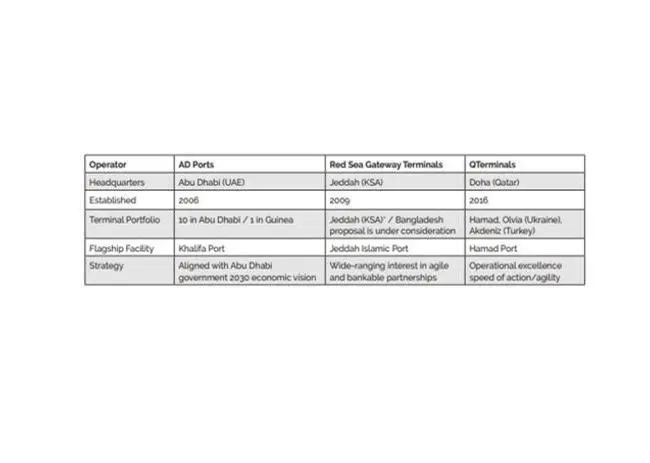
To better understand the respective business models in play and ambitions of each of these “new generation” companies the experience of each of them gleaned at home is considered, how they positioned themselves to expand internationally and the progress made to-date as well as potential future prospects. Table 1 profiles each of the three companies.
ABU DHABI PORTS: BIG AMBITIONS
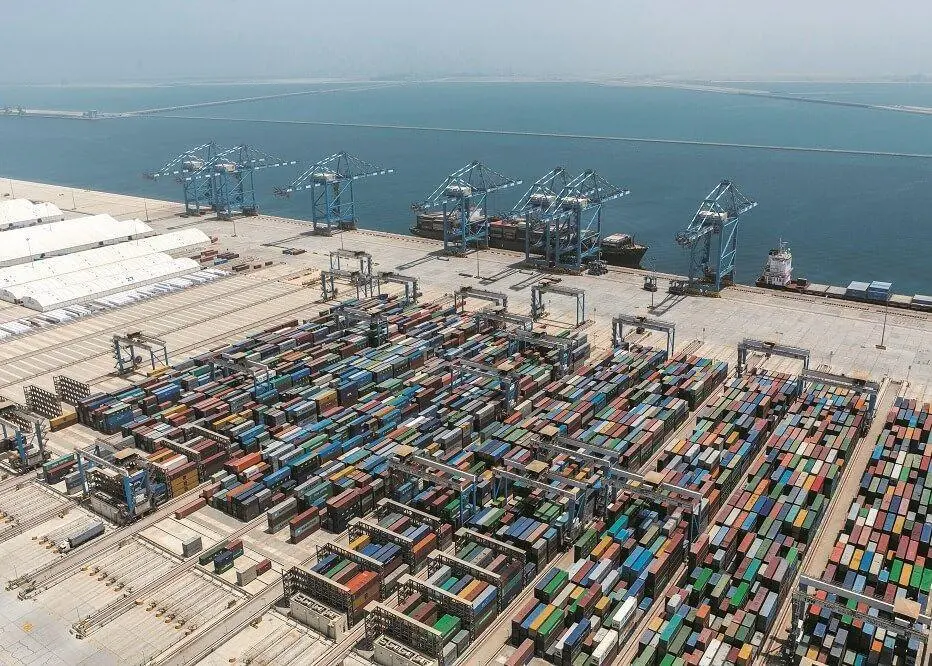
Headquartered in Abu Dhabi since being established in 2006, AD Ports is fully aligned with the economic plans and directives of the Abu Dhabi Government’s 2030 Economic Vision. This includes a greater contribution to the development of non-oil GDP and activities. AD Ports has a clear vision of portfolio expansion going forward, with its strategy not limited only to container terminals but acquisitions across the entire transport logistics chain anticipated as opportunities present themselves.
One thing is definitely known about AD Ports – expect it to accelerate its plans, and quickly. Formed in 2018, the Abu Dhabi Developmental Holding Co, now known as ADQ, is a sovereign fund with a reported US$110 billion in assets, including a 45 per cent stake in Louis Dreyfus Company BV. It is the entity in control of some of the Emirate’s largest portfolio assets, which includes AD Ports.
Mohamed Hassan Alsuwaidi, CEO of ADQ, has openly stated that his biggest worry is whether he is moving “fast enough” to secure projects – consequently, there is every reason to expect further activity in the ports, logistics and trade related industries. AD Ports has a business platform to build on going forward. This consists of ports, logistics, maritime, digital and industrial zones (and freeports) in Abu Dhabi. These are the areas that the company is expected to capitalise on internationally.
This view is endorsed by Alsuwaidi. “To maximise any investment, sometimes you need to create an international tie-up. Sometimes a global presence with an Abu Dhabi anchor is the way to extract more value,” he suggests.
Another executive at AD Ports proffers the view that DP World had blazed a trail and had a 30-year head start but while adapting its business model it still conforms to past behaviour. “The industry continues to evolve, as do geographic areas. Expect AD Ports to grow, especially in its ports and logistics businesses, but also digital activities.” He adds that the company is not interested in the ‘scattergun’ approach of simply going out and buying ports. There must be a large complementary business in place and diversity of cargo type is also of interest.
There are already known examples of AD Ports’ strategy. The group’s current international facility is in Guinea, West Africa. Kamsar Container Terminal (KCT) is operated by AD Ports for Emirates Global Aluminium (EGA). The venture, acknowledged by AD Ports as the “first-of-its-kind” for EGA, supports the loading of vessels for the export of bauxite to the UAE and China.
Further, under its digital business AD Ports is developing a project with the government of India to create a country-tocountry port community system, which will be linked to the one used in Abu Dhabi. Government-to-government relationships are seen as important.
Media in the UK reported in April 2021 that “the Tees Valley Mayor is in talks with the UK Government and Abu Dhabi sovereign wealth fund, Mubadala, over a multibillion pound deal to create a new ‘super port’ in Teeside,” while a UK Government source similarly stated, “One of the projects that we’re working on with Number 10 (UK Prime Minister’s office) and Mubadala (the global investment arm of the Government of Abu Dhabi) is the acquisition of PD Ports.”
QTERMINALS SECURING CONCESSIONS
QTerminals was jointly established by Mwani Qatar (51 per cent share) and Milaha (49 per cent share), to provide container, general cargo, Ro-Ro, livestock and offshore supply services in the development of Hamad Port, Qatar.
The company records a straightforward vision when outlining its international ambitions: “To become a recognised world class, customer-focused operator with a global portfolio to create long-term shareholder value.”
Explaining why it believes it can grow its international portfolio, QTerminals states: “The competitive advantage we have is as a relativity new global port and terminal operator in the market, demonstrating that QTerminals is agile and dynamic and ensures informed decisions are made quickly, both in terms of our current operations and our growth ambitions. QTerminals has the ability to react and adapt rapidly and effectively to change, ensuring we are successful going forward.”
On acquisitions, it further notes: “We primarily target markets and opportunities where our direct competitors are not currently operating on a large scale. It is always better as a new player in the industry to mitigate the risks and the impact of direct competition, as invariably there are no winners in such circumstances. Nevertheless, we do not shy away during competitive processes or public tender bids and have proven we can compete and win amongst an environment whereby more established operatives are active.
QTerminals has taken some positive steps. In August 2020 it signed its first international port deal for SC Olvia in Mykolaiv, Ukraine. The 35-year concession agreement was signed with the Ukrainian Ministry of Infrastructure and Ukrainian Sea Ports Authority and is an international PPP project co-sponsored by the IFC and the EBRD.
Under the terms of the Concession Agreement, QTerminals will invest UAH 2.8 billion (approx. US$ 100 million) in the project, with the handover of the facility and the start of the concession planned for December 1, 2021. Additionally, in January 2021, QTerminals completed the US$ 140 million acquisition of the Port of Akdeniz, Turkey, from Global Port Holdings, establishing QTerminals Antalya.
The company notes: “QTerminals Antalya is undergoing a full integration into QTerminals Group across several key workstreams, and this integration is expected to be completed by Q4 2021.“
RSGT: INTEREST BUT…
RSGT has a strong interest in building its international terminal portfolio, although it has seen limited success to date. The company is a partnership between the Red Sea Gateway Terminal of Saudi Arabia and the MMC Corporation Berhad (MMC), a Malaysian utilities and infrastructure group.
Its ports and logistics division, MMC Ports, is the largest port operator in Malaysia, holding majority or sole interests in the main Malaysian ports, including the leading transshipment port of Tanjung Pelepas. The company has secured home base solidity.
In December 2019, RSGT signed a 30-year Build-Operate-Transfer (BOT) concession as an add-on to its existing container terminal at Jeddah Islamic Port (as part of the port reducing its container terminals from three individual facilities to just two), with DP World remaining the second operator.
In 2018, RSGT confirmed its plans and ambitions to Port Strategy stating: “Most operators obviously started with the one port, their home base. They mastered the business, developed a hunger, but most importantly, they looked around and found perfect conditions…..we believe that long term infrastructure creation and operations business will be supported by agile and bankable partnership structures.”
Since this time, RSGT has targeted international investment opportunities and has made the shortlist for the Kribi (Cameroon) terminal concession in 2018 and then for the Douala (Cameroon) concession in 2019. It has since, in 2020, signed a Memorandum of Understanding (MoU) in with the Bangladesh Ministry of Shipping to cooperate on multiple port and infrastructure projects including a public-private partnership to develop Bangladesh’s port infrastructure and maritime sector.
The Port of Chittagong has confirmed that RSGT is interested in operating the Patenga facility, although so are both DP World and Adani Ports of India. The ability of RSGT to secure this opportunity represents a good test of the company’s ability to begin to fulfil its overseas ambitions.
GOING FORWARD
All three operators are progressively looking at international opportunities. The hallmark of QTerminals approach is to move quickly and target direct deals that can be closed rapidly. RSGT fields a measured approach but needs to move from short-list to finish line.
ADP has the most diverse approach. It has a wider remit, taking in ports, logistics and digital opportunities and is also prepared to leverage government-to-government relationships to assess the right opportunities. It will be interesting to monitor the success of each company going forward and to see how they adapt their respective business models over time.
Related Articles
 PORT & TERMINAL NEWS
 PORT & TERMINAL NEWS
 PORT & TERMINAL NEWS