




NEW SMART BOLLARD TESTS
A new Smart Bollard is under test in Rotterdam – major benefits are foreseen.
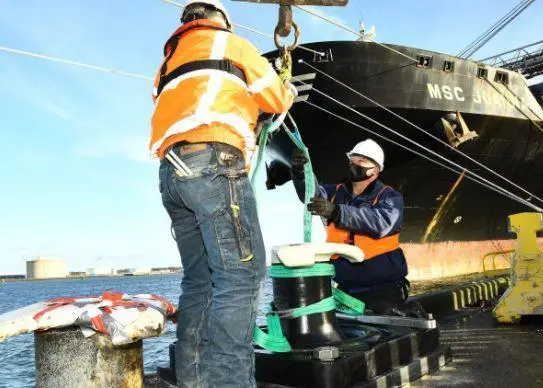
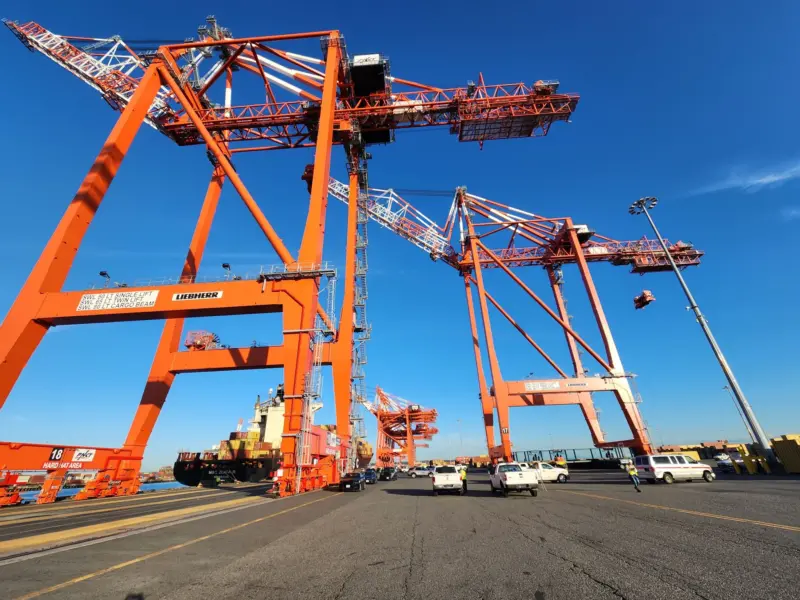
A new Smart Bollard is under test at Hutchison Ports ECT Delta Terminal on the Maasvlakte, Rotterdam. The bollard can measure the loads imposed on mooring lines in realtime. It allows the real-time safety monitoring of the moored vessel, and generally it provides clearer information about the berth conditions for vessels.
The Smart Bollard will be tested over the coming months and subject to positive results will be officially launched this summer. It is being developed by Zwijndrecht-based Straatman BV in collaboration with the Port Authority of Rotterdam.
INNOVATION TO ACCELERATE IMPROVEMENTS
“In order to accelerate improvements in the port we started an innovation and research programme some years ago. The programme is all about safety in the port, cost efficiency and making the port more efficient through innovation, research and digitisation,” explains Joppe Burgers, Senior Project Engineer & Project and Programme Manager, Port Authority of Rotterdam.
He elaborates. “We knew that there was not such a thing as a smart bollard anywhere in the world when we started. Generally, the only solution available was to temporarily install load-shackles to monitor line loads, whereas the Smart Bollard will be permanently installed on quays and integrated in the port system.”
Burgers and his colleagues embarked on the Smart Bollard project two years ago. Boatmen Association KRVE and Gertjan Strietman, Managing Director, Straatman, have been involved from the start. A central feature of the research and development (R&D) was to explore whether there were applicable sensors available and what could be developed to measure the loads on the mooring lines.
The R&D process started by establishing that bollards are the first interface between a vessel and port infrastructure. From this point Strietman initiated the development of the concept with research and measurement runs on existing bollards, only to find it was best to design a new bollard to achieve the exact and reliable measurements and required control of the mooring process from 100 to – 300 tonnes. The application extends across all seagoing vessels right through from container vessels to bulk carriers.
COLLABORATIVE EFFORT
Maarten Verboom, Sales Manager, Straatman, praises the collaboration with both the port authority and the port community in Rotterdam. The engineers and designers conferred with their counterparts at the Rotterdam-based Boatmen Association KRVE, who then helped review the design and will assist during the tests.
“They have a lot of know-how about the use of the bollards. The boatmen association also developed the ShoreTension system together with the port authority and ECT years ago. ShoreTension is a hydraulic mooring system that automatically keeps mooring lines tight in severe conditions such as suction caused by passing ships, severe weather conditions and swell. It also prevents mooring lines from breaking in the case of on-/ offloading and tidal differences,” he explains.
“ShoreTension has kindly offered to assist with measuring equipment on the test bollard. Smart Bollards and ShoreTension can be applied separately, however the combination results are effective and improve mooring especially in bad weather conditions,” states Verboom.
Additionally Hutchison Ports ECT Delta Terminal has assisted by accommodating this trial, as Burgers notes. “We are dependent on help from within the port community. We all try to improve our port and without collaboration innovations would not succeed.”
BENEFITS AND NEXT STEPS
All parties involved agree that the Smart Bollard has the potential to simultaneously enhance safety and reduce downtime. Going forward it is also seen to be possible to further develop software to the point where data can be monitored onboard ship, including an alarm system to warn of critical mooring lines strain and a line break. Such data is already available through Straatman’s online portal and can be easily integrated within port management systems.
Naturally all involved are aware that the Smart Bollard will be more cost-intensive than the existing bollards, but the return on investment will be worthwhile, enhanced by increased safety due to predictability. As Strietman puts it, “In fact, it is odd that a vessel of €100 million, including half a billion worth of cargo can moor without exactly knowing what’s going on with strain on the mooring lines.”
Related Articles
 EQUIPMENT
 EQUIPMENT