![PortStrategy[GreenPort]](https://www.portstrategy.com/wp-content/uploads/2026/09/PortStrategyGreenPort.svg)



Robots help reduce emissions
Ports in California are demonstrating how autonomous technology could revolutionise freight transport helping to achieve zero-emission freight movement across the state.
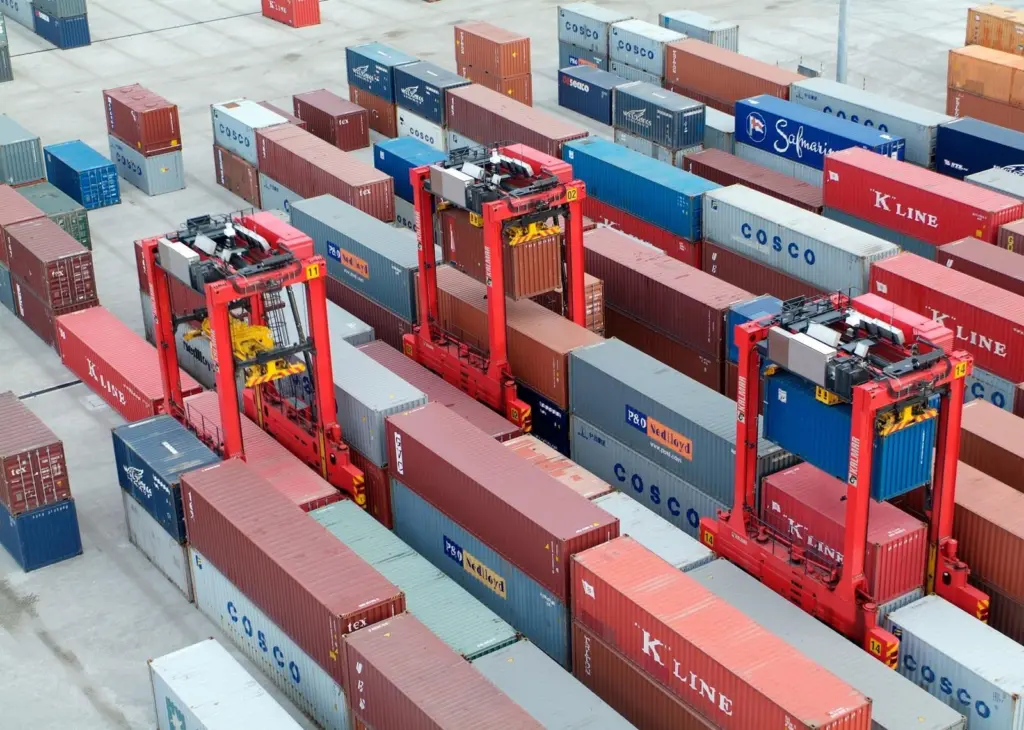
The Port of Los Angeles and TraPac, a unit of Mitsui O.S.K. Lines Ltd., are investing $693m in four dozen self-driving cranes and automated carriers, plus related infrastructure, helping to double the speed of loading and unloading ships at the port’s marine-cargo facility, reducing emissions and boosting profit.
The container terminal has recently released an audit of its mitigation measures to ensure environmental compliance, demonstrating that the terminal has met the requirements in 94% of cases. Automation, with its emphasis on zero-emission freight movement, could be a factor in meeting targets.
The state of California has already contributed grants for battery-powered tractor-trailers at a new automated facility in the Long Beach Container Terminal, which began receiving cargo earlier this month. The port is sharing the $2bn redevelopment cost with the shipper, Orient Overseas Container Line, a subsidiary of Hong Kong-based Orient Overseas International Ltd.
The new facility will use electric, self-driving cranes and carriers that follow the path of transponders buried in the cement on the dock, enabling the terminal to double the volume of containers handled whilst halving emissions.
In terms of emissions, commercial shipments currently produce half the state’s toxic diesel-soot emissions and 45% of the nitrogen oxide that plague Los Angeles with the nation’s worst smog. In Long Beach an estimated 15% of the children have asthma, six percentage points higher than the national average, according to a community coalition report.
Governor Jerry Brown wants 100,000 zero-emission freight-hauling machines in California by 2030, according to recent workshop presentations at the state’s Air Resources Board. These could include self-driving cranes and carriers like those at TraPac.
Governor Brown could also subsidise fuel-saving alternatives, such as semi-autonomous trucks, which were recently tested in Europe, and may also may promote Uber-like services to find loads for empty or half-empty trucks. Additionally he is considering a per-container cap on pollutants and greenhouse gases at each terminal.
The ports of Long Beach, Los Angeles and Oakland handle 40% of US container traffic and converting them to all-electric equipment that’s often self-driving will cost $35 billion in the next 30 years, compared with $7 billion to replace existing technologies, according to a December study for the Pacific Merchant Shipping Association.
However, for some the argument is already won. “Efficiency and the environment go hand in hand,’’ said Jon Slangerup, chief executive of the Port of Long Beach. “They’re two sides of the same coin.’’
Related Articles
 ALTERNATIVE FUELS GREENPORT
 OPERATIONS
 ALTERNATIVE FUELS GREENPORT