



Big ambitions, but challenges
Russia’s ‘great turn to the East’ has seen a new emphasis on the exploitation of the Northeast passage but as Oleksandr Gavrylyuk explains big challenges remain
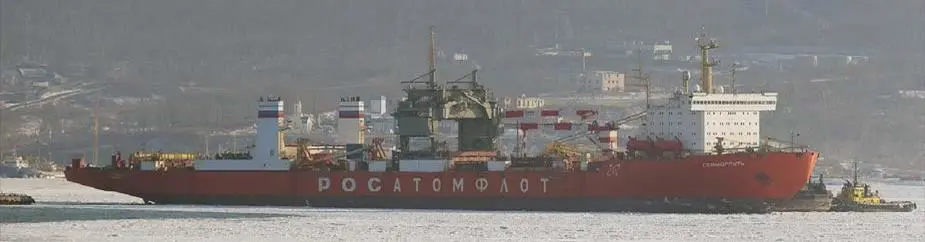
On 24 June 2023, Sevmorput, Russia’s only nuclear-powered lighter/container carrier, left the country’s Baltic port of St Petersburg to round the Scandinavian Peninsula and start its first voyage along the Northeast Passage this year.
Aimed to deliver numerous and cargoes (containers, metalwork, lumber, cranes and motor vehicles) from north-western Russia to its remote Far Eastern regions, the vessel was scheduled to arrive at the harbour of Vostochny (near Vladivostok), on the Russian coast of the Sea of Japan, 22 days on from its departure date. From here, the ship will proceed to call at the port of Petropavlovsk-Kamchatsky on the nation’s easternmost Kamchatka Peninsula, from where it will go back to Murmansk in the European part of the Russian Arctic, according to Vyacheslav Ruksha, Deputy Director General of the state-run nuclear energy corporation RosAtom.
The sole developer of the Arctic’s infrastructure since 2018, RosAtom, initiated Sevmorput’s regular shipping service last year. In 2022, the ship made two round trips with just four ports of call and the load factor varying from 10 to 90 percent. This year, it is planned to make three such voyages and call at 11 harbours (including major ones, such as Arkhangelsk, Nakhodka and Magadan) along the way.
Built in 1988, Sevmorput is able to single-handedly navigate ice up to one meter thick at an average speed of two knots. When following an icebreaker, the vessel can pass through even thicker ice fields.
However, with an increasing number of scientific reports predicting the ice-free Arctic in less than a decade, Moscow is looking forward to its long-standing dream of year-round navigation in the region finally coming true.
With Russia’s Arctic stretching for more than 24,150km of its littoral, the country is responsible for over 53 per cent of the Arctic Ocean’s entire coastline and 80 percent of its oil and gas reserves. The Russian Arctic zone accounts for 10 per cent of the world’s oil and 25 percent of its gas resources. It contains 95 percent of Russia’s reserves of platinum group metals, 74 percent of nickel, 55 percent of cobalt, 67 percent of apatite ores, 61 percent of rare metals and 14 percent of bauxites, as cited by the nation’s Ministry for Natural Resources.
Extraction of the Arctic minerals has been a major goal for Moscow for decades, gradually transforming it into one of the globe’s leading hydrocarbon producers and exporters. As a result, the use of the 5600 km-long Northern Sea Route (NSR), Russia’s segment of the Northeast Passage) has always been of paramount importance for the country.
DEVELOPMENT CATALYST
Since the Kremlin’s full-scale invasion of Ukraine last year, the NSR’s significance has grown even more. The West’s economic sanctions have made Russia shift its main trade focus on to the Asian-Pacific region (and above all China).
In August last year, it adopted a comprehensive programme for the NSR development by 2035 comprising over 150 various activities. The development strategy calls for a continual expansion of the annual traffic along the NSR from 34m tonnes in 2022 to 80m tonnes in 2024, 150m tonnes in 2030 and 220m tonnes in 2035. The number of voyages along the NSR is expected to grow to 1747 in 2024, 3381 in 2030 and 3895 in 2035.
The route’s overall infrastructure remains either underdeveloped or obsolete. Russia’s Arctic coast lacks handling facilities, especially container terminals, while railway and road approaches to the available ones are limited in their capacity.
To improve the situation, the Hydrographic Enterprise (HE), RosAtom’s subsidiary) is going to carry out five harbour development projects in the Arctic zone from 2023 to 2026. RUB12.77 billion out of the projected RUB34.8 billion cost is intended to be sourced from the so-called “extra-budgetary” sources, according to Aleksandr Bengert, Director General, HE.
The Kremlin’s “Great Turn” to the East has been shaping a new transport and logistics reality. For instance, with 33 vessels being already under construction, the Russian Arctic zone will need 97 more cargo ships by 2030, in the opinion of Vyacheslav Ruksha. To guarantee their passage through the ice fields, RosAtom is about to expand its icebreaking fleet from 10 (seven nuclear- and three diesel-propelled) icebreakers operating along the NSR currently to 15 (nine nuclear- and five diesel-powered) ones by 2030. To raise the funds for building at least two nuclear-powered ships, the corporation has signed a cooperation agreement with the state-controlled VTB bank.
Another major challenge is finding cargoes for the round trips along the NSR. For example, when Sevmorput left St Petersburg tin June this year, the loading factor reached 95 per cent of its carrying capacity. However, providing goods for the return voyage has remained a tall order. While the Russian authorities want their Asian partners to help solve the problem, there are still little signs of interest from Beijing or New Delhi.
Related Articles
 OPERATIONS
 OPERATIONS
 OPERATIONS