![PortStrategy[GreenPort]](https://www.portstrategy.com/wp-content/uploads/2026/09/PortStrategyGreenPort.svg)





Brace for a rough ride
Problems in the shipping market will have a far-reaching impact on container ports and terminals. Andrew Penfold considers the threats and opportunities
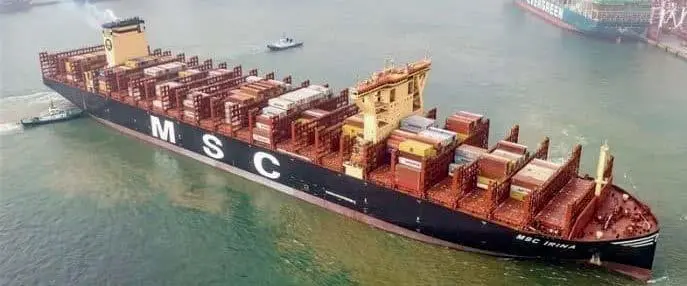
It’s time to look at the container markets again and try to assess what will be the impact of a downturn on the port sector. For any long-term observer of the container business, it looks like a case of ‘déjà vu all over again’. The basic position can be summarised as follows:
- The supply side is set for a massive expansion – especially in the larger size vessel ranges. There are only limited opportunities to use these ULCS and Megamax vessels outside the Asia to Europe and Transpacific trades.
- Demand is uncertain. At the global level economic uncertainty is at very high levels. The latest IMF forecasts for global economic growth (April 2023) is 2.8 per cent for 2023. This is much lower than long-term trends and, given political uncertainties, may well understate the actual outcome.
- The impact on different container trades will vary sharply, but the established vessel ‘cascading’ in the market will spread any negative effects very broadly (and very rapidly).
- The decline in the supply/demand balance has already hit the market – way ahead of the delivery of new tonnage. This suggests that problems will run over the next two years and beyond.
This outlook can only cause difficulties for the container port and terminal sector.
Nothing is really new in the shipping markets. Similar conditions have typified the markets over most of the period since 2014 and – indeed – real sustained profitability for container owners has been nebulous since the Financial Crisis.
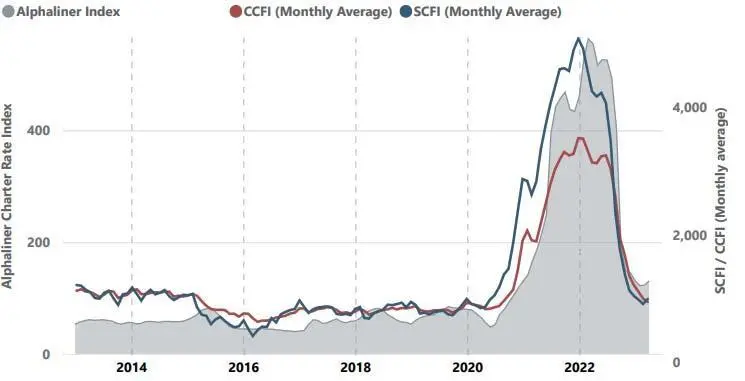
Data collated by Alphaliner is germane here. Focusing on the market since 2014, it’s clear that the unprecedented surge in freight rates (SCFI/CCFI) and charter rates (Alphaliner Index) in 2021-2022 was by no means typical of any market upturn and was a true ‘Black Swan’ event if ever there was one. Rates peaked at hitherto unseen levels and have equally rapidly collapsed back to a much more typical position. It’s clear that this return to ‘normality’ will continue.
It’s all about supply and demand with the usual overlay of fear and greed. Shipping lines weren’t clever but lucky, with the freight sector probably the only real beneficiary of the epidemic. Supply chain disruption resulted in windfall gains for the industry. The question now is what did the lines do with all this cash? Have they deep enough pockets to survive through a prolonged downturn? It’s worth taking a closer look at each side of the equation.
There are, of course, differences on each major route but past experience confirms that no individual trade can long be insulated from the broader balance of supply and demand. Rates remain higher than before the Pandemic but the outlook for supply and demand is not positive.
THE SUPPLY SIDE
The container fleet is now faced with a massive addition of new capacity for delivery over 2023 and 2024 and overall, a period of excess vessel capacity is certain. Despite the collapse in freight rates the level of ordering has remained very high, with this funded by additions of novel units utilising new fuelling methods such as methanol and – of course – LNG. It is estimated that around 730 new vessels will be added to the fleet by the end of 2024 – an increase of at least 10 per cent in total fleet capacity. The orderbook also includes some 150 vessels slated for delivery in 2025. Even with potential cancellations and delivery delays (yet to be noted) this represents a truly heroic commitment to the future container business.
These orders are focused on the largest size ranges with Neo-Panamax and Megamax vessels dominating the position. It is far from clear how the market can absorb this capacity. At the same time, the strongest demand has been noted in the intra-regional markets – especially in Asia – where much smaller vessels are optimum. These tranches of the fleet have been out of favour and there are concerns about capacity availability in some niches.
Superimposed on all of this is the uncertainty of the implications and deployment patterns as the alliance structure is reformed, as Maersk and MSC part company. The fallout from this is another variable.
WHAT ABOUT DEMAND?
The shipping lines have gambled on demand returning to (at least) historic levels. Will it?
The macro-economic outlook is not positive and the degree to which the current Chinese export recovery can be sustained remains unclear, with longer term shifts way from this model already beginning to gather pace. Inflation remains high and the resulting impact on real wages in the major import zones will further limit the uptake of consumer goods. Retail sales in recent months have been disappointing and actual declines have been noted in the EU.
The stabilisation of rates in the past two months has been partially driven by wholesalers rebuilding stock after the supply chain disruptions. This is, by definition, a one-off factor.
These combined trends will hit demand for the largest classes of vessels, although putting a number on this remains very difficult at present. Any further upset at the geopolitical level can only push the market further into negative territory.
The following key factors with regard to demand need close monitoring:
- Macro-economic growth and the risks associated with this – especially at the geopolitical level. The China/Taiwan situation is the key risk here.
- The degree to which the Pandemic has shifted supply chains away from China. Will this accelerate and what does this mean for port investments?
- The entire China strategy is in a state of flux with moves to boost local demand and shift away from export-orientated middle value goods. Emerging nations will take an increased market share, but correctly formatted port capacity is not there yet.
It doesn’t look like the pre-Covid pattern will emerge unaltered. The freight market is heading downhill, and the only uncertainty is how deep the hole will be.
WHAT CAN THE LINES DO?
Before considering the port implications it’s worth looking at the potential moves that lines will make to mitigate these issues. Scope for manoeuvre is quite limited:
- Capacity can be absorbed by slow steaming and rerouting longhaul trades. This only indirectly impacts the level of freights, and in any case average liner speeds are at a ten year low already.
- There is scope to cancel and delay orders as has been done in the past, but demand for other ship types is strong and yards are not likely to be cooperative. The costs will be high.
- Scrapping is an option and seems certain to increase – especially for older tonnage in the mid-size ranges.
- The degree to which shipping lines have embarked on alternative fuel strategies, often without a clear-cut costbenefit analysis versus more conventional options, seems likely to slow. Making well intentioned ‘green’ moves will become less affordable.
- They can squeeze their suppliers.
The latter will be partly focused on the port sector.
IMPACT ON BOX PORTS
So, what happens when your customers’ revenues collapse? The focus will be on spreading the pain. Bunker suppliers and other providers of consumables will be pressured, but what about the terminals? In the past, lines faced with a weakening bottom line have sought to pressure stevedores for lower rates and discounts. These moves have not gone down well given the level of investments made in terminals and continuing pressure to provide further, deeper, capabilities.
For established high volume terminals the response has been to resist by seeking to provide essential capabilities and to maintain margins by increased productivity. For major terminals this will continue, but it is important to note that in the major port ranges it is increasingly difficult to differentiate between terminals given the overall level of investment. Also, the supply/demand balance will weaken.
The degree to which this will focus demand on line-owned terminals at the expanse of common-user facilities will also undermine the latter facilities, although the alliance restructuring anticipated will provide some scope for negotiations here.
Elsewhere the emphasis will be on bringing new capacity on-line, in the emerging markets as they increase their role in the trades. This means additional handling capacities for much larger vessels. Close focusing of attention on these situations offers real potential for developers and investors. Demand will be strong here, and the major lines will be obliged to serve these markets or see their role declines is where the opportunities lie.
Related Articles
 EQUIPMENT
 OPERATIONS
 OPERATIONS