![PortStrategy[GreenPort]](https://www.portstrategy.com/wp-content/uploads/2026/09/PortStrategyGreenPort.svg)


Brexit – uk trade impact
Andrew Penfold analyses the impact of Brexit on UK trade to-date and identifies forward trend lines with particular reference to trade with the EU and secondary European markets
It’s now nearly two years since the UK (excluding Northern Ireland) left the EU’s Single Market. The impact to-date has been uncertain as a result of continuing COVID-19-related distortions and other factors that have shaped trade vectors since early 2020.
Data is, however, now becoming available that allows the shape of future trade patterns to be established. This data is virtually complete for 2021 and meaningful estimates can be made for 2022. So, what has happened and what is the outlook? How will these trends impact on port development in the UK and for major North Continent trading partners?
SIFTING DIFFERENT FACTORS
Its very important to weed-out various issues that have impacted the entire European market and not confuse these with the emerging underlying structure of UK trade. All of Europe has seen supply chain disruption in the wake of the pandemic and uncertainties at the macro level, with the war in Ukraine further complicating the analysis. In addition, specific factors such as the continent-wide shortage of truck drivers, port congestion and mounting green pressures are all shaping the situation.
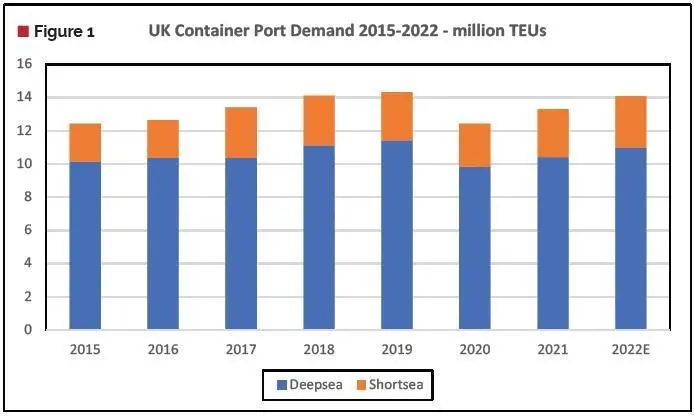
Nevertheless, a simple assessment of the numbers of containers handled at UK ports in terms of shortsea and deepsea volume provides a good summary of non-EU trade and allows an assessment of influential macro factors – Figure 1. This is highly simplified data and includes empty container moves. The position is further clouded by the failure of the stats to factor-in non-EU cargoes feedered across North Continent ports.
However, it is apparent that UK deepsea trade continues to be driven by macro-economic factors and is linked to the scale of the economy. This has not changed, although the use of continental feeder hubs for this traffic complicates the analysis. In 2019 total TEU volumes reached some 14.3 million TEU, with this contracting in 2020 and since recording some recovery. Preliminary estimations indicate a total of some 14.2 million TEU this year. Within this, there has been a limited proportional decline in direct deepsea, with this reflecting increased continental feedering to smaller ports as a result of well-publicised congestion in the major gateways.
SHORTSEA TRADE STRUCTURE
The key area of interest, however, is trade with the EU and other secondary European markets which are captured in the UK port statistics as ‘shortsea’. So, what has actually happened?
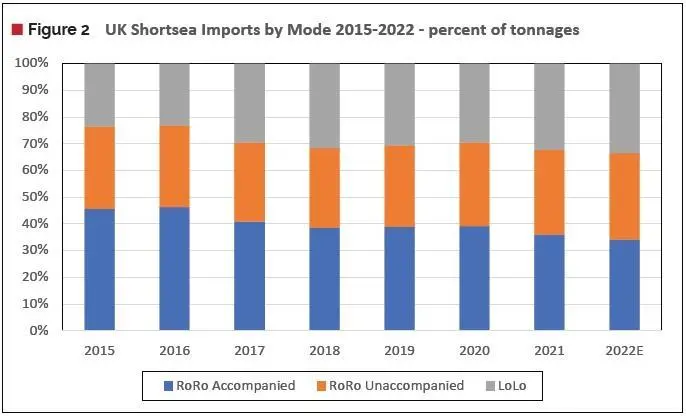
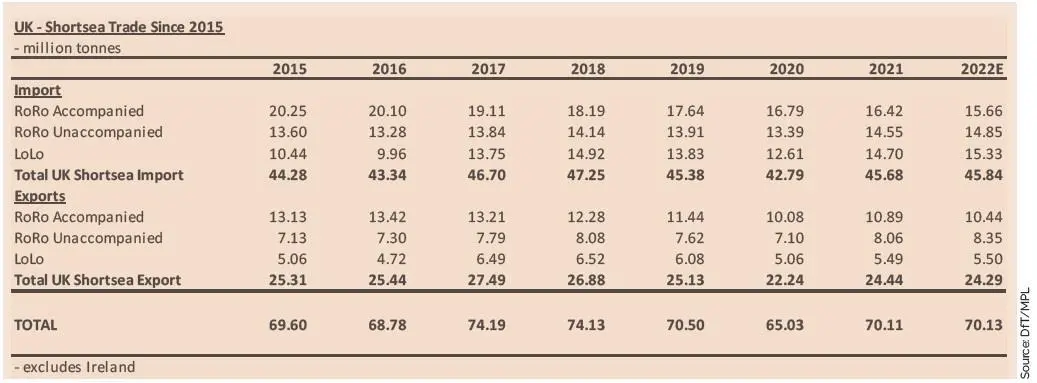
Table 1 provides a summary of developments since 2015 in terms of cargo tonnages. Trade volumes expanded by around 6.5 per cent between 2015 and 2018 and then contracted in 2019 with this reflecting the stock build-up period ahead of the planned EU exit. Further contractions were noted in 2020 due to COVID-19 and there has since been a limited recovery. Total volumes remain below the peak 2018 total, however. The bias in favour of imports remains, but this has declined slightly over the period. Within this there are very important trends:
- Accompanied RoRo has contracted sharply and seen market share fall from 46 per cent in 2015 to a current level of around 34 per cent. This reflects the trend towards avoiding congestion at Dover and moves to route cargoes closer to ultimate destination (and origin).
- Unaccompanied RoRo has benefited from this trend, with market share increasing over the period. The greater land requirement for storing trailers prior to collection has driven these cargoes to ports providing greater available areas. It is anticipated that this will continue.
- Shortsea LoLo has been the major beneficiary, with market share jumping from 23 per cent to 33 per cent over the period. This has followed from greater penetration into the lower value consumer and intermediates markets and the greater role of feedering of deepsea boxes.
The situation is further summarised in Figure 2.
Total shortsea trade volumes have been partially constrained by Brexit, but this effect is limited. However, increased bureaucratic pressures at Channel ports has seen a redirection of demand to other ports – especially those nearer to Midlands distribution centres and with available land for storage. The dwell time for a trailer is around 1.5 days for an import unit on average, while (historically at least) dwell time at Dover – under good conditions – was a matter of minutes. This factor, and increased use of containers, will continue to shape the market.
It may well be the case that the accompanied truck sector will become increasingly focused on perishable goods and other very high value cargoes that are truly time sensitive.
NON-BREXIT INFLUENTIAL FACTORS
The overall development of demand – and its modal distribution – has also been influenced by several non-Brexit factors:
- The shortage of truck drivers is a pan-European issue and is forecast to worsen in the next few years. This has increasingly favoured the unaccompanied sector. The use of ferries to northern ports significantly reduces driver demand, with multiple daily pick-up journeys to/from ports serving the Midlands and the North becoming an increasingly viable possibility. This shift favours ports with available land.
- These benefits have been further underlined by the broader trend towards green initiatives. Using a vessel to deliver goods nearer to destination is a positive in this respect.
- Increased Brexit bureaucracy is an issue but is likely to be eased as a new equilibrium is finally achieved as the political temperature cools.
- The imbalance in the UK shortsea trades is also influencing developments. There is very limited export potential in the south, but the north of England offers much more potential. An improved trade balance (with resulting lower overall costs) is also influencing demand.
- There has been much talk of increasing direct freight flows between Ireland and the rest of the EU by eliminating the UK landbridge and some services have been increased. So far, however, this has been limited and Irish Sea traffic remains robust.
It might be assumed that all this will result in the reanimation of smaller ports in the south that have had a role in these trades in the past. This could be a factor, but the introduction of much larger RoRo freight ferries in the North Sea will ultimately limit the potential here.
PORT INVESTMENT IMPLICATIONS
These changes are already having a direct influence. The development of terminals on the East Coast, where land is relatively cheap (and available) and larger vessels can be handled, has been directly behind the initiative from Associated British Ports (ABP) to develop increased facilities and new berths at Immingham on the Humber. Further south, the Medway ports are also recording increased unaccompanied trailer volumes as a direct result of difficulties in Dover and are said to be targeting developments.
The factors driving changes in post-Brexit shortsea trade are seen to be complex and still have a long way to play out. But these changes offer major potential for such developments.
The shift to increased use of unaccompanied trucks and LoLo containers seem certain to further increase interest in hitherto ‘unfashionable’ ports on the North Sea coast and new investment can clearly be anticipated. Far-reaching changes are underway.
Related Articles
 EQUIPMENT
 OPERATIONS
 OPERATIONS