

Building practical resilience
Jaret Fattori, Senior Consultant, BMT, lays out an effective route to building resilience and adaptation planning to counter the negative impact of extreme weather events and to assist the transition to a low carbon economy
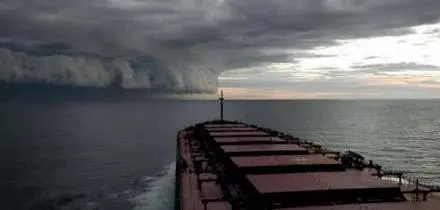
Situated in current and future hazard areas, maritime infrastructure is exposed to increasing climate-related risks. Owners and operators (across ports, harbours, marinas and shipyards) are exposed to a unique set of challenges and impacts due to their proximity to the coast and waterways. As the current and potential future impacts from climate become better understood, many maritime sector organisations are starting to take their first steps toward resilience and adaptation planning.
There is an increasing societal emphasis being placed on the concept of resilience, particularly in addressing the dual challenges of climate risk in terms of the transition to a low carbon economy and adapting to acute and chronic physical threats such as sea level rise.
While emphasis on decarbonisation has spurred innovation and investment into electrification, renewables and alternative fuels, the latest report and the outcomes of the negotiations at the recent COP27 indicate it is likely now a shortening window of opportunity for organisations to meaningfully address carbon dioxide levels before significant physical risks materialise. Reporting and regulatory requirements around climate risk financial disclosure are also emerging, with TCFD reforms being implemented by national governments and stock exchanges across many jurisdictions.
Pressure from the investment community, as well as upcoming mandatory disclosures, have spurred the evaluation of risk from all sectors. Despite these considerable drivers of change, the requirement for assessing climate resilience is currently discretionary. Organisations’ current actions are primarily driven by investor and corporate Environmental, Social, Governance (ESG) aspirations, though this is beginning to shift to address internal risk management processes and best practices.
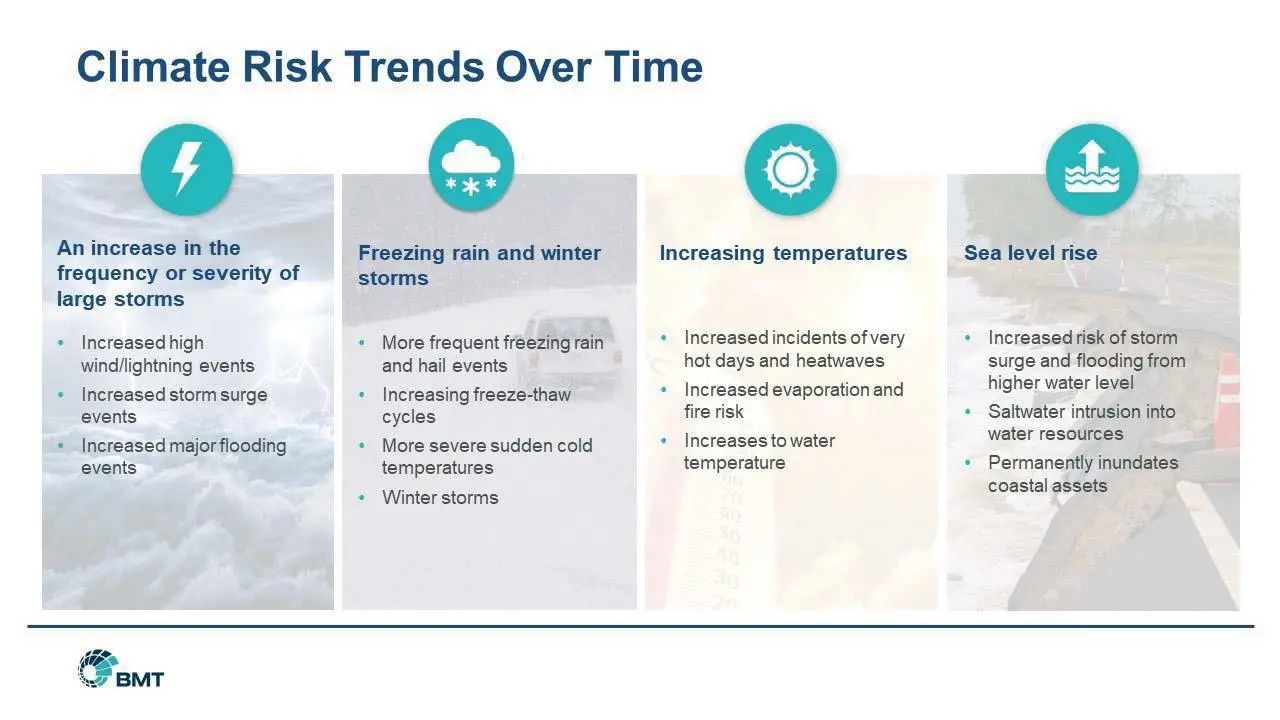
As shown in the figure above, this will play out in the form of acute impacts such as storms, flash floods, and winter storms but also much more gradual climate changes. These include sea level rise, temperature increases, drought, erosion, increased sedimentation (leading to more frequent dredging) and changes to wind dynamics potentially affecting maritime navigation. Many of these hazards are already being felt by ports and harbours around the globe – 2005’s Hurricane Katrina closed the Ports of New Orleans, Mobile and South Louisiana for up for four months; 2017’s Hurricane Harvey interrupted the Port of Houston’s operations for over a week. More recently, Atlantic Canada was impacted by Hurricane Fiona in early 2022, suspending service for several ports and disrupting power to huge areas.
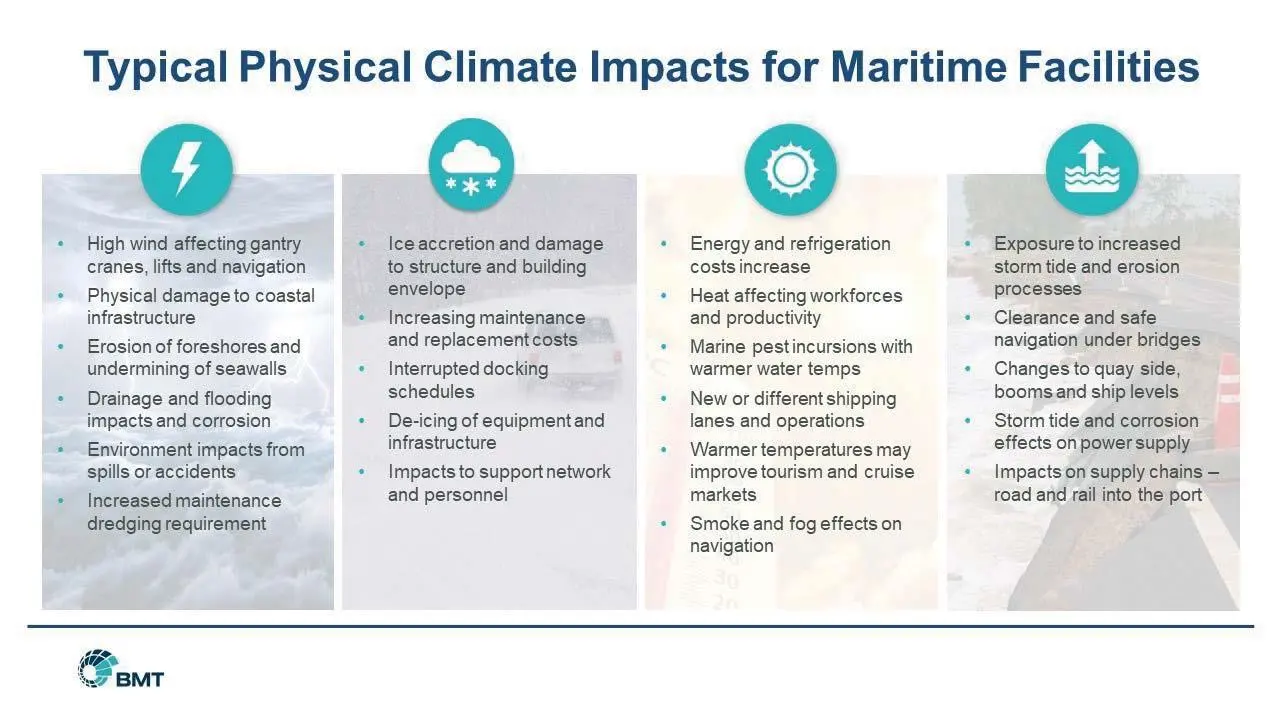
The figure above identifies some of the direct and downstream impacts that may affect maritime systems.
Jaret Fattori is currently a Senior Consultant with BMT, using his background in environmental and civil engineering, as well as his expertise in climate change science, to advise clients on climate resiliency, carbon emission reduction, and sustainability. His technical background has helped him consult on climate change risk in conjunction with governments, businesses and non-profits. Jaret harnesses the efforts of multi-disciplinary teams in coastal engineering, infrastructure and supply networksandtoproviderobustclimateriskanalysis.
Related Articles
 OPERATIONS
 OPERATIONS
 OPERATIONS