![PortStrategy[GreenPort]](https://www.portstrategy.com/wp-content/uploads/2026/09/PortStrategyGreenPort.svg)





CONTAINER ROLLERCOASTER: WHAT NEXT?
How will the container sector emerge from the market shocks posed by ongoing COVID-19 issues and now the Russia-Ukraine war? Andrew Penfold explores this fundamental question
Given the uncertainties and risks that have been noted since the pandemic, and now the Ukraine war, far-reaching questions need to be answered concerning the outlook for the structure of future container trades. We have seen surging freight rates and chaotic logistic chain developments – how will this play out and what are the implications for container ports and terminals? Have the major shipping lines made the correct decisions regarding their windfall profits?
DISRUPTION NOT MORE DEMAND
The first point to be made is that high freight rates have not really been driven by a surge in demand. Rather, supply chain disruption – way beyond port boundaries – has precipitated this situation. The effective withdrawal of a large proportion of container shipping capacity, especially on the major east-west trades, has altered the market balance with surging freight rates the result.
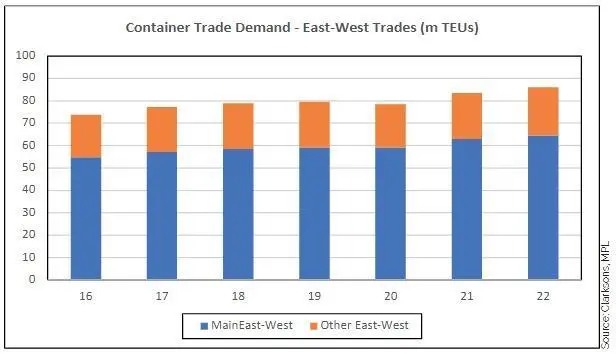
The development of trade volumes on the major trades is detailed in Figure 1. The pandemic-led downturn in 2020 was limited, and the pace of growth since then has been within an anticipated range. There was a decline of some 1.6 per cent in 2020 and then a recovery of 6.6 per cent in 2021 with preliminary estimates of three per cent growth this year – hardly a massive surge in demand.
At the same time, container freight rates exploded, with the benchmark Shanghai Containerised Freight Index (SCFI) increasing from 995 at the end of 2020 to a peak of over 4000 in early 2022. Although there has been some subsequent decline, it remains at very high levels. The outlook for demand is not really that positive, with inflation-led uncertainties in the global economy and structural shifts underway away from a perceived over-reliance on China. Unknown fallout from the Ukraine crisis is also undermining sentiment in Europe.
The surge in rates is entirely due to labour shortages in trucking capacity in China and in the major import regions and resulting disruption in equipment positioning. There have been some periodic losses of labour in the port sector, but this has not been the major source of the problems – indeed, a degree of equilibrium in the terminal sector has been achieved (notwithstanding the threat of renewed lockdowns in Shanghai and other major Chinese export points).
So, what happens if the logistic chain problems are resolved, and a degree of stability returns to the container market? To try and answer this we need to look at the behaviour of the shipping lines in the past twelve months.
WINDFALL PROFITS: REACTIONS
Following years of meagre returns the major shipping lines have recorded unprecedentedly good results in recent months. For example, Maersk has seen an increase of around 160 per cent in revenues per TEU between the third quarter of 2020 and the end of 2021. This pattern has been noted for all the major lines.
Resulting windfall profits have led to different strategies. On the one hand, some lines have assumed the current supply/demand balance is the new normal and rushed into further ordering of new capacity. Others have sought downstream investments and placed the emphasis on acquisition of strong regional forwarders and other transport companies. The jury is out on the correct approach.
Investment in logistics companies has been one strategy, with lines seeking greater control of the supply chain with the emphasis on e-commerce and local presence.
Maersk has been highly active with moves such as the US$3.6bn purchase of LF Logistics, a logistics and consumer sourcing company, the acquisition of Visible Supply Chain Management, a business-to-consumer (B2C) logistics company focused on B2C parcel delivery and B2C fulfilment services in the US and the purchase of B2C Europe Holding B.V. (B2C Europe), a business-to-consumer logistics company focused on B2C parcel delivery services in Europe.
CMA CGM has invested heavily in CEVA Logistics and followed this up with the acquisition of Ingram Micro’s Commerce and Lifecycle Services business, the purchase of last mile provider Colis Prive and the near 100 per cent purchase of GEFCO, the European automotive logistics concern. It is also implementing diversification into the air cargo market acquiring four A350F aircraft.
MSC has made a $6.4bn offer for Bolloré Africa Logistics. This seems like a strong move and a useful way of investing the benefits of a unique (perhaps one-off) situation. It is also eyeing the airline sector with moves to acquire a major stake in the Italian state airline ITA Airways.
However, the degree to which downstream investments can be successfully integrated into shipping lines business models remains unclear. There are many examples of unforeseen difficulties with this approach. The uncertain benefits of line investments in container terminals – especially when seeking third party customers – is an illustration of the difficulties inherent here.
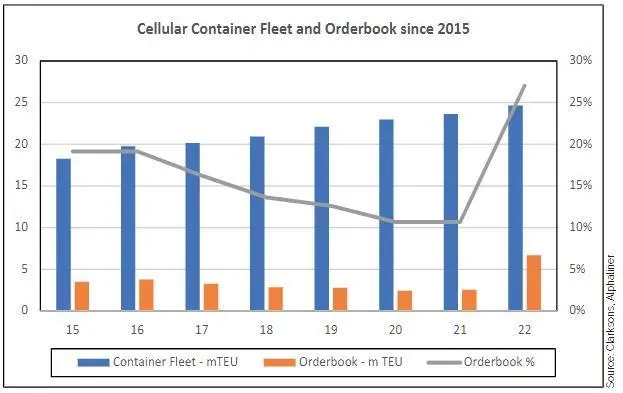
The other development approach has focused on expanding liner capacity, and this can only generate severe concerns. Figure 2 summarises the development of the container fleet and the cellular orderbook. There has been a massive surge in the ordering of new vessels with the orderbook increasing from around 2.5 m TEUs at the end of 2021 to a current level of nearly 6.7m TEUs – 27 per cent of existing fleet capacity. If the disruption delays in the logistics chain are resolved, and with limited underlying trade growth, where will all this tonnage be deployed?
The situation is actually even more problematic than here suggested. A look at the orderbook position for the largest classes of vessels (15,000TEU+ – above New Panamax and the ULCS fleet) confirms that in early May this stood at some 3.8m TEUs, with this being equivalent to 95 per cent of existing fleet capacity. These vessels can only be deployed on certain trades. Is it really the case that demand will double on Transpacific and Asia-Europe trades in the next two to three years? What happens when the supply chain issues are resolved?
DEJA VU
Anyone with a sense of perspective in the shipping markets will have the feeling that this has happened many times before. Over exuberance in ordering – either as the result of technical revolution (usually size-based) or a misreading of market fundamentals always results in a glut of tonnage being delivered onto an oversupplied market, with predictable results for lines’ financial positions.
A collapse in freight rates can be anticipated in the next two years as all of this capacity arrives and the container business faces unprecedented changes in direction.
In summary, the problems will be:
- The danger of macro-economic contraction – with risks higher now than at any time since the Financial Crisis. Even trend expansion will not absorb all this new capacity.
- Easing of the logistics issues that have distorted the supply side of the shipping equation. These are already being managed and the underlying situation is much improved.
- The move towards nearshoring. The recent Russian situation and worsening political issues with China have undermined some of the confidence in globalisation. Even if alternatives to China can be found (India, Indonesia, Vietnam, etc.) the infrastructure for the largest vessels is not yet in place in these regions.
Shipping lines need to be very careful in capacity planning against this background, after all these levels of risks seem much higher than in previous cyclical downturns. But it may be too late for some…
PORT IMPLICATIONS
Identifying the implications for containerports and terminals is a complex task and various local issues will need to be accommodated. However, some basic factors will emerge:
- There will be an oversupply of the largest classes of vessels. The established east-west trades cannot absorb this volume of tonnage. Shipping lines will seek to cascade some of this tonnage onto other trades. This cannot be easily achieved without uprating of terminal capacity – especially with regard to draught and quay lengths. Who will pay for this investment? Moves need to be made now to offset these problems.
- Within terminals, the reliance on larger vessels – perhaps with less frequent services – will mean increased peak loadings on terminals. This will have an impact on crane and yard capacities. Once again high investment will be required to accommodate this.
- As has been the case in other shipping market downturns, lines will seek to lower the prices they pay for container handling. These demands must be resisted, especially if terminal operators (and ports) are to provide the level of investments required.
At present terminal capacity is seen to be at a premium. Given that this is really the result of one-off specific conditions now would be a good time to lock in line customers. Perhaps now is the time for longer term contracts? Joint ventures with cash-rich lines may also make some sense.
Batten down the hatches!
Related Articles
 EQUIPMENT
 OPERATIONS
 OPERATIONS