![PortStrategy[GreenPort]](https://www.portstrategy.com/wp-content/uploads/2026/09/PortStrategyGreenPort.svg)


Optimising inland shipping at Hamburg
Hamburg is realising the potential for highly efficient inland waterway traffic, explains Gerald Hirt, managing director, HVCC Hamburg Vessel Coordination Center
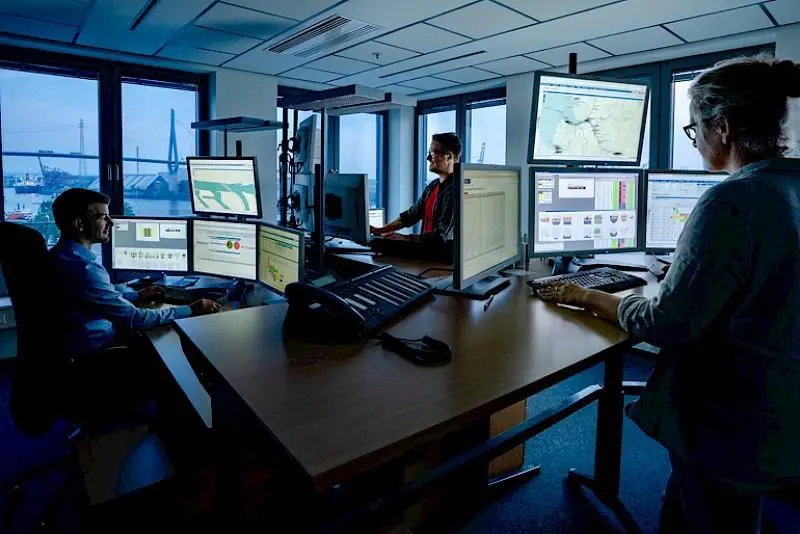
The Port of Hamburg is traditionally a rail port with the rail share in hinterland traffic for container transport at over 46%. However, inland waterway transport as part of the transport mode mix is becoming increasingly important.
In 2019, Germany’s largest seaport was able to record over 145,000 teu in container transport by inland vessel, an increase of 13%. This is a share of 2.5% in the modal split. If project cargo and bulk cargo transports, which are particularly suitable for inland waterway vessels, are added, the share reaches almost 10%.
Modal shift
The waterways are important to the port’s business both from an economic and environmental perspective.
In addition to the 145,000 teu that were moved by inland waterway vessels in the Hamburg hinterland last year, a further 170,000 teu were moved by barge within the port. These container transports within the Port of Hamburg have replaced a total of around 120,000 truck transports and are a good example of a successful modal shift in freight transport in the Hanseatic City.
The aim is to enhance inland shipping’s position as an effective and environmentally friendly mode of transport and to make use of its great potential as a key pillar of hinterland traffic. Inland waterway transport is reliable and independent of the traffic situation on the roads. But above all it is environmentally friendly and thus offers good opportunities to reduce the ecological footprint.
Integrated inland waterways monitoring
For more than ten years, the HVCC Hamburg Vessel Coordination Center has been optimising vessel traffic in the Port of Hamburg as a central, neutral and cross company coordination point.
Initially, the focus was on feeder traffic, but as ship sizes increased, the coordination of large vessels followed. From these experiences the potential for inland waterway transport became clear. Raising this potential is a gain for the port, the terminals and inland shipping itself.
The planning of inland vessel arrivals in Hamburg, the coordination of rotation within the port as well as the assignment of berths and terminal handling will in future be digitalised with the help of the new inland shipping platform, making the processes more transparent and efficient at the same time.
The platform creates a synchronous planning basis between ship owners, ship management, terminals, authorities and HVCC and ensures a smooth data exchange between all parties involved. The HVCC uses synergies resulting from the planning of ship calls at the terminals at an early stage and thus optimises the overall port rotation. Thus, the new platform also changes the previous workflow and way of collaboration between stakeholders.
Digitalisation enables improved integration of the inland vessel in transport chains. The development of a central inland shipping platform for Hamburg is expected to improve planning and enhance the quality of handling.
Embracing digitalisation
Digitalisation is not only of great importance in the current challenging situation, but of course it helps enormously in coping with scheduling tasks.
The Port of Hamburg works 24/7, 360 days a year. Ensuring efficient operations and reliably supplying the economy and population in Germany and Europe is always the focus. The Port of Hamburg has ensured this at all times, even during the Covid-19 pandemic and the HVCC has made its contribution.
Going digital is the decisive factor is how the HVCC can improve the ecological footprint of its customers and users. With the help of our coordination services, inland shipping companies reduce their bunker consumption because they can optimally adapt their speed to the availability of berths.
At the same time, the inland vessel as a mode of transport becomes more attractive for forwarders and shippers, who can reduce their ecological footprint by shifting to the inland vessel.
The new waterways platform fits into the overall environmental strategy of the port.
In their coalition agreement, the governing parties in Hamburg have stipulated that the port should become CO2-neutral by 2040. Against this background, the HVCC Hamburg Vessel Coordination Center is making an important contribution to reducing climate-damaging emissions.
In addition to the waterways platform, the HVCC has launched a highly innovative digitalisation project together with the maritime technology company Wärtsilä and the cruise group Carnival.
The aim is to create more reliable ship arrivals, more efficient ship handling and port logistics, as well as reduced fuel consumption and emissions. The project partners developed and tested a worldwide unique digital solution for just-in-time ship arrivals. For the first time the direct, real-time data exchange under real-world conditions between port and ship was realised in order to enable a dynamically optimised Hamburg approach. The first live tests were carried out on the M/S AIDAperla and M/S AIDAsol – ships which regularly call at the Port of Hamburg.
Testing has found that continuous, dynamic, real-time data exchange improves coordination and allows speed modifications based on recommendations of the HVCC, if the conditions in the port and the navigation area are changing during the approach.
Following the successful tests in the cruise segment, there are now plans to expand into cargo shipping. With approximately 3,000 seaports and 100,000 commercial vessels around the world, the potential for further networking is enormous.
Related Articles
 ALTERNATIVE FUELS GREENPORT
 ENERGY & TECHNOLOGY GREENPORT
 ENERGY & TECHNOLOGY GREENPORT