![PortStrategy[GreenPort]](https://www.portstrategy.com/wp-content/uploads/2026/09/PortStrategyGreenPort.svg)




Small scale hydropower: an alternative power option for ports?
Renewable energy technology, such as hydropower, can provide non-polluting alternatives to reduce emissions caused by fossil or nuclear fuels. Due to their location, ports could use tidal and wave power for meeting some energy requirements*
Royal Haskoning has vast experience in the design and development of ports and also plays a key role as an advisory body to port authorities all over the world. The company has recently gained experience with tidal and wave power options. As water levels in ports are dominated by tides and waves, Royal Haskoning sees opportunities to gain energy from these renewable energy sources and thus helps to comply with the stringent objectives set by the Kyoto-pact and Environmental Protection Agency which ports are committed to meet.
A lot of different aspects are involved in a hydropower project, such as mechanical engineering, electrical engineering, hydraulic engineering, logistics, legislation, economy and environment. The expertise and experience of professionals in a variety of disciplines allows them to fully consider all these aspects and thus regards multidisciplinary projects as their core business in order to develop sustainable and practical solutions. Considering this, Royal Haskoning sees three possible opportunities to exploit hydropower in ports.
Tidal current and wave applications
One approach focuses on tidal current conversion applications that could be introduced in ports. This can be manifested either as tidal range systems hereby aiming on higher power output ranges, or as tidal flow systems, also referred to as hydrokinetic applications which are fitted for smaller power output ranges. As another approach, wave energy conversion techniques could also be taken into consideration.
The latter two, hydrokinetic and wave energy conversion devices, offer ways to tap the energy of moving water without impoundment (dams) or diversion required by many conventional hydroelectric facilities. Hydrokinetic energy conversion devices are designed to be deployed in a stream or current capturing kinetic energy from the flow of water. Conceptually, the operating principle is similar to the way wind energy conversion devices work. The rotor, driven by the water flow passing through, powers a generator without impounding or diverting the flow of the water resource. An example of Swan turbines moored on a river bed is illustrated in photo 1.
To give a first idea of the potential electrical power that can be extracted from a tidal flow the following equation can be used:
P=1/4.(π.d^2)/4.v^3
In this equation, P is the power output [kW], d is the diameter of the rotor [m] and v is the free flow velocity of the water [m/s].
The system can be easily integrated, for example by constructing a basic foundation to anchor the machine at the bottom of a river or channel, with a minor impact on fish migration. Moreover the energy is produced on a predictable basis which is a key advantage compared to other renewable energy sources e.g. wind energy. However, in all cases, shipping is taken as a priority. Thus conflicting situations could arise, as most commonly, the most promising locations in a river or channel in a port area are claimed as the navigational route. Studies are currently running where docks or channels are linked by small channels in a way that the energy of the water flow displacement could be captured by turbines.
Wave energy represents a form of renewable energy created by wind currents passing over open water. Wave energy conversion devices create a system of reacting forces in which two or more bodies move relative to each other, while at least one body interacts with the waves. The body moved by the waves is called the displacer, while the body that reacts to the displacer is called the reactor. There are many ways in which such systems can be configured. The common measure of wave power, P, is:
P=(g^2.T.H^2)/(32.π)
This equation is expressed in kilowatt per meter [kW/m] of crest length, i.e. distance along an individual crest. g represents the acceleration due to gravity [m/s2], T the period of wave(s) [s] and H the wave height [m]. It should be noted that this is the energy offered by a wave. Turbine losses as well as generator losses still have to be taken into account.
Wave energy devices have the key advantage that they can easily be implemented without a major impact on shipping or the environment. On the other hand, the energy which can be harnessed will be lower compared to hydrokinetic or tidal range systems.
Looking at port areas, implementations on piers or wave breakers could be desired as systems which lower the energy content of waves and hereby generate electricity. In ports, waves could also be created by vessels navigating by. As such waves sometimes have to be dimmed, this softening process could be exploited as an energy creating application. However, these waves are steeper and have a shorter period T, which make them difficult to harness with conventional wave energy conversion devices. Studies within Royal Haskoning are currently running to find solutions in the near future.
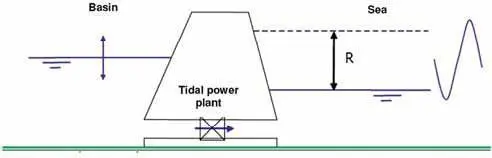
Finally, tidal range energy shows a remarkable potential. However, the output of this form of energy generation is predominated by large water surfaces and therefore it is not always applicable in existing ports. However, gaining tidal energy from the tidal range has been done with tidal mills since the 8th century AD. Currently only one large scale tidal power plant exists in the world, in La Rance, France. Here a barrage was placed in an estuary with high tidal range, thus creating a basin on the upstream side. The potential of this tidal range energy can be calculated as follows for one tidal cycle:
E=1/2.γ.A.R^2
In this equation E is the energy [J], _ the volumetric weight [kN/m3], A the surface area of the basin [m2] and R the tidal difference [m].
Although this method is often mentioned when damming off large estuaries, it can also be implemented in a port on a small scale. There the first challenge is to find a basin in an often busy port area. Ports with docks behind locks and lakes in the vicinity of a port area can be used as such basins. The next challenge is to find a location for the turbine where the jet flow from the turbine has a minimal effect on shipping. An illustration of tidal range power plant can be seen in figure 3.
The market potential for tidal range, hydrokinetic and wave energy is vast, ranging from small-scale distributed generation applications to large-scale power plants hereby also looking at near-shore applications. As every port is different, an inventory has to be made of the properties and restrictions of the port important for tidal and/or wave power. In discussion with port authorities locations can be found where water power is interesting and could be exploited. The main obstacles to development result from these being relatively new technologies, unfamiliar to licensing and resource agencies, and unfortunately as yet largely unproven from the point of view of investors.
www.royalhaskoning.com
Related Articles
 ALTERNATIVE FUELS GREENPORT
 ENERGY & TECHNOLOGY GREENPORT
 ENERGY & TECHNOLOGY GREENPORT