![PortStrategy[GreenPort]](https://www.portstrategy.com/wp-content/uploads/2026/09/PortStrategyGreenPort.svg)




Dredging – no bottom in sight
Maintaining channels and berth depths has become an operational migraine as dredgers flock to more lucrative reclamation projects instead, as Stevie Knight discovers
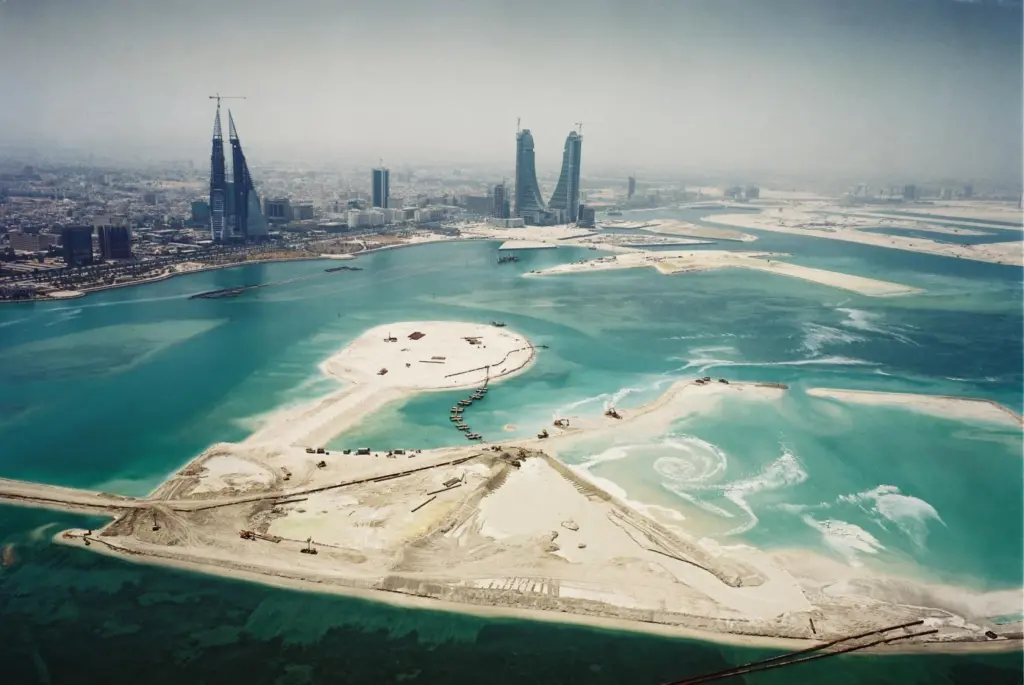
Ports, dredging and the phrase ‘over a barrel’ go together for even the smallest operations around the world today. Those not blessed with a natural harbour have to keep dredging – and even larger ports have had to put in extra resources for capital works in order to keep the big ships flowing.
And dredging companies may have found the gold at the end of the rainbow
try { if(String(“Dredging_artile_pic_rainbowing.JPG”).length==0) { document.getElementById(“cricket”).style.display=”none”; } } catch(e){ }
Despite the global downturn, there seems little chance that the larger ship sizes will melt away. “Although the dredging market has been cyclic in the past, it might not be anymore – we have gone so far along the path of world trade,” says Constantijn Dolmans, general secretary of the International Association of Dredging Companies. He adds: “Even if this slows, volume is not really expected to decrease, I expect that there will still be a, slightly reduced, growth in shipping transport. And the larger ships are often more economic anyway.”
The problem would seem to be that the glut of work – and relative scarcity of dredgers – has meant that the dredging companies can pick and choose which projects they wish to do, leaving others on the shelf. Some places have an ongoing maintenance relationship, like the port of Harwich which has a Westminster dredger on call, but a capital works programme, however urgently needed, can be left kicking its heels – unless of course the port has friends in high places, like the London Gateway project, backed by DP World.
Which projects get picked can be swung by factors like repositioning costs. This can tilt a decision, given the huge size of the recent builds (like the Cristóbal Colón which has a 46,000 cubic meter capacity) and the still relatively-high price of fuel, because companies have to absorb the expenses themselves once the dredger has finished a job, although mobilisation may be factored into costs.
This means around half the world’s dredgers are hanging around the Middle East, taking advantage of both its stupendous building projects and blossoming shipping facilities. The other place they swarm is near the home of the four major companies: Boskalis, Van Oord, Jan de Nul and Dredging International all come from Holland or Belgium, where the companies often work together on large-scale government-backed reclamation works. This cosy relationship has aroused unsubstantiated allegations of price-fixing in some quarters.
For example, the All India Port and Dock Workers’ Federation recently accused these big contractors of operating as a cartel and extorting exorbitant fees, while on the other hand the international companies are unhappy with the skewed table that the Indian Government has created by legislation that rules in favour of a home-grown contractor if it comes within 10% of an international dredging bid.
But although there are some smaller indigenous companies around the region (like the partially state-owned Dredging Corporation of India), there is still no large or effective presence, though Dredging International now has a joint venture with Larson & Toubro, called International Seaport Dredging, and the possible rewards have tempted companies like Sical Logistics, an extremely new player with no previous dredging experience.
In short, local dredgers are spread too thin to cover even the present annual maintenance requirement of the major ports – totalling around 65m cubic metres – let alone the sharp increase predicted from a buoyant economy.
This causes problems that are compounded by a lack of planning and monitoring. For example Barisal, (Bangladesh’s second largest river port) is located on the Kirtonkhola river which loses navigability around the port area every September, and has done for the last 20 years. Despite this, no monitoring of the situation had taken place, and regular dredging works had simply not been scheduled until deteriorating conditions forced the authorities to move the whole operation to a working quay a kilometre upstream and attempt an emergency remedy. As to why the situation had got so out of hand, the authorities cited lack of funds and non-availability of dredgers.
While in Africa, dredging of the Niger Delta is big news, with the government putting scarce resources into the scheme which will create inland ports at Onitsha and Idah. It is an ambitious project that is catching attention: already two US-based dredging firms – KOFA International and Dredging Supply Co – have promised to assist the country with low-cost finance and capacity building, on a five-year pay-back period.
But it is not always easy to translate the vast possibilities that Nigeria offers into tangible developments. For example, Nigerian company Shoreline Dredging and Oil Services recently admitted that in the past the company had depended on subcontractors but discovered that reliability was an issue and the company ‘vision’ could sometimes be compromised. However, Shoreline’s expansion plans, fuelled by a company share floatation, includes the acquisition of a jetty and dredger to help minimise its reliance on bought-in help.
A few ports have been tempted by independence. Cochin Port Trust in India was looking at buying a dredger after a very tetchy letter from the All India Port and Dock Workers’ Federation to the Union Shipping Secretary recommended it as a way of stopping the international companies making tall demands on Indian ports. So, with a bid in from Dredging International for around $150m, and a dredger proposition of about a third of this (plus the creation of local jobs), it was looking like a no-brainer.
And then in stepped Jaisu Shipping with an offer of around $100m – 20% over Cochin’s budget but ‘within acceptable margins’. However, it may not have been Jaisu’s insider knowledge as much as the lead-in times to acquire a dredger plus the perennial manning and skills problem that put Cochin off, according to Mr Dolmans. After all, getting a crew in place and taking on capital works in the same breath may have left them with cold (and wet) feet.
Needless to say, scarcity of skills has added to the ongoing problem. Lack of available manpower hasn’t been helped by the relatively small pool of large, international dredging companies, since training is usually in-house. However, the answer may be at hand from technology – the Training Institute for Dredging (TID) has a mobile simulator that gives trainee recruits concentrated levels of (simulated) experience, plus TID will be opening its first web-based training portal in 2009.
Related Articles
 EQUIPMENT
 CONTAINER & CARGO HANDLING
 CONTAINER & CARGO HANDLING