![PortStrategy[GreenPort]](https://www.portstrategy.com/wp-content/uploads/2026/09/PortStrategyGreenPort.svg)





LIQUEFIED NATURAL GAS THE NEXT BIG THING IS HERE
The current main driver for change in the port sector, as in the global energy market, is the increasing demand for liquefied natural gas (LNG). As Mike Corkhill reports, for a growing number of ports, LNG represents not only a rapidly expanding traffic but also a major new responsibility.
The global LNG industry is in the midst of an unprecedented growth phase with seaborne movements set to double during the current decade and reach 200-220m tonnes per annum (mta) by 2010. Increasing energy consumption, environmental concerns and the need to diversify from an over-reliance on oil are driving the growing demand for clean-burning natural gas.
Of the total international trade in natural gas, three-quarters is transported by pipeline and one-quarter by sea as LNG. However, LNG movements are currently expanding much more rapidly than those by pipeline, as the delivered cost of LNG continues to be reduced and more remote sources of gas in coastal locations are developed.
DEVELOPING THE INFRASTRUCTURE The rapid expansion of LNG traffic is entailing a quantum leap forward in terms of new ships and port and terminal infrastructure. The 52 LNG carriers now under construction are due for delivery through 2006 and will boost the cargo-carrying capacity of the existing 153-ship fleet by over 44 per cent.
There are 17 gas liquefaction, or export, terminals in service worldwide. Six of these sites are currently being expanded, with the addition of new liquefaction trains, while five new export terminals are being built and seven more are in the planning stages.
The global LNG import terminal network is even more extensive with 41 facilities able to receive, store and regasify LNG in operation.
With LNG demand forecasts now even more buoyant than they were 12 months ago, the industry is in a state of flux and new projects are being unveiled virtually every week. There is a growing consensus that the number of import terminals could double by 2010, and will certainly exceed 70 such facilities. With 21 new import terminals now under construction, there will be at least 62 in service by the end of 2007.
AXIS SWINGS TO THE WEST The axis of the worldwide trade in LNG has been shifting in a westerly direction in recent years. In 1990, when imports by Japan, Korea and Taiwan accounted for almost three-quarters of all LNG shipments, only 32% of LNG production came from the Atlantic Basin and the Middle East. In 2002 LNG output from these regions topped 50% of the total for the first time. Furthermore, LNG purchases by consumers in the Atlantic Basin will increase much more quickly than those by Asian nations over the coming decade. Not only are the gas pipeline systems of Spain, France, Italy and the US poised to absorb growing volumes of LNG imports but also several small, isolated markets in the Atlantic Basin are showing an interest in LNG. Puerto Rico and the Dominican Republic are two such markets already up and running.
This month the world’s 41st LNG import terminal, at Sines in Portugal, is being formally commissioned, while the UK is preparing to rejoin the ranks of LNG importing countries by 2007 due to the need to make up for dwindling North Sea supplies. In addition, Mexico, Jamaica and Honduras are investigating the possibility of importing LNG.
The US is set to be the largest Atlantic Basin growth market over the current decade. At this stage it is difficult to forecast the precise level of deliveries to US LNG terminals in 2010, as this volume will ultimately be determined by domestic gas production levels and prices then pertaining. However, current estimates are that total Atlantic Basin LNG sales will increase from 30m tonnes in 2000 to approximately 100m tonnes in 2010.
Market expansion in Asia will be relatively more sedate in the years ahead, as Japan and Korea are already major buyers of gas. LNG purchases by Pacific/Indian Ocean importers will grow from 70m tonnes in 2000 to some 115m tonnes in 2010. The most notable development in the region will be the emergence of two new LNG importers, India and China – two countries with the potential to be major buyers of LNG as the new century advances.
BUILDING ON EXISTING INFRASTRUCTURE Subject to the availability of adequate additional supplies of gas, the most cost-effective way of bringing new LNG production capacity onstream is to build further liquefaction trains at existing LNG export terminals. Thus, the third LNG production plant at the Malaysian port of Bintulu – LNG Tiga – has recently been commissioned. The two-train LNG Tiga complex increases the LNG export capability at Bintulu to 23 mta, pushing it into first place as the world’s the largest LNG loading port ahead of Bontang in Indonesia.
Elsewhere, Australia is building a fourth liquefaction train, a facility that will boost the export capacity of its North West Shelf (NWS) project from 7.5 mta to 11.7 mta following its commissioning in 2004. Some of the new gas is earmarked for Guangdong LNG which will inaugurate Chinese LNG imports in 2006 when its new receiving terminal at Shenzhen in the Pearl River Delta is commissioned. The NWS project partners are planning to provide a fifth train at its Karratha site in northwestern Australia by 2008.
In the Middle East, Qatar is boosting its export capabilities with the addition of two new trains for RasGas. Once completed in 2006, the new facilities will boost total production capacity at the adjacent Qatargas and RasGas plants in the port of Ras Laffan to 22.8 mta.
Qatar is also negotiating three new “LNG megaprojects” with potential gas buyers in the UK and the US. If they are all agreed, Ras Laffan could have an LNG loading capacity of 60 mta by 2010, making it by far the world’s biggest LNG port at that date.
Oman LNG is another company committed to expanding its output potential, with a third train currently under construction at its Qalhat export terminal. Deliveries from the new unit are expected to commence in early 2006 when the company will have a total LNG output capability of 9.9 mta.
In the Atlantic Ocean Nigeria LNG is adding fourth and fifth trains at its Bonny Island terminal while, at Point Fortin in Trinidad, Atlantic LNG is proceeding with the construction of a fourth train, and considering a fifth.
NEW EXPORT TERMINALS UNDERWAY Although the construction of additional production trains at existing terminals will provide significant new amounts of LNG for the market, they will not be sufficient to meet the overall demand. A number of countries new to LNG are now constructing export terminals that will begin providing product by 2006 and 2007 to supply agreed sales contracts. These are the Snohvit project in northern Norway (4 mta), the Sakhalin II project in eastern Russia (9.6 mta), the Tangguh project in Indonesia (7 mta) and two initiatives in Egypt – the Egyptian LNG project at Idku (7.2 mta) and Damietta (5 mta).
A number of other LNG export projects are in the planning stages, with start-ups earmarked for the period 2007-2010. Most notable amongst these are Donggi (Indonesia), Gorgon (Australia), Darwin (Australia), Bal Haf (Yemen), Escravos (Nigeria), Brass Island (Nigeria), Equatorial Guinea, Luanda (Angola), Sepetiba (Brazil), Camisea (Peru), Mariscal Sucre (Venezuela) and Valdez (US). Iran is also keen to exploit the plentiful gas supplies of its Pars field and has been in discussions with a number of potential LNG buyers, including several Indian companies. The fate of the majority of these second-tier LNG projects, including the latest Qatari proposals, will depend on the extent to which the US emerges as an LNG importer.
US – THE SWING MARKET Twenty years ago the US was on the verge of becoming a major importer of LNG. However, the exploitation of new domestic gas reserves and slackening demand forced prices down. LNG imports quickly became uneconomic and two of the country’s four receiving terminals were mothballed.
Today, the US stands on the verge of a new LNG dawn and this time there is little prospect of domestic gas supplies slowing down the LNG bandwagon. US gas reserves are declining at the same time as the demand for the fuel is escalating, not least for the many new gas-fired power plants being built. The US is a large and sophisticated market, with a nationwide gas distribution grid amenable to link-ups with new LNG receiving terminals. In addition, current US gas prices are well above the level at which LNG imports become economic. In fact, industry and regulators alike are beginning to agree that LNG imports are needed in order to bring much-needed stability and security to the US gas sector.
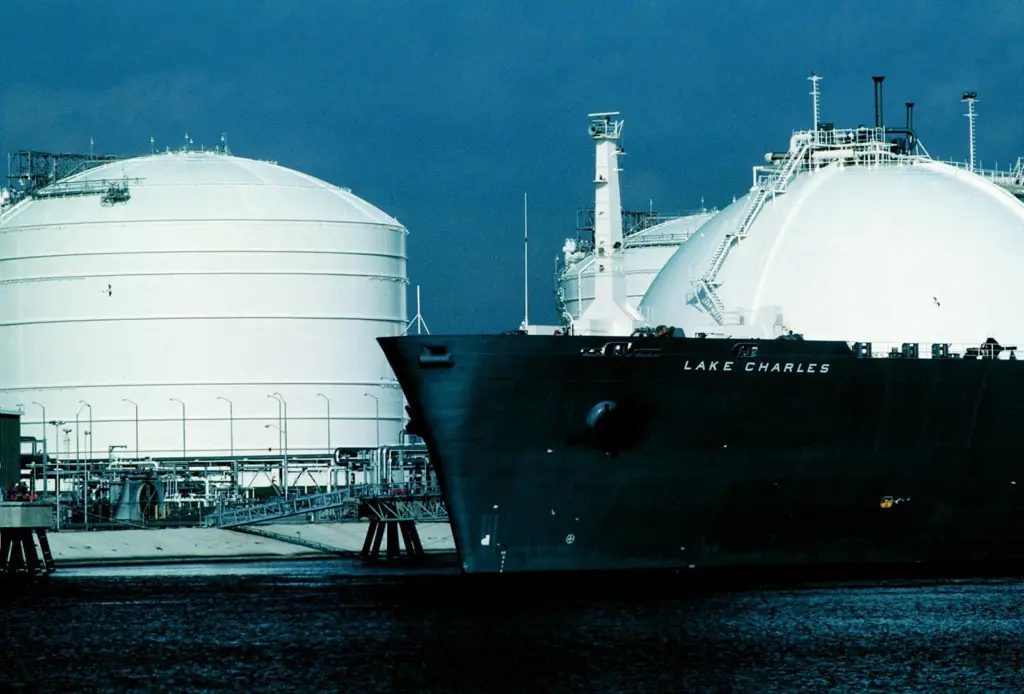
As yet, US LNG imports are still modest – 4.83 mta in 2002 – but they are increasing. The figures for 2003 are not available as yet but for the best part of the year shipments to Lake Charles, Louisiana, the largest US import terminal, were running at the 6 mta level. In addition, cargoes to the Everett terminal in Boston are also increasing and the Cove Point, Maryland and Savannah, Georgia terminals were reactivated in 2003.
Although three of the four existing US terminals are being expanded, this extra capacity will be insufficient to meet with the expected LNG import traffic – the latest estimate of which is put at 40-50 mta by 2010.
THE US IMPORT TERMINAL CONUNDRUM In the last two years proposals for 30 new LNG import terminals to serve the US market have been tabled, and it is thought that about 10 of these will be needed by the end of the decade. Some are located outside the contiguous United States, i. e. in Baja California, the Bahamas and eastern Canada, and will be linked to US customers via pipelines.
The location of terminals outside the US overcomes the problem of securing the necessary regulatory permits and local resident approvals for a new facility on US shores. The US NIMBY (not-in-my-backyard) lobby is a powerful one that many potential importers prefer to avoid. Others have adopted innovative approaches to providing the necessary import infrastructure, and some success has already been achieved. For example, ChevronTexaco has recently received approval for its Port Pelican import terminal. This 5.7 mta floating facility will be moored 40 miles south of Lake Charles in the Gulf of Mexico and will be able to offload, store and regasify LNG delivered by tanker when it comes onstream in 2007. Although a number of offshore LNG export and import terminals have been mooted in recent years, Port Pelican looks set to be the first such facility to be commissioned.
Another recent breakthrough in the Gulf region is the approval by the US Federal Energy Regulatory Commission (FERC) of Sempra Energy’s proposed $700m Cameron LNG receiving terminal near Lake Charles, Louisiana. Sempra was aided in its drive to secure the OK for the first new onshore LNG facility to be constructed in the US in more than two decades, by the fact that the site was formerly an LPG import terminal and some of the necessary infrastructure is already in place. Operations at Cameron are scheduled to commence in 2007.
RECONSIDERING LNG AND MARKET REALITIES “LNG growth in the US depends on supply availability; having the necessary import infrastructure in place; and supplier confidence in the viability and stability of the regulatory regime, ” Martin Houston, executive vice president of the BG Group, told delegates to the US Ministerial Summit Meeting on LNG in Washington last December. The authorities and the general public in the US are waking up to the fact that increased LNG imports are necessary and that this traffic will help ease the price volatility in the energy markets and reduce the cost of their fuel. This is likely to be translated into further approvals for the construction of new US LNG import terminals in the months ahead.
LNG IMPORTING COUNTRIES, 2002<$>Importing Million Part of Change from country tonnes total, % 2001, % Japan 54.25 48.03 -1.35 Korea 17.84 15.80 +10.66 France 10.57 9.36 +18.09 Spain 10.26 9.09 +30.35 US4.83 4.28 -5.19 Puerto Rico 0.46 0.41 +12.51 Taiwan 5.36 4.75 +12.97 Turkey 3.70 3.28 +0.52 Belgium 2.73 2.41 +58.85 Italy 2.55 2.26 -4.17 Greece 0.38 0.34 -4.55 Total 112.94 100.00 +5.89 Source: Oil & Gas Journal
LNG EXPORTING COUNTRIES, 2002 Exporting Million Part of Change from country tonnes total, % 2001, % Indonesia 26.45 23.42 +10.16 Algeria 20.53 18.18 +5.98 Malaysia 14.95 13.24 -3.04 Qatar 13.73 12.16 +9.43 Australia 7.37 6.52 -0.43 Brunei 6.82 6.04 +1.93 Nigeria 5.84 5.17 +1.87 Trinidad & Tobago 3.99 3.53 +41.01 Oman 6.33 5.60 +15.40 US1.33 1.17 -3.37 Libya 0.50 0.44 -14.40 Total 112.94 100.00 +5.89 Source: Oil & Gas Journal
Related Articles
 CONTAINER & CARGO HANDLING
 CONTAINER & CARGO HANDLING
 EQUIPMENT