

ETS: trade diversion risk?
In April 2023 the European Parliament approved legislation to include maritime shipping emissions under the EU Emission Trading System (ETS). In this article Royal HaskoningDHV explores the potential risk of shifting trade routes to ports outside Europe to avoid ETS related costs
ETS IN A NUTSHELL
Under the extended ETS legislation1, shipping companies need to surrender allowances for CO2 emitted by commercial cargo and passenger ships of 5000 gross tonnage (GT) and above. A gradual phase-in will apply between 2024-2026. By 2026 the European Commission will review whether ships between 400 and 5000 GT will also be included in the EU ETS. In addition to CO2 emissions, the legislative bodies agreed to include methane and N2 O in the EU ETS from 2026 onwards.
As further details are still awaited, this Business Briefing focusses on CO2 emissions. Box 1 explains how the ETS allowance system will work in practice.
The proposed ETS obligation differs between CO2 emitted on intra-EU voyages (100 per cent allowances) and extra-EU voyages (50 per cent allowances). An intra-EU voyage is defined as a voyage where both the origin and destination of the voyage are within the EU. If either the origin or the destination is outside the EU, the voyage is defined as extra-EU. The distinction is relevant as it can create a financial incentive for shipping companies to reduce intra-EU voyages2.
Box 1. ETS Allowances in Practice
Under the ETS regulation, shipping companies must, on an annual basis, surrender a quantity of ETS allowances to their administering authority. The quantity of allowances is equivalent to their annual greenhouse gas emissions; each allowance represents one tonne of greenhouse gas emissions. The administering authority is determined based on where the shipping company is registered. Each EU Member State has its own authority. If the shipping company is not registered in an EU Member State, it is attributed to the Member State where it had the highest number of port calls in the two previous monitoring years. As of 2024, the Commission will publish and regularly update a list of shipping companies and their respective administering authority. The EU ETS system sets an absolute limit or ‘cap’ on the total amount of certain greenhouse gases that can be emitted each year by the entities covered by the system. This cap is reduced over time so that total emissions fall.
POTENTIAL IMPACT
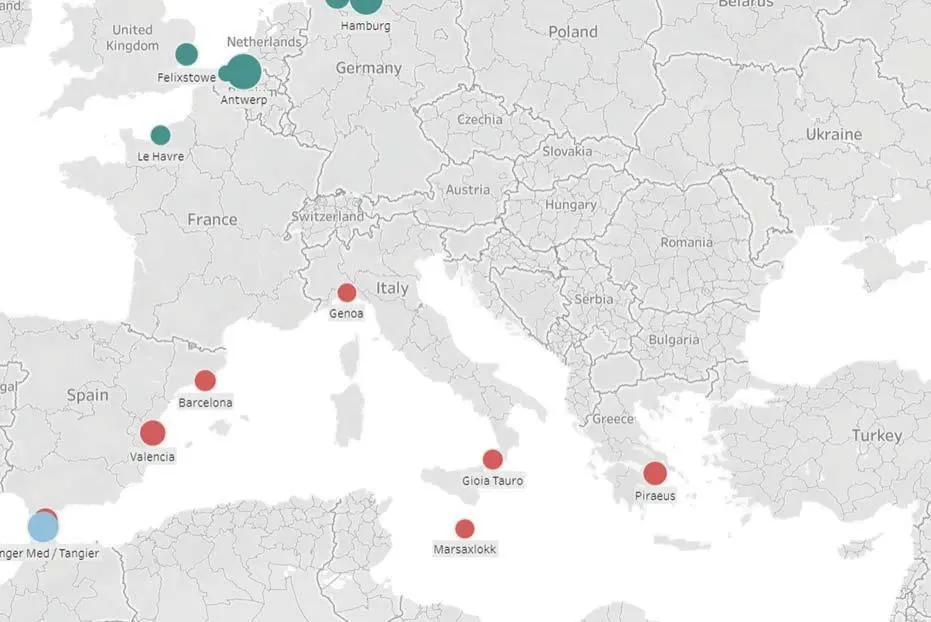
Generally speaking, the lower the geographical distance towards an alternative non-EU transshipment port, the larger the risk of shifting trade routes. The risk that container shipping companies will try to avoid the ETS obligation will depend on different variables including the ETS price, (alternative) fuel prices and the existence of alternative shipping routes using ports outside the EU. Figure 1 provides an overview of large EU container ports and geographically nearby non-EU ports. RHDHV notes that the risk of shifting trade routes towards ports outside Europe is particularly relevant for transshipment activities; import/export cargo is less likely to be rerouted.
COST BENEFIT ANALYSIS
The RoyalHaskoningDHV has setup a financial cost-benefit analysis to assess the financial impact on shipping companies and the risk of shifting trade routes. The building blocks of the financial cost-benefit analysis are fuel costs, charter costs and the expected costs as a result of the obligation to surrender ETS allowances, referred to as “ETS costs”. On the one hand, a shift of a trade route towards a port outside Europe is expected to lead to lower or zero ETS allowance costs. On the other hand, a shift is expected to lead to higher charter costs and fuel costs. RoyalHaskoningDHV has developed its own regression models to estimate charter and fuel costs for different vessel types based on historical data of, among others, Seaweb and Clarksons. The financial cost-benefit analysis is set up for two cases:
- Eastbound (Asia-Europe): 20k TEU ship from Suez to Algeciras (2002 nm)
- Westbound (Transatlantic):10k TEU ship from New York to Rotterdam (3383 nm)
For the sake of simplicity, this study uses the following assumptions:
- The analysis is based on container transshipment;
- The analysis is based on ETS allowance costs after the gradual phase-in period;
- The analysis assumes similar port costs in EU port and non-EU port;
- The analysis takes into account a specific leg of a larger container routing. The effects on the total routing (e.g. Asia – Europe) are not part of this analysis.
RISK OF EVASION
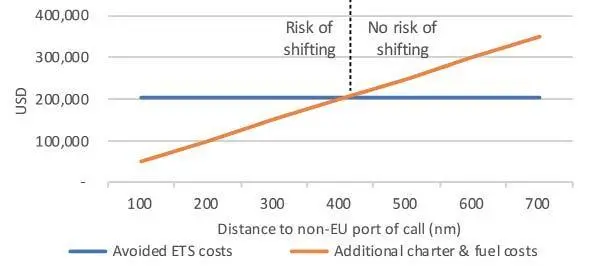
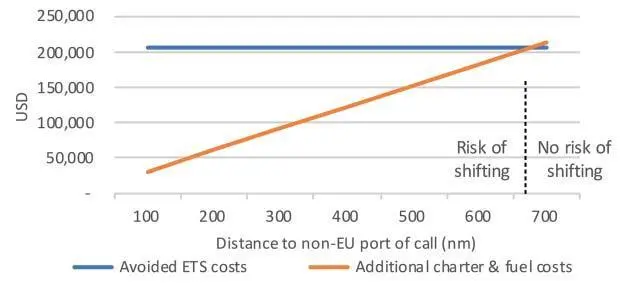
The risk that container shipping companies will try to evade the ETS obligation will depend on different variables including the ETS price, (alternative) fuel prices and the existence of alternative shipping routes outside the EU. Generally speaking, the lower the geographical distance towards an alternative non-EU port of call, the larger the risk of shifting trade routes. RHDHV has estimated the ‘tipping point’ where the avoided ETS allowance costs outweigh the increased charter and fuel costs.
On the Eastbound case (FIgure 2), the tipping point is estimated at a geographical distance of around 400 nautical miles from the original EU port of call. Beyond that point, the additional fuel and charter costs are likely to outweigh the avoided ETS costs.
On the Westbound case (Figure 3), the tipping point is around 650 nautical miles.
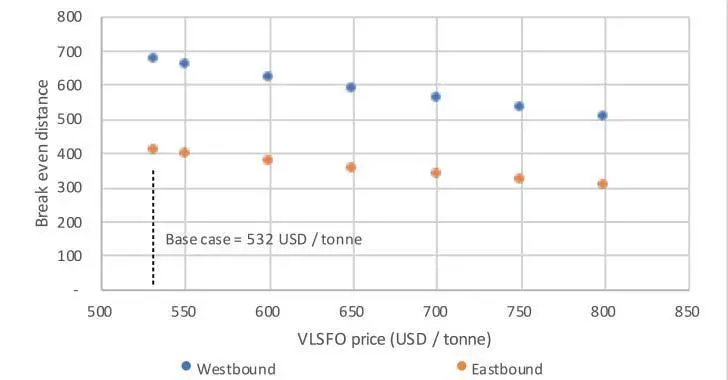
The difference between the Eastbound and Westbound case is due to multiple factors including the distance of the original trade route and ship size assumptions. As expected, the risk of ETS evasion will be higher if the original trade route (e.g. New York to Rotterdam) is longer and the geographical distance towards an alternative non-EU port is lower. A sensitivity analysis (Figure 4) shows that the ‘tipping point’ can decline to around 300 nm (Eastbound) and 500 nm (Westbound) in case of higher fuel prices.
STAKEHOLDER IMPACT
At this stage it is hard to predict to what extent the additional ETS costs will be transferred to customers (i.e. higher cost per TEU) and to what extent shipping companies will intensify their efforts towards clean fuels as a result of the ETS regulation. RHDHV notes that reliable access to alternative fuels will help making the shift, which underpins the importance of initiatives like the Green Corridor between Singapore and Rotterdam. An important takeaway from this analysis is that European regulators should closely monitor potential evasive behaviour to make sure the desired decarbonisation efforts of the maritime sector are to be achieved.
[1] As the legislative text has not been published yet in the EU Official Journal, this Business Briefing is based on the publicly available information about the agreement.
[2] To avoid evasive behaviour, the new legislation includes a specific clause for container ships calling at non-EU transshipment ports (which have >65 per cent transshipment activity) which are located less than 300 nautical miles from an EU port. Although the leg from origin to the transshipment port technically can be considered a voyage between a non-EU port and another non-EU port, still 50% of the ETS allowances are required for this voyage.
Related Articles
 OPERATIONS
 OPERATIONS
 OPERATIONS