![PortStrategy[GreenPort]](https://www.portstrategy.com/wp-content/uploads/2026/09/PortStrategyGreenPort.svg)






GRAIN: A PRICE TO PAY FOR WAR
Andrew Penfold discusses the far-reaching changes triggered in world grain trade by Russia’s invasion of Ukraine. Higher prices with potentially very damaging consequences are a central theme
The fall out from Russia’s invasion of the Ukraine is still far from clear. From the current perspective (mid-April) no end is in sight with destruction and casualties mounting rapidly. What is increasingly apparent is that Russia has resumed its old (Soviet) status as global bogey man number one and that even any kind of tacit economic support is untenable. Some countries are still sitting on the fence but as evidence of barbaric behaviour accumulates this can’t go on.
Aside from Ukrainian victims a much larger risk is emerging that is focused on grain supply. The global implications of this are far-reaching and will hit the world’s poorest. There are implications for the shipping and port sectors.
LOWER VOLUMES, HIGHER PRICES
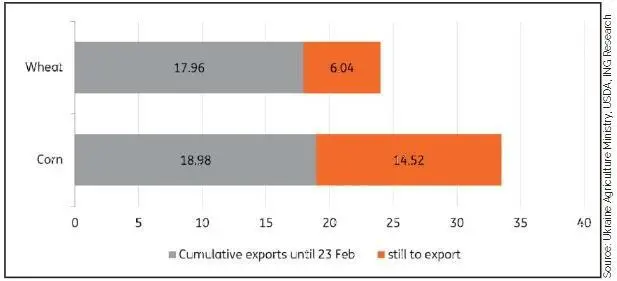
In the 2021-22 crop year the US Department of Agriculture (USDA) placed Ukraine’s maize (corn) production at 42m tonnes, with exports of at least 33m tonnes – around 17 per cent of global supply. There is a similar situation for wheat; the USDA placed production at 33m tonnes with exports of 24m tonnes (a global market share of 12 per cent). The country Is also important in the various oilseed groups. It is far from clear under current circumstances how production will develop in the next few years and – perhaps more importantly – how any export surplus will reach global consumers. Up until the invasion, the Ukraine had already exported around 75 per cent of totals for the current crop year (2021-22), with this suggesting a shortfall of at least 14m tonnes that will fail to reach international markets in the balance of the current crop year (Figure 1), with no certainty about production in 2022-2023.
On a global basis, Russia is even more important with around 35m tonnes of wheat exports in 2021-22 and 4.5m tonnes of maize exports.
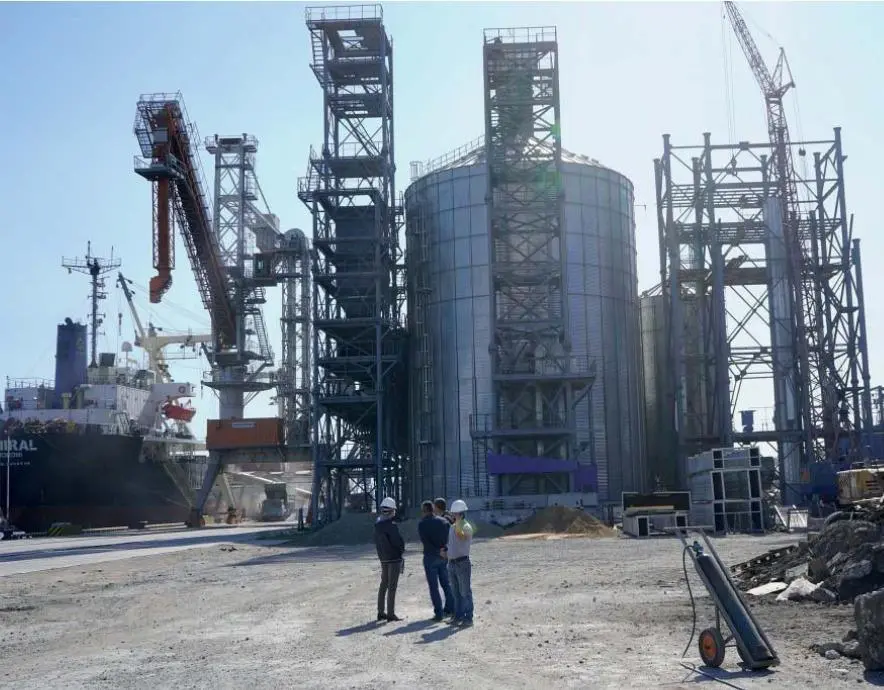
Ukrainian ports are shut, and the Ukraine’s Maritime Administration has confirmed that they will remain closed until the war is over. There is no clear picture on the level of damage to the grain export infrastructure in the ports so a rapid resumption cannot be assumed.
The issue with Russia is focused on sanctions, with purchasers reluctant to commit to additional contracts and banks hesitant to finance Russian commodity deals. These concerns could perhaps ease if a desperate situation emerges for global food supplies, but severe disruption is guaranteed.
There has been an immediate and direct impact from lower exports on the grain market. AgFlow, a crop data company, has estimated that the number of grain bulkers leaving Russian ports was down by 67 per cent at 73 in March, with nothing shipped from the Ukraine.
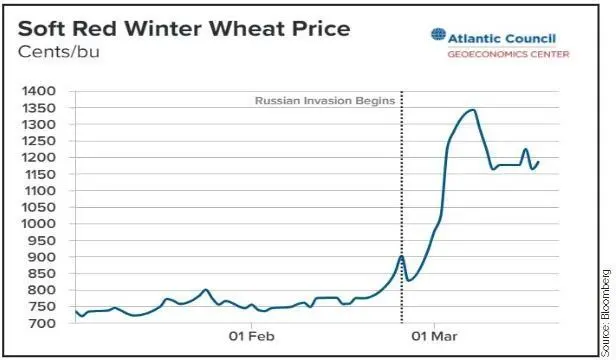
All this is being manifested in much higher grain and oilseed prices with a 70 per cent increase in global wheat prices and maize increasing by 30 per cent in the period since January 2022.
Prices were already high due to Covid disruption but seem set to show even steeper increases because of these supply constraints. The Ukraine and Russian tonnages cannot be simply turned on again and prices will be much higher than anticipated for several years.
SUBSTITUTIONS AND CHANGING TRADE PATTERNS
Some countries are heavily dependent on Ukrainian wheat and this is especially noted in the MENA region (Middle East and North Africa). The relative proximity of these markets to the Black Sea has seen a rapid increase in dependency on shorthaul supplies with port facilities largely tailored to these requirements.
Egypt, Yemen, and Turkey will all need to find alternative supplies and it is important to note the importance of aid-funded wheat in some of these markets. Indeed, it has been reported that some countries (for example, Egypt) have withdrawn from the global market, with this indicating that current prices are simply unaffordable.
The MENA region will be at the centre of the storm. Most of the region relies on wheat imports with spiralling prices leading to political disruption and – at worst – famine. In many MENA countries, basic food prices such as bread are heavily subsidised by the government. When prices rise to an unattainable level, the government can no longer afford to keep prices low, with predictable results.
The level of political risk is enormous with the instability that led to the Arab Spring in 2010 attributed by some directly to higher bread prices. Even if peace were to break out – which seems extremely unlikely – there will be no rapid recovery to the established status quo ante.
It may be that the greatest number of casualties from Russia’s adventure will be those who starve in the Developing World due to a lack of grain delivered at a reasonable price.
China, as the world’s largest grain importer has already ordered its importing agencies to ensure sufficient supplies in the current uncertain market irrespective of price. This can only mean an increased dependency on the US for any shortfalls and China has lifted phytosanitary restrictions on imports from Russia – although the routeing of this source remains problematic. There has also been increased substitution in the oilseeds markets with this especially benefitting the soyabean sector.
Indeed, the only real alternative suppliers with relatively stable climatic conditions are the US and Canada, with both having the potential to increase plantings to meet greater demand and much higher prices. If the current disruption is prolonged increased plantings in other suppliers may help but will not offset loss of Black Sea grains.
PORT IMPLICATIONS
Prior to the early 1990s, the grain trades were dominated by exports from North America and more volatile year-on-year shipments from Australia and Argentina, with Brazil developing its role as a soyabean producer. Demand was focused on the rapidly emerging east Asian economies and increasing shipments of food aid to Africa and other low-income zones. In addition, agriculture support in the European Union was seeing subsidised exportable surpluses. The port infrastructure was optimised for these trades.
Since then, the re-emergence of the fertile Black Earth breadbasket in the Ukraine and Russia has revised the picture with these suppliers moving to centre stage – although export infrastructure has always remained behind the curve. The switch back to alternative suppliers has significant implications for port development. Some specifics:
- MENA (and other) ports will need to be upgraded to berth the larger vessels that will be used on longer haul non-Black Sea trades.
- US (and to a lesser extent) Canadian export elevators will need additional investment. The capacity is there, but total volumes shipped have been below maximum levels for some time. Additional upstream remedial investments are also likely to be needed.
- Greater attention will need to be paid to grain stockpiling. With increased reliance on typically volatile production and export sources, this will focus attention on both Australian and Argentine export terminals.
- The grain aid sector was already increasing, and this will now accelerate. Shipping wheat to draught restricted facilities will need very careful management – and increased port investment.
It is not clear where the funding for all of this will come from, but if political instability is not to avalanche across the globe it will it have to be found. Thankyou Mr Putin!
Related Articles
 INSIGHT & OPINION
 INSIGHT & OPINION
 PORT & TERMINAL NEWS