![PortStrategy[GreenPort]](https://www.portstrategy.com/wp-content/uploads/2026/09/PortStrategyGreenPort.svg)





Is it as simple as 1 + 1 = 2
Container ships are getting bigger, and ports are investing in deeper water, longer quays, and larger cranes. This is a common phrase regularly used across the container industry. But is the equation that simple?
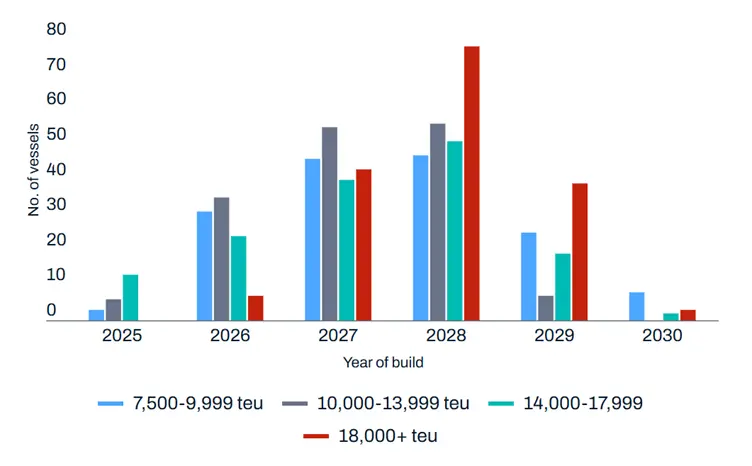
According to well-respected liner shipping information provider, Alphaliner, the current orderbook for newbuild container ships is now in excess of 10 million TEU, the equivalent of over 30% of the current fleet capacity in service on a global basis.
As Figure 1 shows, the majority of the new vessels fall into the category classified as Ultra Large Container Vessels (ULCV), which are 14,000+ TEU in size – though between 2026 to 2029, there is significant growth in ships that are above 18,000 TEU, with around 170 units due into service before the end of the current decade.
Leaving aside the question of whether there is sufficient cargo demand to fill a high amount of new tonnage coming on stream, the ocean carriers are expected to maintain the usual strategy of redeploying (or ‘cascading’) units from primary East-West routes to secondary trade lanes, especially on North-South routes. Aside from laying-up tonnage, a costly and last resort, this is really the only viable option for shipping lines.
Fundamentally, ports will continue to serve the major trunk routes, where there are strategically-placed developed ports – the new Gemini arrangement is perhaps a good example of a specific network of ports used on a major route that is geared around the very largest ships in service.
This is a strategy that works well for a shipping line and/or alliance that has access to largescale, deep-water ports with sufficient capacity in the best geographic locations.
Yet for many parts of the world, the ability to develop new ports is simply not that easy. The West Coast of North America is a good example. The Port of Vancouver (BC) is now gaining traction on its Roberts Bank 2 project that will offer long-term future capacity and allow larger container ships to call – likewise, the North West Seaport Alliance is finishing the T-5 expansion project to condense older and smaller berths with limited infrastructure to be able to cater for bigger vessels. Elsewhere, the Port of Los Angeles has confirmed its intention to develop Pier 500 but it still needs to raise the Vincent Thomas Bridge by 8m to 64.3m to allow ships of up to 23,000 TEU to access terminals along the East and West Basins.
The economics of ULCV’s make sense, assuming the vessel is full and can maintain its schedule integrity, but while shipping lines can incorporate larger vessels into services on a reasonably straight forward basis, the time and investment needed for ports and terminals to gear-up and be ready is more challenging. Extending quay line and dredging for deeper water, let alone finding space for new facilities, is only possible when or IF, all necessary environmental permitting has been successfully completed – and how long does that take?
Container shipping lines may well continue to order bigger vessels and seek to introduce what’s currently on order before the end of the current decade, but whether enough ports, in the right locations, are ready and able to successfully support them is another question. Unfortunately, 1+1 simply does not equal two.
Related Articles
 INSIGHT & OPINION
 INSIGHT & OPINION
 PORT & TERMINAL NEWS