![PortStrategy[GreenPort]](https://www.portstrategy.com/wp-content/uploads/2026/09/PortStrategyGreenPort.svg)





COASTAL AND TRANSHIPMENT OPPORTUNITIES FOR SAUDI
Jeremy Brown reports that when current reforms and the easing of Customs restrictions are complete, the Saudi regulatory framework will be more supportive of port trade development and should allow ports to better benefit from their unique trading position. New coastal shipping options and transhipment opportunities can then emerge.
From a trade perspective, the Kingdom of Saudi Arabia’s location has two marked effects on the country. The first is that it constitutes a unique stepping stone between the sleeping giant of Africa and the future power house of South Asia.
The second is that it provides a land bridge between the Mediterranean and Egypt in the west, and the GCC States and Iraq and Iran in the east. Adding a further dimension, it also sits beside the main-line shipping routes from Europe to Asia.
These factors represent some major opportunities for Saudi Arabia, as well as the states it connects to, particularly Bahrain. For the ports, now in a state of semi privatisation, government owned but with cargo terminals privatised, many opportunities have existed.
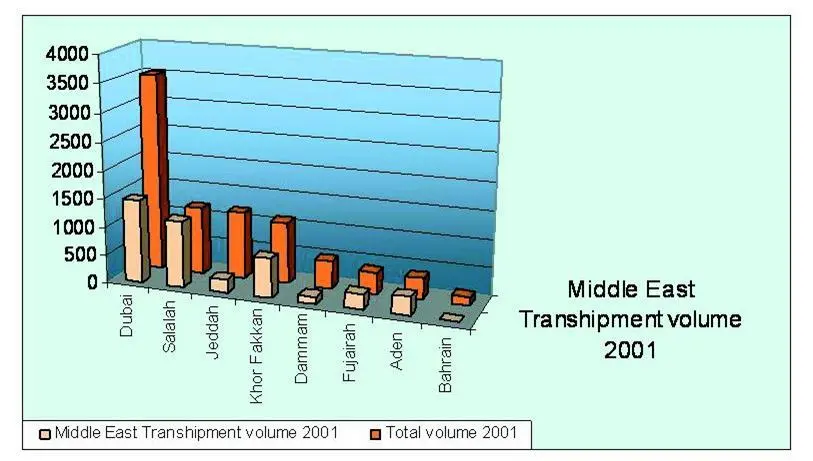
Some still do, but some also have slipped away. The reasons are varied and are being addressed in many areas, but the opportunities are proving hard to grasp – or to reel back in. A glance at the transhipment volumes through the Middle East’s hub ports compared to hinterland cargo shows where the opportunities lay.
In the ports sector, the country is more diverse than an initial impression would suggest. Saudi Arabia has a total coastline of 2,330km, approximately 1,800 of which skirt the Red Sea and 530 face the Arabian Gulf. Officially, there are fourteen ports on the Red Sea and ten on the Arabian Gulf. Of these, many are dedicated oil terminals and military cargo facilities, and only eight are multipurpose facilities dedicated to commercial cargo movement.
The eight that the Ports Authority consider the Kingdom’s main gateways comprise two purpose built ports dedicated to the industrial cities of Jubail and Yanbu, four major and one smaller world class multipurpose ports (Dammam, Jeddah, Yanbu Commercial Port, Jubail Commercial Port and Jizan), and a port predominantly dedicated to ferry services, passenger and ro-ro, at Dibha nearing the Jordanian border and at the mouth of the gulfs of Suez and Aqaba.
UNDER-UTILISATION A FEATURE A feature of the major ports, particularly on the Gulf coast, is underutilisation. These ports have been built without the constraints of land and capital availability, and perhaps with scant regard to the environmental impacts that most port operators face when developing major facilities. For a visitor more used to the bustle and congestion of Asian ports, or the trade driven, high utilisation of European and North American ports, the hectares of hardstand and lines of under-utilised cranes and equipment are an extreme contrast.
Here is potential in plenty – but where is the cargo? The answer lies in the rationale for the ports.
At Yanbu and Jubail, roughly opposite each other on the two coasts, the facilities have been purpose-built to facilitate the development of the new industrial cities. Everything is on a massive scale, mirroring the huge petrochemical and industrial complexes spread across the flat landscape, with their own power and desalination plants. The facilities are also there to handle the commercial, gateway cargo for their hinterlands. However, just down the road, the commercial ports of the two cities are major ports in their own right, competing for the industrial products and, in particular, the containers that move to the terminals at Dammam and Jeddah. Inter-port competition exists, but is hampered by centralised port tariff control and other regulatory constraints, and competitive advantage is distorted by ultra-cheap road transport.
Two commercial ports at the northern and southern extremities of the Red Sea coast are worlds apart. The southernmost port of Jizan, a few kilometres from the border with Yemen, has facilities in plenty but little cargo. A multipurpose port with a substantial container terminal, it serves a rich agricultural and horticultural area, but sees little of this produce, most of which navigates the dangerous, mainly two-lane highway north to the markets of Jeddah and Riyadh. There is significant industrial potential here, and there are signs that the Government and Chamber of Commerce are working towards an industrial city. Meanwhile, the port sees a handful of ships a year, plus its daily passenger /freight ferry link with the potential tourist magnet of the Farasan Islands.
Far to the north, the port of Dibha is dedicated to ferry services linking with Egypt and ultimately Mediterranean Europe. It is small, superbly endowed with a natural harbour sheltered from the extreme weather of this part of the Red Sea, and efficiently managed. It has a busy bus terminal linking it with the Holy Shrine cities of Makkah and Madinah and the Gulf states, along with accommodation, restaurant, car repair and banking facilities. Transloading and cross docking facilities are well utilised, and the waiting areas provide a useful glimpse of the diversity of the trade through here. Vehicles with registration plates as diverse as Oman, UAE and Bahrain mix with TIRplated trucks from Western Europe. Private traders grossly overload their cars and four-wheel drives with rolls of carpets and cartons. It was reported that one private vehicle recently had such a high load on its roof-rack that the slipstream of a passing bus blew it over!
On the Red Sea coast, the proximity to the mainline, round-theworld services adds a further dimension. Despite recent growth and its excellent location, the transhipment volume handled by the Jeddah Islamic Port is minor compared to the other Middle Eastern hubs (see table inset above). Its busy container terminals handle mostly gateway cargo and it has several passenger/freight services to the African coast. It has the potential to service the ports of Africa, short sea steaming time across the Red Sea, and – when the rail link to Riyadh and the Gulf is inevitably built – it has the potential to change the whole dynamics of shipping into the Gulf. In the meantime, it remains the bridesmaid, by-passed by major transhipment opportunity flows.
In addition, whilst not a port as such, the fastest growing gateway is the causeway linking Saudi Arabia to Bahrain, which completes a major land-bridge route that starts in Europe and the Mediterranean and finishes at the Gulf Cooperation Countries (GCC) of Bahrain, the United Arab Emirates and Oman. In fact, it is not true to say that it finishes here, as ferry services and the many smaller ships that comprise the ‘dhow’ trades, serve many ports further east through Iran to Pakistan and the Indian sub-Continent.
Within Saudi Arabia, land links are well developed. Physically, it is a country where highways and rail face no major constraints of terrain, but where distances and the vulnerability of highways, railways and pipelines in a region that faces instability and conflict, cannot be underpinned by coastal shipping without an eight to twelve day transit time between east and west coast ports.
OPPORTUNITIES TO MOVE FROM ROAD TO COAST Road transport enjoys an enviable situation in relation to tax, user charges and regulation that ensures that it is extremely competitive and rail, where it exists, is even more competitive. The road infrastructure, much built since the 1980s with the massive surge in oil revenues, is now showing the signs of overuse by poorly maintained and overloaded trucks and the possibility of moving some of the load off the roads and into coastal shipping must look very attractive. Rail is developing and will expand further over the next few years. However, little moves by coast except some crude oil and refined products.
The overriding impression of Saudi Arabia’s seaports is reserve capacity. When current reform and easing of Customs restrictions are complete, the regulatory framework will be more supportive of port trade development. There are signs that the ports are competing more effectively, and that the privatised terminals are contesting business more fiercely in some ports. Time will tell whether it will be too late to recapture lost opportunities but some port authorities, the Chambers of Commerce and the shipping industry have plenty of ideas and enthusiasm for the task.
Jeremy Brown is a consultant with Australian-based Meyrick & Associates. He has recently been involved in shipping studies in the Middle East, with particular emphasis on coastal and transhipment opportunities in the region. He may be contacted at jeremy@meyrick. com. au
Related Articles
 CONCESSIONS & INVESTMENTS
 TERMINAL OPERATIONS
 PORT & TERMINAL NEWS