![PortStrategy[GreenPort]](https://www.portstrategy.com/wp-content/uploads/2026/09/PortStrategyGreenPort.svg)




DIVERSE ACTION PLANS
The Red Sea is home to a number of different ports. AJ Keyes assesses how ports and terminal operators in the region are adopting different agendas and strategies.
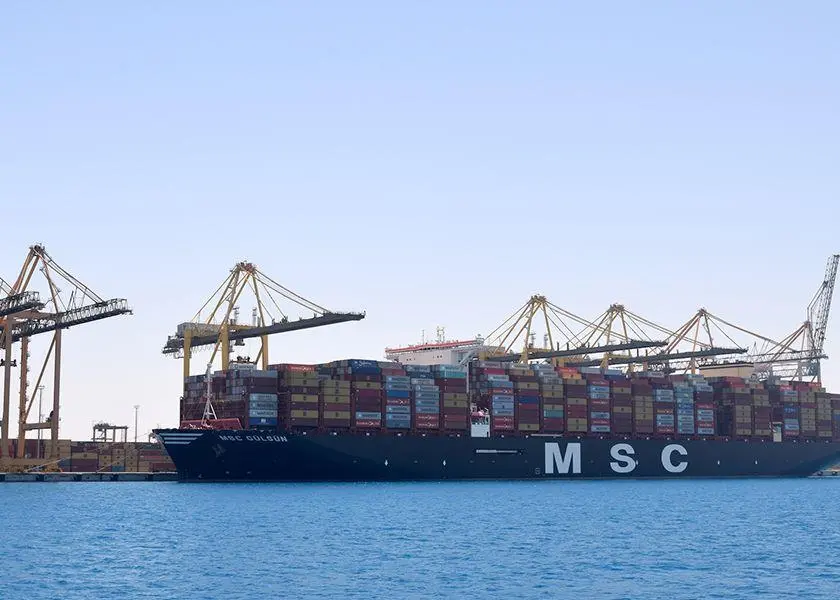
The Red Sea region contains a diverse range of ports, with a number of facilities undertaking different roles. These range from established import-export terminals and transshipment hubs in the Kingdom of Saudi Arabia (KSA) through to a new set of ports in East Africa now coming of age in their own development cycle.
The ports in KSA are Jeddah Islamic Port (JIP) and King Abdullah Port (KAP) and both are well into established investment upgrade and expansion projects, but in comparison the ports in East Africa are only now starting to develop strategies. Berbera, for example, is seeking to improve connectivity to landlocked countries such as Ethiopia, which compares to politically driven factors influencing development dynamics in Sudan and Djibouti.
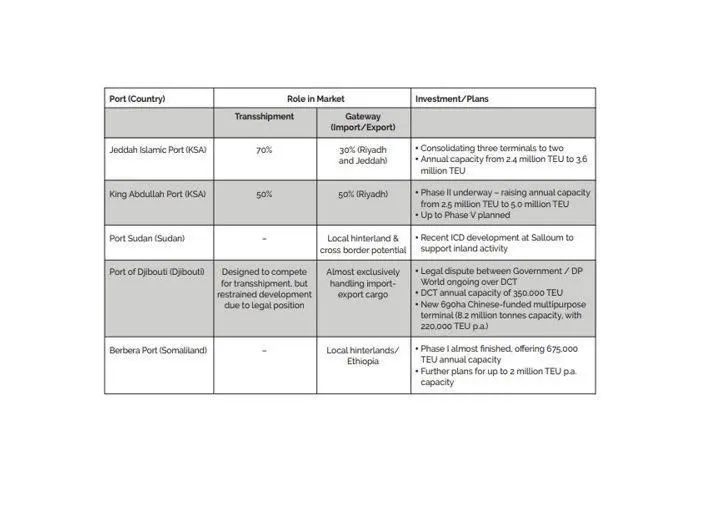
In terms of the current and planned infrastructure for these ports, Table 1 profiles the primary role of the selected main facilities in the Red Sea, along with known or anticipated expansion plans.
NEW COMPETITIVE DYNAMICS
JIP is a key east coast gateway serving the important Saudi Arabian market of Riyadh. However, the emergence of the privately owned-operated facility, KAP, has introduced significant competition in the Red Sea port market. Collectively, these two ports already offer around 7.4 million TEU per annum of container space, but this will rise in the coming years to 14.1 million TEU once build-out plans are completed.
Development plans at JIP are based on RSGT expanding its quay to 1300m, with a further 1000m possible once the former third terminal (North Container Terminal) is removed and the facility reconfigured. At the same time, DP World’s Jeddah South Container Terminal (JSCT) is dredging to 18m depth, has potential for an additional 500m of quay and introduction of automated equipment.
At KAP, its Phase II plans added eight new quay cranes, with a total of five phases included in its long-term masterplan. Transshipment is fuelling increased demand at these two ports. Approximately five years ago, JIP’s transshipment activity represented 35 per cent of throughput, but now the share is 70 per cent. Inland connectivity is also important in KSA.
The US$7 billion Saudi Landbridge project incorporates different expansion initiatives to the existing rail network, including a new 950km direct link from Jeddah to Riyadh and its 8.5 million inhabitants.
BERBERA PROGRESSES – BUT SUDAN STALLS
DP World is making progress at Berbera Port, Somaliland, with investment commitments of up to US$442 million over three phases. Phase I, with 400m of quay is almost complete, with plans already underway to expand the quay to 1,000m, offer 10 ship-to-shore quay cranes and work towards annual capacity of two million TEU.
The operator regards this concession as a “breakthrough” in developing access to landlocked Ethiopia. DP World has also signed a Memorandum of Understanding (MoU) with the Ministry of Transport in Ethiopia to help develop a major international trade and logistics corridor linked to Berbera.
This decision is consistent with its global supply-chain strategy, as identified in “New Kids on the Block“ on p28. This trade corridor will see investment of US$1 billion over the next 10 years and will span ongoing motorway development between Berbera and the Ethiopian border town of Wajaale, construction of dry ports, warehouses, container yards, coldstore facilities and supporting freight forwarding offices. The Somaliland government hopes that Berbera will capture 50 per cent of Ethiopia’s maritime traffic in the future. Currently, about 95 per cent of Ethiopia’s trade goes through Djibouti.
In a December 2018 report, “Port Development and Competition in East and Southern Africa: Prospects and Challenges,” the World Bank confirmed, “….97 per cent of the volumes handled by the port of Djibouti either leave or arrive to the port via truck. This contributes to congestion problems in the city of Djibouti. It is assumed that Djibouti’s share of Ethiopian cargo will decline about 10 to 15 percentage points in the five-year period commencing in 2021.”
This projected drop in throughput is despite the start-up, in early 2018, of the new 753km electrified rail line linking Djibouti to Ethiopia’s capital city, Addis Ababa. Funded by Chinese money and open since 2018, take-up has been slow, according to local sources.
Dagmawit Moges, Minister of Transport for the government of Ethiopia, outlines future aims: “Ethiopia aims to diversify its port access facilities and services to improve its trade corridor access routes. The development of this Corridor will not only meet with the growing demand of Ethiopia’s international trade, but also enhance our nation’s capacity in utilising our existing major corridor both in terms of volume of trade and efficiency.”
Accessing inland markets is also relevant to Port Sudan but volumes are only 40 per cent of the space available. The South Quays offer sufficient water depth (16m) and length (720m), but political uncertainty in the country, plus desire of both Russia and Turkey to continue to seek to develop military bases (such as at Suakin Island) is a cause of concern and hold the potential to influence cargo shippers to use other gateways in preference.
Sudan has also been cited as a potential gateway for Ethiopian cargo. In mid-2020, studies examined the feasibility of constructing a 1,522km rail line between Addis Ababa, Khartoum and Port Sudan, a route agreed by both governments.
However, with the political situation in Sudan remaining challenging it promises to be some time before such a project reaches the implementation stage. Assab, in Eritrea, has also been dubbed as “Ethiopia’s route to the sea” but has since seen developments of a military nature, with the UAE concluding a 30-year lease to use what was the mothballed port of Assab in the past few years, despite reported interested from DP World and other international operators.
DJIBOUTI: WHAT NEXT?
In 2000, DP World and the Djibouti Government signed a 20- year concession to operate the Port of Djibouti, which eventually led to Doraleh Container Terminal (DCT) opening in December 2008. DCT’s good geographic location to eastwest shipping routes, with a minimal deviation offered considerable potential as a transhipment hub.
Following a dispute between the two parties, the government seized back DCT and in January 2020, the London Court of Arbitration ruled that the 2006 concession agreement be restored. Despite the country being governed by English law, and five previous rulings in DP World’s favour, the government is yet to respect the decision and there are no indications that it will do so.
The fact that the government is reporting that the public port reported a 30 per cent increase in 2020 and stated that Djibouti is “doing fine without DP World” gives a strong indication of its future intention not to relinquish control back to DP World.
THE WAY FORWARD
Going forward, Saudi Arabia is putting the building blocks in place to meet long-term gateway and transshipment demand, a sizable platform for development. The ‘new kids on the block’, the East African ports, are basically exhibiting typical emerging nation symptoms with a mix of local and international politics, disputes and military factors influencing development. In a number of cases, for example Sudan, it is clear that a more rational view of business development would serve them well by way to capitalise on modern port development as a path to achieving economic prosperity.
Related Articles
 CONCESSIONS & INVESTMENTS
 TERMINAL OPERATIONS
 PORT & TERMINAL NEWS