![PortStrategy[GreenPort]](https://www.portstrategy.com/wp-content/uploads/2026/09/PortStrategyGreenPort.svg)






Finally Reform
Alex Hughes reports on how Israel is finally wrenching its ports into the 21st century.
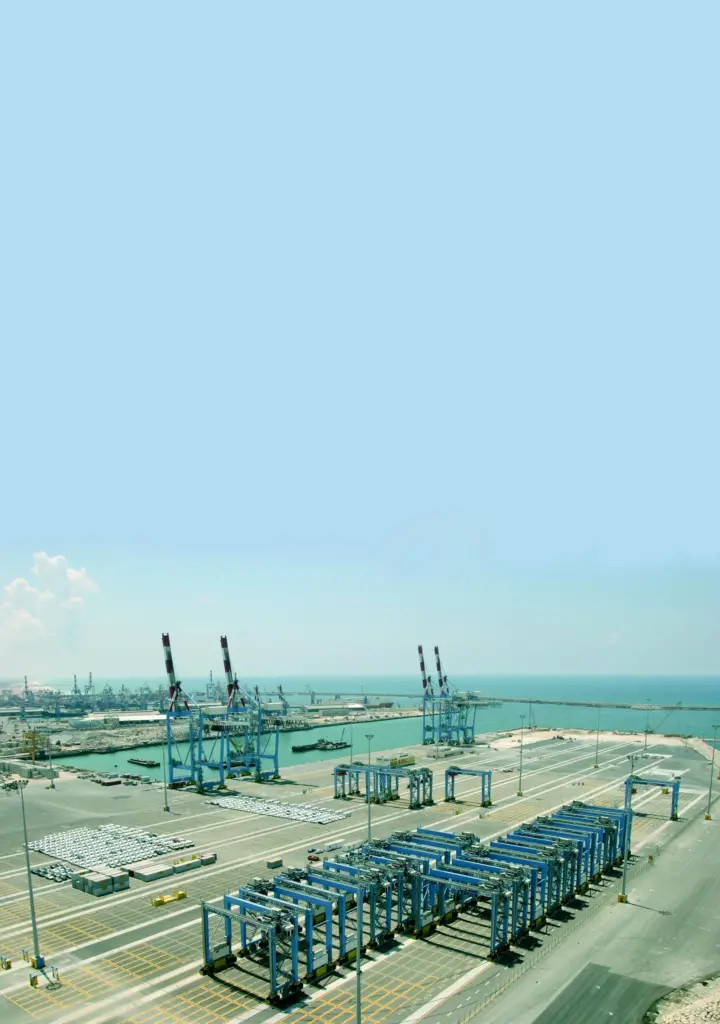
In the second half of 2004, the Israeli parliament, the Knesset, passed the necessary legislation making it possible for management of operations at the country’s ports to eventually be privatised. The now familiar model chosen was that of the state retaining ownership of port infrastructure and private operators taking over day-to-day operation of cargo handling via long term concessions.
However, a decision was taken not to implement this structure all in one go. Instead, separate operational management companies were established in the ports of Ashdod, Haifa and Eilat, while effective ownership was transferred to Israel Ports Development & Assets Company (IPC), whose ceo Amos Ron, agreed to speak to PS.
“The final agreement allowing this change in structure was signed in February 2005 involving port unions, the government and the new port companies, ” explains Ron, whilst stressing that, for the moment, both his own organisation as well as those providing cargo handling services at each of the three ports remains 100% state-owned.
However, the enabling legislation sets out a timetable for the transfer of at least 15% of the port companies to the private sector within five years in the case of Haifa and Ashdod, with up to 49% to be disposed of within ten years. In contrast, the process at Eilat could be taken forward much faster if required.
“While some of the shares will initially go to the workers themselves, in the longer term, the government will dispose of any remaining equity it holds to interested buyers, ” says Ron.
As for future new infrastructure development, this will be taken forward by IPC in conjunction with private sector partners, either as BOTs or concessions. Nevertheless, as is currently the case, no state finance will be available for port development. Infrastructure has to be paid for either by revenue generated by the ports themselves or through the issuing of loans.
Asked whether the introduction of private sector structuring of the existing port companies had had any tangible results so far, Ron emphasises that there definitely has been a gradual improvement in the level of service quality. “Despite the fact that all three port companies remain government owned, this does not mean that the management team in each of them is not interested in competing.
“Granted, currently the competition is not that fierce, but there have been some significant marketing efforts and changes to service provision which have resulted in some liner companies switching calls from one port to another, ” observes Ron.
A second notable effect has been that of new lines moving their hub operations from other regional ports to those in Israel based on improved competitive conditions. Israel is increasingly being seen as a transhipment option for distribution of containers throughout the Middle East, which is having a positive impact on throughputs.
SHIFT IN MINDSET “There has also been a shift in the mindset of the workforce which now has incentives to offer improved customer service. This is the result of becoming more involved in the whole process of running a terminal rather than just working for yet another government-controlled company, as was the case in the past. As a result, all industrial disputes have been eliminated which is a new phenomenon in Israel, ” Ron points out. (Two days after Ron spoke to PS, a wildcat strike broke out at Ashdod with stevedores downing tools to protest that the port company was not honouring financial agreements. ) He, nevertheless, remains far from complacent, stressing that the next reform has to be that of the tariff structure which is currently too inflexible to provide the leeway port managers need to attract more business. Tariffs, which are set centrally, are not designed to maximise revenue per se, but rather reflect a policy of crosssubsidisation of services.
“We hope that the government will complete its ports modernisation programme by the end of the year by revising the existing tariff structure. This would be based on a maximum set tariff which should then allow private companies to offer customers discounts.”
In terms of investment, IPC is presently implementing a US$3bn development programme and will have to raise US$1bn of this externally. Ron explains that ROI in large infrastructure projects is calculated over a period of 30 years.
Interestingly, when charging the port companies to recoup investment that IPC has made in its terminals, a fixed 7.5% interest rate is charged. Ron comments that the port companies are seeking to reduce this with any subsequent reduction offset across a broader range of services that IPC provides.
As for the port companies themselves, the financial performance of the two largest ports – Ashdod and Haifa – has been very much in line with expectations, says Ron. Last year, for example, Haifa posted a profit of US$23m and Ashdod US$6.39m.
“Haifa is able to generate much higher revenue because it’s the largest container port in Israel and open seven days a week. In contrast, Ashdod is a general cargo port which only works 5? days a week and therefore has less revenue and profit potential.”
In fact, while Haifa’s results were a reflection of its improved efficiency, its bottom line performance did not reflect future costs associated with a series of new quays currently under construction.
Furthermore, for Ashdod to boost its figures it will have to improve its efficiency, stresses Ron, if it is to keep up with Haifa and remain competitive.
In terms of traffic, while neither 2001 nor 2002 were particularly good for Israeli ports, since then growth has averaged 6% a year in tonnage and 8% for container traffic.
“In the longer term we don’t expect general cargo traffic to grow but we absolutely anticipate major growth in containers. Our emphasis at IPC will therefore be on building new box handling facilities, ” says Ron.
In January, the then chairman of IPC, Dan Tichon, quit his post in what was a very public falling out with ceo Amos Ron. Writing to the transport minister, Tichon commented that a recent internal audit had discovered “serious irregularities”, which he believed would cause “systematic damage to the company’s criteria”. Worse still, state supervisory authorities to whom he had reported the findings of the audit were seen as “collaborating with special partisan interests to prevent this situation from being corrected”. As a result, he felt obligated to resign as chairman.
Commenting on this, Ron concedes that there had been a significant difference in approach towards the privatisation of the country’s ports between himself and Tichon. Indeed, just three months after the initial restructuring had been completed, Tichon had gone to the press to denounce the process as a failure.
“We concluded that he was probably against the reform process and was demonstrably opposed to taking some of the more dynamic risks needed to drive this whole process forward. In order to end what had become a comfortable state monopoly, I, as ceo, knew that radical changes had to be made. Had I not implemented these we would not now be where we are today. He, as chairman, wanted to do everything by the book which would have meant at the end of the day we would have reformed nothing, ” concludes Ron.
Related Articles
 CONCESSIONS & INVESTMENTS
 TERMINAL OPERATIONS
 PORT & TERMINAL NEWS