



Onwards and upwards
No looking back for Middle East terminals that continue to climb the capacity ladder, reports Alex Hughes
The recession that forced a large scale re-think on many port expansion plans around the world failed to dent Middle East optimism and a number of terminals added new capabilities throughout the downturn.
One terminal that has stoically avoided the maelstrom was Khalifa Port Container Terminal. The Abu Dhabi Terminals-managed hub handled around 650,000 teu in the first six months of this year, equivalent to growth of 25%. Overall traffic is expected to reach 1.2m teu by the end of the year, up around 20% year-on-year.
Chief executive Martijn van de Linde explains: “The majority of this is coming from increased exports and transhipment traffic. Imports are rising too – in the region of 5%-6% – but this is more in line with the overall increase in GDP.”
This boom in export boxes has involved such sectors as steel, aluminium, polymers, pharmaceuticals and food processing. The aluminium sector in Abu Dhabi exports more than one million tons annually, while polymers are due to double to 4m tons in 2015. This helps explain KPCT’s own export growth, which is forecast to continuing its double digit growth over the next few years.
In terms of transhipment, Abu Dhabi now has feeder links serving the upper Gulf, other emirates and also India.
“We first started developing transhipment traffic last year based on the fact we were getting calls from larger vessels,” says Mr van de Linde. “Transhipment currently accounts for 16% of total traffic, which we predict will increase to around the 25%-30% mark.”
In phases
KPCT, which first opened for business two years ago, will eventually have capacity of 2.5m teu in its first phase development. At the moment, it is limited to 2m teu, although the extra 500,000 teu will be achievable once three new quayside gantry cranes are put into operation. This will then be followed by Phase II, for which civil works are already in place.
“Phase I capacity will be sufficient to see us through to 2019-2020, while Phase 2 should allow us to handle up to about 5.5m teu,” he says.
Khalifa port will eventually assume responsibility for the majority of cargo handling once undertaken by Mina Zayed. Containers were the first to be moved, to be followed shortly by ro-ro and then bulk and general cargo, leaving just cruise ships to call at the old port.
With alongside draft of 17 metres, KPCT can accommodate the largest vessels afloat, although the terminal currently only handles 14,500 teu ships; however, additional dredging to the turning basin will ensure that larger vessels will encounter no manoeuvring difficulties.
All together, KPCT has nine operational cranes and another three on the way. These are super post-panamax units whose dimensions have been slightly revised. They are now a couple of metres higher to avoid any air draft issues with any part loaded 18,000 teu ships that could be higher out of the water.
Growth plans
Israel is also adding capacity. Two new ports – Bayport and Southport – are to be built to reflect projected trade needs. Although they share a common basin with existing ports at both Haifa and Ashdod, they are geographically distinct and have separate road and railway access.
Chief operating officer of Israel Ports Company, Dov Frohlinger, notes that government policy is to promote competition in the provision of services. “The new facilities address this policy and create a framework that deals with long-term traffic demand growth, factoring in the latest shipping trends.”
It might seem strange to site the two new facilities relatively close to existing ones, however Mr Frohlinger notes: “As part of our 50-year master plan, we explored alternative locations along our 200 km Mediterranean coastline, but found them challenging due to environmental and urban planning factors. The new projects provide a more sustainable solution and have been designed with a better balance between economic and environmental considerations.”
At present, Israel Ports is in the middle of a tender for the operations of the two new facilities. Four global operators have been pre-qualified to participate in the bid stage, which is, in itself, of interest, since existing container terminals are operated by state-owned port companies. These are also slated for privatisation at some time in the future. The competition authority has forbidden the existing operators to bid for the new facilities, although is not against the creation of deeper draft berths, which would enable them to compete with the new facilities.
Deep goals
Indeed, both Bayport and Southport have been designed to accommodate EEE class vessels with 17.3m water depth at the quayside. First phase capacity will be in the region of 800,000 teu, with further phases bringing the potential to over 1.5m teu.
As for the implementation timetable, Mr Frohlinger points out that construction should commence at Ashdod later this year, with the first phase becoming operational in 2020-2021. A subsidiary of China Harbour & Engineering is building this facility at a cost of $900m. Work, which will take seven to eight years to complete, will include construction of a 1,050-metre pier north of the existing port, as well as a 2,800-meter breakwater.
Meanwhile, two Israeli groups are competing for the construction contract at the second port at Haifa. This will take five to six years and involve building a 1,100-metre pier and a 3,100-metre breakwater at a cost of $1bn.
On whether the new ports will be unionised, Mr Frohlinger notes: “The new facility operators will recruit employees who will be free to decide if they want to unionise in accordance with the law (or not). I expect that the global operators will bring their vast experience to the project and shape optimal working conditions.”
Transhipment switch
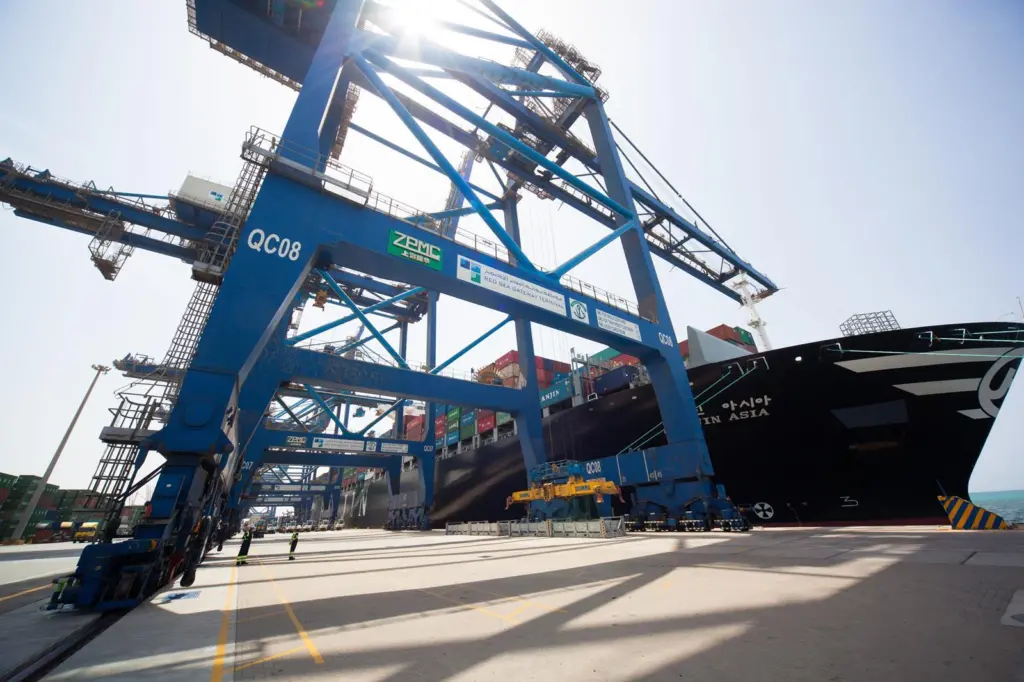
Meanwhile, Saudi Arabia’s Red Sea Gateway Terminal, located at Jeddah Islamic Port (JIP) has experienced a switch from transhipment traffic to more import-export boxes. In the first six months of this year, it handled around 655,000 teu, down 5.6% over the corresponding period in 2013. According to RSGT managing director, Soren Hansen, this is due mainly to a decrease in transhipment volumes.
“The gateway (local) volume ratio has improved to 60% for 2014 year-to-date, compared with 56% in 2013,” he says. “We are expecting to end the year meeting our budget of 1.4m teu; an increase of around 2% from previous year. As a result, we are forecasting an increase of 10% in second half traffic compared with the second half of 2013, which is again down to an increase in local traffic at JIP.”
Mr Hansen notes that RSGT currently has enough capacity to serve the main customers calling at the terminal. However as a committed long-term investor in JIP, RSGT says it is actively exploring all options to improve overall conditions, which includes expanding its capacity and equipment capabilities in the near future.
As for hinterland development, RSGT serves all Jeddah’s import-export needs, with the city of Jeddah going through a tremendous growth rate in recent years, something which is expected to continue into the future.
“RSGT is well placed and prepared to serve the expected cargo growth going through JIP.”
Gateway volumes
So far this year, transhipment has made up 40% of cargo throughput, although this has declined somewhat as shipping lines have shifted transit volumes to other ports while increasing import-export boxes.
With a dedicated dual-way channel with a draft of up to 16.5 metres and a 650m turning basin, the terminal has no limitations on the size of vessels it can accommodate. “As a result, we can accommodate vessels of over 16,000 teu,” says Mr Hansen.
In terms of productivity, RSGT currently averages 124 moves per hour across the berth, which is an improvement of 51% from the average performance of 2013, when it was just 82 moves. This, notes Mr Hansen, has been the result of adding more yard equipment, which was first put into operation in 2013, as well as continuous efforts to raise the skill of the manpower and improve teamwork. Indeed, should the stowage plan so allow it, the terminal is prepared to commit up to eight quayside gantry cranes per deep sea vessel call.
On the land side, average truck turnaround time is in the region of 25 minutes, broadly similar to the figure posted in 2013.
Significantly, the Kingdom of Saudi Arabia is investing heavily in equipping the country with a modern rail network. Upon completion, rail and ports will be able to operate together, cutting the travel time for freight, says Mr Hansen. “This will benefit both RSGT and JIP in providing a land connection for cargoes by railway from the eastern side of Saudi Arabia and its neighbouring countries, which will further increase cargo volume going through Jeddah.”
KPCT revels in self-automated success
Khalifa prides itself as a semi-automated terminal. The yard is fully automated in terms of stacking cranes, as is all movement of boxes from the yard to the trucks and from the yard to the vessel buffers. However, horizontal transport from the container yard to quay cranes is not automated.
“We were building the first semi-automated terminal in the Middle East, so we weren’t exactly sure what impact the climate would have,” says KPCT’s Martijn van de Linde, “As a result, we were reluctant to become a completely automated terminal. We also needed the right expertise on board and also the right capabilities, which meant having to train everybody ourselves.”
That said, provisions for making the switch to a fully automated terminal have been incorporated into the overall design.
When KPCT first embarked on its automation path there were a number of unknowns as to how automation would behave in a very hot and dusty environment. Despite this, KPCT has successfully made use of lasers, cameras, OCR, differential GPS and RFID. There have, says the terminal, been no major problems, although some small issues connected to IT and technology have become apparent. These have, predictably, been mostly climate-related, with dust particles interfering with accuracy of cameras and laser systems.
“Altogether, these have been very minor considerations,” says Mr van de Linde. “In fact, they have been so insignificant that they have not impacted at all on our customers. However, while we have a semi-automated terminal, we also pay someone to clean the cameras every week!”
The outcome at KPCT can be attributed to the highly cautious approach adopted by the management in tuning and optimising the system before going live. A whole year of real life-cycle testing was undertaken before it officially opened for operations.
In terms of technology providers, Konecranes provided the automated yard cranes; the control systems for the automated yard cranes and also for the quay crane control system came from TMEIC; the TOS is Navis SPARCS N4; while Dalosy ME was contracted to supply the automated gate system, shuttle positioning system and quay crane OCR equipment.”
Khalifa posts productivity highs
Khalifa Port Container Terminal’s current productivity of between 30 and 35 gross moves per crane hour compares favourably with the 27-28 moves achieved when it first opened. Every year since then, it has improved by at least three moves per hour.
“Our aim is now to reach at least 40 moves per hour, which was the figure we originally agreed upon when planning the port,” says the terminal’s Martijn van de Linde. He adds that the aim is to achieve a minimum berth productivity of 150 moves per hour, with an upper limit of about 200 moves.
“In general, that means each crane undertaking 300 moves, so on average we would deploy five or six gantries per vessel to achieve that.”
There are, however, important caveats. A lot depends on call size and stowage plans, as optimisation of the latter is key to allowing the maximum amount of gangs to be deployed.
But high productivity is not simply restricted to the quayside; truck productivity is also pushed, with 12 minutes averaged from OCR gate in to OCR gate out.
“Twelve minutes is a lot better than we ever dared dream of,” says Mr van de Linde, who concedes that the original KPI was 30 minutes. He attributes the exemplary performance to an extremely good experience with the automated gates.
“It took a while for the trucking community to change its way of working, but now that it has, everybody had reaped the benefits. Instead of trucks making two or three trips a day, they can now make five.”
Haulage companies make an appointment online before coming to KPCT, which schedules visits in two-hour slots. Picking up an import container involves first clearing it online with customs and also paying terminal charges. Trucks can then simply drive through the gate, with OCR registering the number plate and ID, thereby allowing the truck to go straight through the AFC, where the yard system should have already positioned the container. The RFID on the truck interfaces with yard equipment, which then quickly loads the container on to the chassis, allowing the truck to leave.
Related Articles
 PORT & TERMINAL NEWS
 PORT & TERMINAL NEWS
 PORT & TERMINAL NEWS