


Opening doors
A temporary lift of sanctions is raising hopes for a boost in Irans port and terminal business. Aiden Grange reports
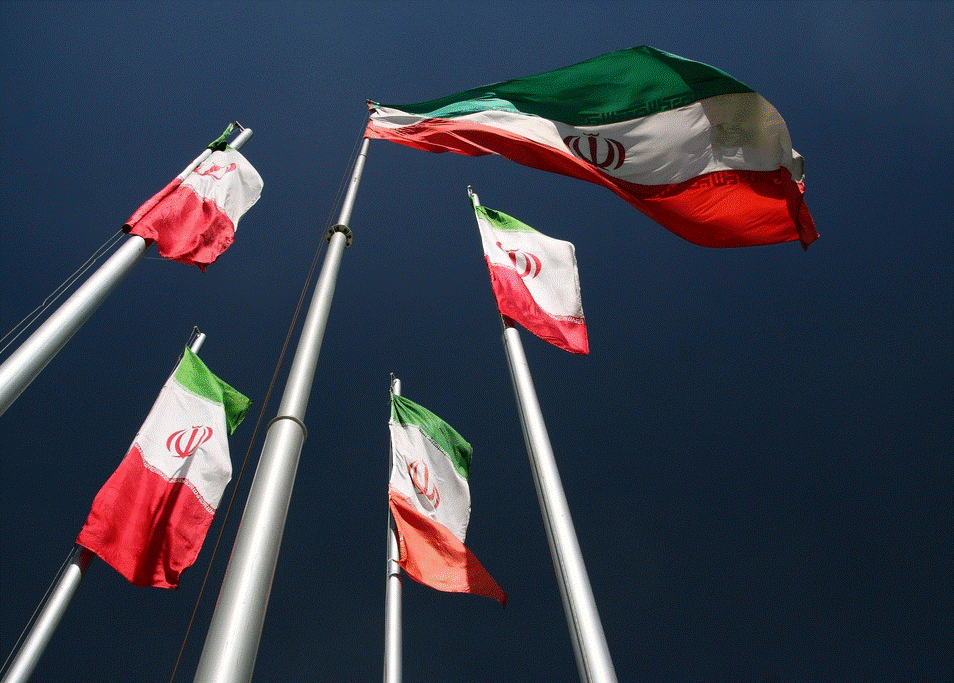
Trade and investment sanctions imposed by the western world on Iran have eased this year, creating significant opportunities in the Middle East’s most populous nation and one of the world’s largest oil producers.
While it is not completely “open doors” and many liner shipping companies have not resurrected direct calls at Iranian ports, cargo volumes have picked up.
In addition, investor sentiment has improved. There is increased talk of foreign businesses ploughing money into Iran, of port and cargo transit corridor development projects being rekindled and of Iran fulfilling a bigger role in international trade.
But projects are likely to take time to come to fruition as will a sustained recovery in Iran’s economy. Since 2011 when the United Nations Security Council imposed tougher sanctions in an effort to halt its nuclear programme, the nation’s GDP has fallen. In 2013, it was down more than 12% to $369bn while in mid-2013 oil exports had plummeted from 2m barrels a day to just 700,000 barrels a day.
Meanwhile, Shahid Rajaee, the country’s largest container port, suffered a haemorrhaging in cargo volumes. Prior to 2012 when sanctions were tightened, over 20 liner companies, including Maersk Line, CMA CGM, Hanjin Shipping Co, Wan Hai Lines and NYK, regularly called at the port. Most withdrew.
Tidewater Middle East Co, the port’s main terminal operator, was served with sanctions because of its ownership links with Iran’s Islamic Revolutionary Guard and was not able to conduct business with international companies.
In 2013, Shahid Rajaee handled just 1.76m teu, down almost 24% on the 2.32m teu handled in 2012 and over 40% shy of the more than 2.8m teu processed in 2011.
Sanction lift
The so-called Joint Plan of Action (JPOA) between the P5+1 (China, France, Germany, UK, plus the US, and Iran), which was agreed towards the end of 2013 and implemented on January 24, 2014, provides hope for the future.
However, it is extremely limited and highly targeted in its scope. In return for Iran agreeing to curb its uranium enrichment activities, the JPOA suspended sanctions on Iran’s petrochemical exports, on imports of goods and services for its automotive manufacturing sector and on the import and export of gold and other precious metals.
Initially scheduled to run until June, it has been extended until November 24, 2014. But there is some uncertainty as to what might happen should a deal on Iran’s nuclear proliferation programme not been reached with P5+1 before this deadline.
The opportunities in Iran are clear to see: Iran is home to an estimated 80m people; its gross GDP is the third largest in the Middle East region; it has a reasonable transport network; Iran has a burgeoning industrial base, especially in the petro-chemicals sector; two-way trade with Asia is strong and expanding; and plenty of overseas investors – especially those living in China and India – are keen to get involved.
Modernisation
While the Iranian Government continued to upgrade its main ports during the sanctions, private and overseas investment is being sought for future modernisation, equipment purchasing and construction programmes. Foreign capital is also deemed necessary for improving transport links between the country’s southern Gulf ports and those located on the Caspian Sea in the north.
At Shahid Rajaee, the state-controlled Ports and Maritime Organization of Iran (PMO) has invested heavily in new equipment last year, installing 18 ship-to-shore gantry cranes and more than 40 RTGs as part of the port’s phase two container terminal development programme. In addition, the authority completed the construction of new railyards boosting the port’s intermodal rail capacity by over 300,000 teu a year.
This year has seen PMO appoint new managers for the port’s T1 and T2 container terminals, albeit on a temporary basis (one year), while tender proposals are finalised and companies invited to bid for long term operating contracts. It is hoped the process will be completed by March 2015.
PMO is also focusing on phase three of the development programme. Port Strategy understands this will involve the purchase of at least eight more super-post panamax STS cranes and four RTGs and raise Shahid Rajaee’s container handling capacity to 7.5m teu. Currently, it stands at about 6m teu.
At the port of Bushehr, PMO and other agencies have agreed to develop a free trade zone and logistics centre while the port at Chabahar, which is located in Sistan-Baluchistan province and close to the Pakistan border, is to be upgraded with Indian money.
Shipping lines based in Asia have expressed the strongest desire to restore services to Iran with Taipei-based Wan Hai Line scheduling direct calls with a 6,000 teu class vessel at Shahid Rajaee within a Far East/China service in July.
COSCON, Hanjin Shipping and Hyundai Merchant Marine are now all discussing with PMO a return to the port, but in all probability waiting for that JPOA end of November deadline and what will happen to that temporary reprieve on sanctions.
Regional strength
The intra-regional trades have been posting strong growth with the governments of Iran and Oman planning to set up of a joint shipping line to capitalise on this business. It is understood that any service would link the Omani ports of Sohar, Musandam and Shinas with Iranian ports at Chabahar, Shahid Rajaee and Bandar Imam Khomeini.
But the majority of Iranian cargo continues to be transhipped over regional hubs in the UAE (Jebel Ali – Dubai and Khor Fakkan – Sharjah) and Oman (Sohar and Salalah). Ali Jahandideh, deputy director of PMO, attributed this to the “lower quality shipping services provided at Iranian ports”.
He said: “This issue has disinclined large shipping lines to operate at our ports and we must work to change this.”
Considerable investment is also planned in the road and rail sectors as the Iranian Government seeks to both bolster the nation’s role as a transit nation for central Asia and beyond and encourage trading and investment partnerships with them.
A recent visit by Iran’s president Hassan Rouhani to Astana (Kazakhstan), for instance, to meet his counterpart, Nursultan Nazarbayev, resulted in various co-operative agreements being signed in the energy and transport sectors. Overall, the intention is to expand trade between these two countries fivefold in the next few years.
Rail links
Particularly significant will be the completion of the Kazakhstan-Turkmenistan-Iran railroad (KTI Rail) that will allow Kazakhstani importers and exporters a faster link to Iran’s southern ports and with it enhanced access to world markets.
The 900km railroad will connect Uzen in Kazakhstan with Gyzylgaya, Bereket and Etrek in Turkmenistan and Gorgan in Iran where it will connect with the latter country’s national network.
According to railroad sources, KTI Rail will have the capacity to transport up to 5m tonnes of Kazakhstan’s exports a year, but with the possibility of increasing this to 12m tonnes a year .
This is just one of several plans that are in place as the Government raises capacity of its various transit corridors by up to 25% over the next five years. Currently, Iran’s transit carrying capacity is estimated to be in the 12.5m to 13m tonne range.
Russia is also viewed as an opportunity, particularly since it banned the EU, North America, Norway and Australia from supplying it with various fresh food products. “Iranian merchants are seeking to boost their export of fruits and vegetables, fish and poultry to Russia,” said Mir-Aboutaleb Badri, deputy director of Iran’s Trade Promotion Organization, who recently visited Russia.
“We are planning to use our maritime transport capacity in the ports of Amirabad, Noshahr and Astrakhan, as well as road capacity in the Sarakhs Special Economic Zone for this purpose.”
Clearly opportunities are opening up in Iran, but uncertainty will prevail until those sanctions are ended for good.
Indians to help develop Chabahar
The Indian Government has approved a joint venture between Jawaharlal Nehru Port Trust (JNPT) and Kandla Port Trust (KPT) that will invest more than $85m in the Iranian port of Chabahar. The deal agreed with PMO also includes a 10-year operating contract, with options for an extension.
Specifically, JNPT and KPT will within the next 12 months purchase equipment for two berths at the port, managing one of the facilities as a dedicated container terminal and the other as a general cargo/multipurpose operation.
The PMO recently completed its dredging programme at the port and ships of up to 80,000 dwt can now berth safely. With JNPT and KPT on board, PMO is well on its way to increasing the cargo handling capacity of Chabahar from 2.5m tonnes a year to 12.5m tonnes.
Strategically, for the Indians, Chabahar is well positioned as a transit gateway for Afghanistan, Turkmenistan, Uzbekistan and other central Asian republics, nations that India’s traders are keen to do more business with.
Related Articles
 PORT & TERMINAL NEWS
 PORT & TERMINAL NEWS
 PORT & TERMINAL NEWS