![PortStrategy[GreenPort]](https://www.portstrategy.com/wp-content/uploads/2026/09/PortStrategyGreenPort.svg)






Ports surf the growth wave
As the UAE and other regional players steer their economies onward and upward, their ports are racing to keep up with demand, both actual and forecast. Nick Elliott reports.
In many ways DP World (DPW) epitomises what is going on in the Gulf generally. Spawned from Dubai Ports Authority, the rebranded terminal operator hasn’t been out of the headlines since bagging CSX Terminals just a year ago. Its current bid for P&O Ports shows the same spirit: that of a small-nation player with a long history of maritime trade, eager to make a name for itself. As with Hong Kong and Singapore, so with Dubai, it makes perfect sense to leverage that savvy in shipping and trade onto the global stage. And there’s no time like the present. Dubai’s economy grew 16% in 2005, higher than China’s.
Whilst high oil prices have fuelled many UAE initiatives at home and abroad, those initiatives have taken on a life of their own attracting a continuing inflow of foreign capital. Today, free zone activity, traditional industries (cement, building materials, aluminium, chemical fertilizers and foodstuffs top the list), tourism, sport and media businesses are what make the emirate tick; there are plans to create industrial incubators to stimulate further industrial growth.
Oil and gas production has been the mainstay of the UAE’s economy and will remain a major source of revenue long into the future. Proven recoverable oil reserves are currently put at 98.2bn barrels or 9.5% of global crude proven reserves. As for natural gas, the proven recoverable reserves are estimated currently at 5.8bn cu m or 4% of the world total. This means that the UAE possesses the third largest natural gas reserves in the region and the fourth largest in the world. At the current rate of utilization, and excluding any new discoveries, these reserves will last for over 150 years.
The UAE’s two principal container terminals are Dubai’s Jebel Ali/Port Rashid complex recording around 6m TEUs last year and Gulftainer’s Khorfakkan Container Terminal (KCT) with close to 2m.
As a sign of what is happening in Dubai, Gulftainer’s other terminal at Sharjah is an interesting barometer having grown from 100,000 to 230,000TEUs in three or four years and now welcoming new direct services. “Customers are transferring business from Jebel Ali, says marketing manager Keith Nuttall. “Why? Because the UAE is growing, and that growth is expanding beyond Dubai. We’re not talking about a sea change but we are certainly talking about an impact.”
Dubai’s meteoric growth has been pushing up prices. Rents have risen by up to 60% and the cost of consumer items has increased by as much as 40%. Road congestion is another headache. “Traffic throughout the UAE is a nightmare particularly on the Jebel Ali/Sharjah corridor, ” says Nuttall. The road runs through central Dubai and is a principal economic artery which gets choked to the point that it has to be closed for several hours a day. “Truckers who five or six years ago could do three or four trips a day can now only do one which in turn is pushing prices up.”
So businesses are spreading out within the UAE to cheaper locations now the infrastructure has become so congested. This is taking them to Sharjah and elsewhere where land and warehousing is cheaper. Carriers are getting the message too and increasingly transferring at least some calls away from Jebel Ali to Khorfakkan, says Nuttall. “We now have two services direct from the Far East in to Sharjah from Maersk and APL. That has never ever happened before. This is because the volume of business in this area now justifies the direct call.”
Construction of the new 400 m long deepwater container berth at KCT is nearing completion and two new Liebherr super post-Panamax gantries are being commissioned. One-over-five RTGs and additional terminal tractor multi-trailer units are also being acquired.
DPW MAPS ITS FUTURE Back in Dubai DPW has given some clues as to its future strategy in recent weeks. It says the merger will facilitate delegation of authority and responsibility enabling them to act quickly; better leveraging of resources, processes and synergies; and the ability to meet a wider set of customer needs. The company also says it will continue to concentrate on regional growth, as well as expanding in global markets.
To date, within the region, DPI/DPW has secured regional deals in Abu Dhabi (Mina Zayed), Fujairah and Yemen (Aden); this on top of a major expansion at Jebel Ali.
The plan to increase Jebel Ali’s capacity by 5mTEUs at a cost of US$1.3bn sprung from an unexpected surge in volumes in 2002. The new capacity is being added at the second ‘north’ terminal and should be ready by July 2007.The port handled 6.4m TEUs in 2005 while capacity is around 9mTEUs. Current growth (22% in the first half of 2005) suggests they will reach maximum capacity three years from now. “We were not prepared to wait until 2008 and see ourselves choked, ” says Jamal Majid Bin Thaniah, DPW’s vice chairman.
Optimism stems from the 2,200 tenants at the Jebel Ali Free Zone (JAFZA) who are forecasting strong growth in their regional distribution activities over the next 10 years, whilst new tenants are being signed up. Additionally, consumable imports catering for the booming tourist industry plus the envisaged growth in a well-healed expatriate business community to fill the astonishing property developments mushrooming offshore Dubai, are providing further justification for the expansion. The project is forecast to result in a 20% increase in transhipment and a 16% rise in imports and exports.
Jan de Nul is carrying out dredging and reclamation works at the new terminal while tenders have been issued for 12 super postPanamax quay cranes and 22 RMGs, with the total equipment and software package valued at US$180m. Kalmar, Noell, ZPMC and Liebherr have all been invited to bid.
And a short distance to the west the rationale behind DPW’s Mina Zayed management services agreement is to create a gateway port for lines wishing to hub Upper Gulf traffic. Time will tell whether Mina Zayed’s proximity to Dubai’s own terminal complex will impede or enhance such plans. Certainly Mina Zayed together with the expanded Jebel Ali will give them plenty of flexibility when accommodating its customers. Under the terms of the agreement signed last August, DPW takes over management of operations at Mina Zayed which will be integrated into its global network and marketed jointly with other ports such as Jebel Ali and Rashid. Both Abu Dhabi and Dubai ports will be sharing operational resources, know-how, marketing and technical facilities.
Meanwhile, Abu Dhabi is to develop another US$2.19bn port and industrial area at Taweelah between Abu Dhabi city and Dubai. “The new port and industrial area will be an essential part of the current strategy aimed at stepping up the pace of development in the economic, industrial and tourism fields, ” says Sheikh Mohammed bin Zayed Al Nahyan, son of the ruler.
Khalifa Port and Industrial Zone as it will be known, will include a container terminal and berths for bulk cargoes. The zone is being developed through public-private sector partnerships and will play a major role in the generation of traffic for the new port.
KGL TO DEVELOP NEW EMIRATES BOX TERMINAL Kuwait and Gulf Link Transport Company (KGL) has signed a US$45m deal with the government of Ras Al Khaimah to develop and manage the Rana container terminal for a period of 21 years at the port of Mina Saqr. The facility, which will have a capacity of 300,000TEUs, is expected to be completed in January 2007 and will be equipped with three new Liebherr ship-to-shore gantry cranes. The terminal will later be expanded to accommodate 3mTEUs.
APMT MOVES ON BAHRAIN In another recent development, APM Terminals has won a 25-year contract to operate Bahrain’s main port, Mina Salman, and the Khalifa bin Salman Port in Hidd which is under construction. APMT, outbidding Hutchison Port Holdings (HPH) in the final round, will operate the concession in partnership with Yusuf Bin Ahmed Kanoo of Bahrain.
Morten J Lund of APMT says: “The way the arrangement is structured is that the concessionaire will initially operate Mina Salman. Operations will then be transferred to the new Khalifa bin Salman Port when it is completed.”
Work on the US$530.8 m Khalifa bin Salman Port is expected to be completed this year. The main port work was awarded to a consortium comprising Great Lakes Dredge & Dock Company, Nass Contracting and Nass-Murray & Roberts Joint Venture, each responsible for carrying out the dredging work, rock and revetments and construction of the quay wall respectively. The terminal will house two 300 m container berths with 18 m depth alongside.
PROGRESS IN KUWAIT With its ruler’s long illness Kuwait’s the decision-making process had become somewhat protracted and with his death there are tentative hopes that things will move ahead more briskly in the future.
Gulftainer has provided a consultancy team at Shuwaikh with a remit to ensure the terminal operates at maximum output and the Kuwait Ports Authrority (KPA) is hopefully soon to announce tenders for eight new gantry cranes for both Shuaiba and Shuwaikh.
There are also plans to deepen the approach channels at Shuwaikh.
“We have been saying for some time that there are two perfectly good ports here which just need enhancing with investment, ” laments Gulftainer’s Keith Nuttall. “The KPA is edging forward and we are confident decisions will be made soon for both the gantries and dredging for both ports.”
Meanwhile the position has already improved considerably. “In 2005 Shuwaikh handled some 550,000TEUs – 18% more than 2004 and 200-300% up on just two or three years before that, ” says Nuttall. “Container ship calls have risen by 25% so working closely with the KPA we have improved efficiency considerably.”
OUTSIDE THE STRAITS DPW’s campaign continues outside the Straits of Howmuz. At Fujairah the operator now has a 30-year concession to operate the container terminal. This they say provides a potential base for a single customer to use the port as a hub for both Gulf and South Asian containers. DPW stressed though that it did not intend to loosen its control over the port. Container traffic is currently negligible.
And further round the Arabian Peninsula, Yemen has awarded DPW a contract to operate and develop the Aden and Ma’alla container terminals. Between 10-20% of the port operating company’s capital will be offered in a public subscription after completion of a berth expansion project. The terminal has two 350 m container berths and handles around 300,000TEUs a year.
Ma’alla Terminal, which includes a free zone, has two 187.5 m berths and handled around 40,000TEUs a year.
BIG PLANS IN OMAN At Sohar HPH has taken a 65% stake in the Oman International Container Terminal (OICT), with the Omani government and Steinweg of the Netherlands. (The Sohar Industrial Port Company (SIPC) is a joint venture between the Omani government and the Port of Rotterdam, the landlord manager of the Port of Sohar. ) According to Jamal T Aziz, deputy ceo of SIPC, the new container terminal will give further impetus to investments in secondary industries using the petrochemicals and metals that will be produced at Sohar.
The new terminal will be operational in the second quarter of this year initially with a 520 m quay and a depth alongside of 16 m.
Equipped with post-Panamax quayside cranes, ‘Terminal B’ – as it will be called – will boast a capacity of around 800,000 TEUs.
Terminal C, with a quay length of 970 m and 18 m alongside depth, will be created in the next phase of OICT’s development.
With a capacity of 1.5 m TEUs, it is due to be completed by end 2007. Conceived in the third phase is Terminal D, which will augment capacity by a further 3.5 m TEUs, boosting OICT’s total terminal handling capacity to 6m TEUs a year.
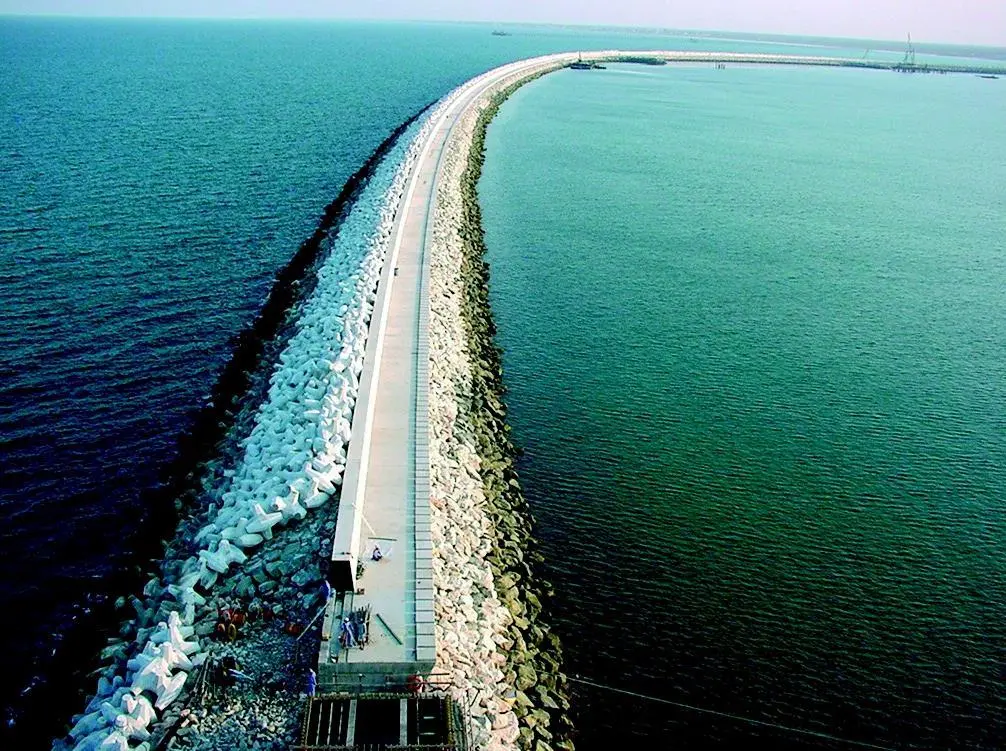
Meanwhile at Salalah a US$262m expansion is underway to provide two additional berths of 18 m depth and a new breakwater of 2.85 km. The expansion will take capacity at the port to approx 4.4m TEU. It handled 2.4m TEUs 2005, predominantly transhipment cargo. AP Moller is principal shareholder with 30% in Salalah Port Services Company. The Omani government, local companies and pension funds hold 60%.
But Salalah is also promoting import/export cargo and developing its general cargo terminal by upgrading and replacing existing equipment with new MHCs, additional paved storage areas, speculative warehouse units and bulk handling facilities. The port has undertaken studies for conveyors, silos and other industrial facilities that will be developed when required. And of course it will play an important role in the development of the nearby free trade zone.
MEGA-PORT FOR SAUDI Saudi Arabia is planning a new US$26.6bn port city on the Red Sea north of Jeddah. Central to the project is the creation of a 2.6m sq m Millennium Seaport “similar in size to the world’s top 10 ports, such as Rotterdam, ” it is claimed by Dubai governmentowned main contractor, the Emaar consortium.
The King Abdullah Economic City will be located on a ‘greenfield’ desert site with some 35 km of shoreline. “With its strategic location on the Red Sea and the instant access to key cities within Saudi Arabia, ” states Emaar, “the port will have a designated area for light industry and logistics and be a natural platform for onward movement of goods to Europe, Africa, Asia and beyond.”
Related Articles
 CONCESSIONS & INVESTMENTS
 TERMINAL OPERATIONS
 PORT & TERMINAL NEWS