



Shifting sands
The focus of Middle East port development has shifted from transhipment capacity to addressing specific domestic bottlenecks. Karen Thomas reports
Until the global financial crisis, ports around the Arabian Gulf coast were scrambling to add new capacity. Between 2003 and 2008, rising oil prices flooded regional government coffers with surplus revenues. Oil-rich governments started to invest heavily in infrastructure, real estate and industrial projects.
While Iraq and Yemen – one ravaged by civil war the other by poverty – lagged behind their neighbours, the region’s wealthiest states went on a spending bonanza over the last decade. Most started to channel their hydrocarbon wealth into ambitious industrial and infrastructure projects.
A new middle class emerged in Bahrain, Kuwait, Oman, Qatar, Saudi Arabia and the UAE, the states that form the Gulf Cooperation Council (GCC), and across the Straits of Hormuz in Iran. The oil boom boosted citizens’ spending power, with regional consumers increasingly brand savvy and hungry for fashionable goods.
Half a decade of increased consumer spending boosted imports of new cars, foodstuffs, electronics and luxury goods. This dual growth, from government and consumer spending, saw GCC ports achieve compound annual growth of 13% between 2004 and 2008, according to Drewry Shipping.
But many of the region’s ports struggled to cope with that growth. Hub ports including Jeddah and Jebel Ali suffered bottlenecks during peak periods, while gateway ports struggled with ageing infrastructure and shortages of equipment.
Many, including the Port of Jeddah in Saudi Arabia, Bahrain’s Mina Salman, Doha Port in Qatar, Mina Zayed in Abu Dhabi and the Kuwaiti Port of Shuwaikh, were built in the 1960s and 1970s on prime inner-city sites. Increased traffic brought tailbacks and delays. Urban congestion worsened, further restricting port operations.
And so regional governments, port authorities and terminal management companies pledged to build new capacity. In 2008, Kuwait Financial Centre estimated that GCC ports had invested $38.2bn in expansion and would spend a further $38.8bn in 2009. But not all those projects came to fruition.
First, the global financial markets crashed. Then, in autumn 2009, Dubai’s real estate bubble burst. Shockwaves from both hit port development across the region. 2009 brought a marked slow-down in regional port expansion. Banks stopped lending. Across North Africa and the Middle East, an estimated $2bn worth of port development projects slowed or were quietly cancelled.
In the GCC, these included Jebel Ali and Salalah. DP World stalled plans to start buildng the third terminal at Jebel Ali, a $1.01bn project to raise capacity to 30m teu by 2030. Jebel Ali had launched terminal two in spring 2009, increasing port capacity to 14m teu a year.
APM Terminals put the brakes on plans for three new berths, including dedicated space for APL, to raise Salalah’s capacity from six to ten million teu. For now, Salalah has capacity to spare. Chief executive Peter Ford expects static throughput at 3.5m teu this year. Now, the three new berths will be common user, Mr Ford says.
Inside the Straits of Hormuz, Arabian Gulf ports have enough capacity to meet short-term demand. In April 2009, APMT opened its new transhipment hub in Bahrain. The $340m Khalifa bin Salman Port brought a million teu of new capacity to the inner Gulf.
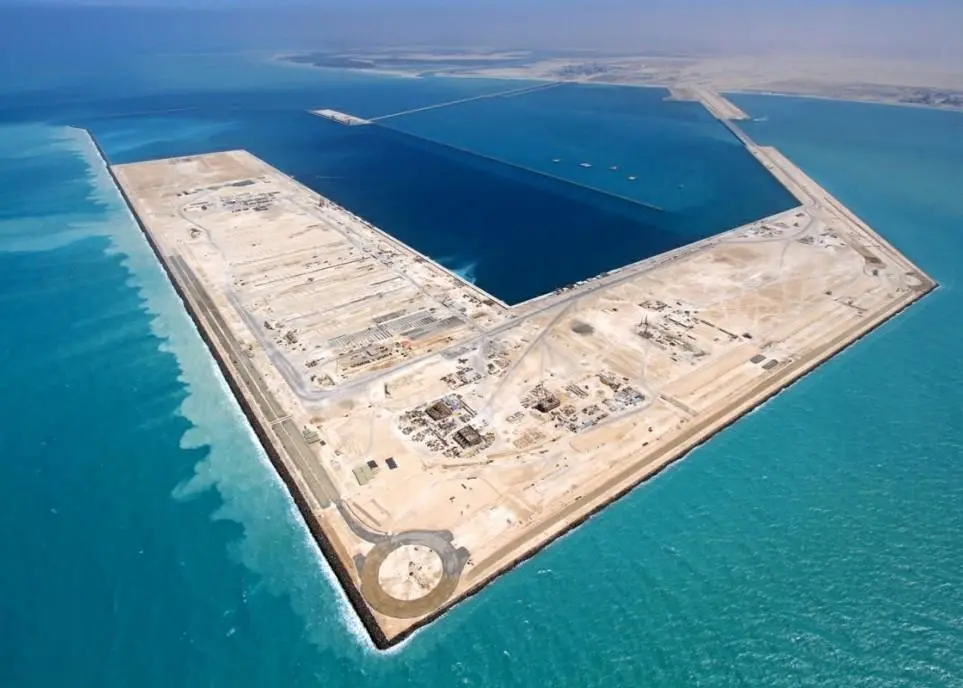
And Abu Dhabi is pressing ahead with its own megaport, half way between Dubai and the federal capital. Khalifa Port will handle cargo for Khalifa Industrial Zone Abu Dhabi (Kizad) from September 2012.
This additional capacity in Bahrain and forthcoming capacity in Abu Dhabi means that the inner Gulf has gone from transhipment bottlenecks three years ago to surplus hub capacity today.
Regional container traffic – in the Arabian Peninsula, Iran, Israel and the countries of the Fertile Crescent – fell from 32m teu in 2008 to 31m teu in 2009, but recovered to 34m teu in 2010, according to Drewry. However, Drewry forecasts that continued growth will need the region’s ports to start adding transhipment capacity by 2015.
For now, though, port development is concentrating on key markets that lack domestic capacity. While DP World has not cancelled Jebel Ali terminal three, it has yet to announce when the project will move forward. The fastest expansion is in neighbouring states whose infrastructure is less developed.
Along with Abu Dhabi, where construction has continued despite the downturn, Qatar, Iran, Saudi Arabia and Iraq urgently need to upgrade their ports to support economic growth and industrial development plans.
Abu Dhabi’s Khalifa Port is a flagship project, its start-up phase valued at $1.9bn. Due to open in autumn 2012, it will handle an initial 2m teu and 8m tonnes of general cargo. With a 16-metre draft, it is built to handle the largest modern container ships.
Khalifa Port will underpin Abu Dhabi’s industrialisation plans. Kizad is a combined port and industrial project worth $7.2bn to year-end 2012. Its anchor tenant is Emirates Aluminium (EMAL), but the plan is to attract clusters of metal factories, pharmaceutical firms, glass production, logistics and distribution companies.
Phased expansion will increase Khalifa Port’s capacity to 15m teu and 35m tonnes of cargo by 2030. If it achieves its long-term goals, Kizad will be an industrial zone two-thirds the size of Singapore, exporting Abu Dhabi-made goods to the Middle East and worldwide.
Rising from reclaimed land half way between urban Abu Dhabi and Jebel Ali, Khalifa Port will bring significant new capacity to the inner Gulf. However, Abu Dhabi Ports Company (ADPC) is at pains to stress that Khalifa Port is positioning itself as a gateway for domestic volumes, and not as a hub, at least to begin with.
In 2010, Abu Dhabi’s existing inner-city port Mina Zayed handled 530,000 teu. When Khalifa Port opens next September, that traffic will shift to the new port. Abu Dhabi Terminals (ADT) will handle the transition. It inherited the Mina Zayed port management contract from DP World last year, and will operate Port Khalifa until 2013.
“We see Khalifa Port as a destination port, and will start with a straight transfer of our existing business,” says ADPC chief executive, Tony Douglas. “We aren’t starting at point zero; we will probably handle an initial 730,000 teu in our first year.”
Another country whose infrastructure is underdeveloped compared with its economic clout is Qatar. The country controls 13.5% of the world’s known reserves of natural gas, according to BP’s 2010 Statistical Review of World Energy and is ramping up its liquefied natural gas exports to Europe and Asia.
Recession has not bypassed Qatar altogether – some of its more speculative real estate projects lost their nerve – but the economy is booming. Qatar National Bank expects the country to achieve real GDP growth of 17% this year. Doha also needs to upgrade the country’s infrastructure in time to host the 2022 World Cup.
Qatar Petroleum has invested $1.7bn in modernising the northern port of Ras Laffan, the country’s main industrial port and point of export for LNG cargoes. But the country’s main commercial port lies on Doha’s vast Corniche, an area better suited to hotels, shopping centres and leisure outlets.
The Port of Doha’s shallow draft excludes all but the smallest feeder craft and its inner city location adds to Doha’s chronic rush-hour congestion. At peak times, trucks queue to enter and leave the port. This further restricts port performance. Qatar Port Authority has long mooted a new commercial port but the project made little progress until this year.
In March, however, officials signed an $880m initial construction contract with China Harbour Engineering Company. The contract aims to complete the port basin, quays and breakwaters within 54 months. Observers say the port will not to meet its planned 2014 start date, however, and will now open in 2016.
Doha New Port will cover a 20km site north of the Port of Mesaieed. The project is valued at $7bn on completion in 2023, comprising a new container terminal, ro-ro berths and general cargo port, to develop in phases. Initial plans reported launch capacity of 2m teu a year; now, Drewry expects it to start with 1m teu.
Both Abu Dhabi and Qatar are awash with hydrocarbon revenues and are poised for a new era of industrial growth. And both Port Khalifa and Doha New Port form part of the two countries’ broader infrastructure investment to support industrial diversification and growth.
Industry watchers who spoke to Port Strategy feel that Qatar’s growth prospects are exciting – but that the country needs to build up its home-grown volumes, rather than develop transhipment capacity.
“Qatar does not generate much containerised cargo at the moment,” says Drewry consultant, Abhishek Tandon. “As with Kizad the plan is to develop downstream industries: Qatar aims to generate 500,000-700,000 teu monthly. But Qatar it has not attracted much inward investment yet.”
Related Articles
 PORT & TERMINAL NEWS
 PORT & TERMINAL NEWS
 PORT & TERMINAL NEWS