



Gassing up
LNG leads the way in the huge projects in Washington and Oregon, writes Martin Rushmere
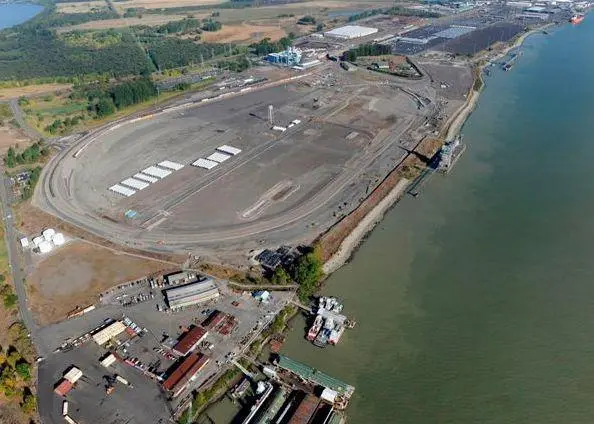
The boom in shale oil and fracking in the US continues to be the main driver behind the huge surge in planned projects at West Coast ports, with a mix of new and revived plans from 10 years ago.
In the last two months a crude oil terminal and a propane/butane plant have been announced, while federal approval has been given for a LNG export terminal and the developers of another crude oil terminal have got to the point of formally applying for federal and state permits.
At least $17bn is ready to be spent on LNG plants, piped in from North Dakota and other Mid-West states, and crude-by-rail. Latest figures from the federal Energy Information Administration show that national crude oil reserves increased by 15% in 2012, the biggest jump since 1970, to 33bn barrels.
All the developments are in Oregon and Washington and all are at small ports that, except for one, rely on bulk and breakbulk for their revenue. Their combined cost far outstrips the much touted container terminal expansion at the country’s two biggest ports, Los Angeles and Long Beach.
Another $2bn is available for coal terminals, although these have less chance of becoming reality because of greater environmental concerns. One has already been abandoned and another is in limbo.
The technology for the liquefaction and storage is well established – ports on the Gulf Coast are the leaders in this. But new safety measures are being taken to allay community and environmental concerns.
Labour loss
The capital intensive nature of these types of projects means that there is less involvement of the ILWU trade union and hence less chance of labour strife. Which is probably why the union is opposing some of them. “We are disappointed that the union has opposed our project,” says one port official, “but this will not stop us from going ahead.”
Lost in the debate and arguments over the best sites and areas for projects like these is the availability of land. Developers have opted for ports with unused industrial land, or those where owners/tenants want to get out. The big advantages are the cost of getting the site and official zoning permission for industrial use.
Analysts see the site availability issue as a big reason for small ports to be considered – plus the fact that sites in big ports are much more expensive.
Looming just as large for all projects are the political, state and federal laws and regulations that have to be negotiated – one developer has compiled 10,000 pages to deal with all the permits involved and answer questions from the public.
“Developers must now consider these unquantifiable costs, in money and time – particularly on lawyers – on top of the physical costs,” says Paul Bingham, economics practice leader at CDM Smith. He sees these aspects almost as a separate industry to be tackled. “Is it worth it, having gone through all the project costs? The demand is there certainly for the product.”
Mr Bingham says there is a possibility of a new business model, where a cluster of energy projects can be developed in one location. “Perhaps developers can piggyback on approval given to a project and then build other plants that conform to the same conditions and restrictions.”
Money talks
The costliest projects are each billed at about $6bn-$7bn. Oregon LNG, which leases 96 acres from the Port of Astoria, puts its cost at about $6.5bn. With an export capacity of 1.3bn cubic feet a day, the design of the project has changed little since being first announced. Gas will be sent by pipeline from the Bakken fields in North Dakota and liquefied at the site before being loaded on to vessels.
That said, the dollar amounts being bandied about by developers are viewed with scepticism by some critics. They allege, privately, that costs are being inflated to shift attention from the environmental problems and influence local communities and state authorities to give their support.
Jordan Cove has been on the books since 2004 and in April took a very big step forward with an export licence from the Federal Energy Regulatory Commission for 6m short tons a year in exports to non-Free Trade countries (those with which the US does not have trade and import tariff agreements), which will be the main customers. Exports have to start within the next seven years.
Industry observers say that the benefit to the nation’s chronic balance of payments problems has been the deciding factor in allowing Jordan Cove and others to go ahead.
Jordan Cove’s ultimate owner, Veresen of Canada, wants to pipe the gas from Canada’s Western Sedimentary Basin and/or fields in the Rocky Mountain regions of Colorado and Wyoming. Canada’s National Energy Board at the beginning of the year approved exports to the US.
The cost is close to $8bn, split between $1.7bn for a 300km pipeline to connect with an existing gas line in Oregon, and $5.8bn for a power station/liquefaction plant, terminal and associated marine facilities.
The facility was originally designed as an import terminal, under different majority owners who now own 25%, and changed to an export terminal when the shale market heated up.
Local links
Coos Bay’s chief commercial officer, Martin Callery, says Veresen saw the importance of involving the local community early on. “Immediately after applying to FERC for an export licence they conducted focus group meetings to keep the public informed of what LNG involves and what the project entails.” These have been followed by regular community meetings.
Sophisticated support has been harnessed to promote Jordan Cove. A nominally independent group has sprung up, using the services of a federal lobbying group in Washington, DC.
Calling itself a ‘grassroots’ organisation, (implying that money comes from individual members) it has been helped by a $15,000 donation from the developer and has enough money to buy television and radio airtime.
Industry observers see this type of tactic as becoming a bigger trend in the maritime industry and note that such practices are common in the oil exploration sector.
On the rails
At Washington’s Port of Vancouver, oil company Tesoro and logistics operator Savage want to build a $100m terminal to handle crude oil brought in by rail, mostly from North Dakota. Announced nearly three years ago, this has prompted considerable community opposition because of recent rail accidents in Canada and the US.
For the port, the fact that a project is in the works is a triumph for taking the initiative and seeking developers when the shale boom started. “We put together a proof of concept a few years ago,” says Curtis Shuck, director of Economic Development and Facilities, “which took quite some time and involved considerable research. Only then did we go out to the market and talk to likely prospects.”
Central to the agreement with Tesoro-Savage are the lease terms: 10 years and $40m. However some creativity was needed to come up with the 40 acres the terminal needs. Three separate parcels of land will be used, connected by a pipeline.
The project is also seen as ultimate vindication for the $275m (some of which has come from state and federal funds) spent on overhauling and expanding the rail link to the port, first planned in 2005. Vancouver says that the revitalised link has attracted $500m in private sector investment.
At Grays Harbor in Washington, Imperium and Westway are hoping to begin construction on their crude terminals in 2015, but, says deputy director Leonard Barnes, “appeals can add an unknown amount of time to the process.” US Development also hopes to start work in 2015 on its terminal and applied for permits in mid-April.
There are probably more energy projects to come. “We have had many inquiries. The Port is particularly well positioned to grow with the addition of the 1800 acre Satsop business park,” says Barnes. “The existing park infrastructure, a former uncommissioned nuclear power plant, is well suited for the emergent North America energy sector.“
Gas goals
Longview in Washington has signed a one-year option agreement for a proposed propane and butane export terminal with Haven Energy, a subsidiary of Sage Midstream. The gases will come by rail from the Dakotas, instead of being flared, refrigerated and sold to Hawaii, Mexico and Asia.
For one port, the immediate future definitely does not lie in oil-related projects. Portland, Oregon says: it is “interested in being part of an American energy renaissance brought on by this remarkable domestic oil transformation. However, we do not believe that we have sufficient answers to the important questions regarding environmental and physical safety to proceed with any type of development at this time.” Officials say that there is widespread concern about recent rail accidents and the safety track record has to be improved.
Behind this lies the standing of Portland as the biggest Green and ecoactivist city in the country, surpassing even San Francisco. Massive public protests would greet any attempt to build an oil export terminal.
The former growth sector of wind energy has reached a plateau, as most analysts predicted, but ports are taking an optimistic stance. San Diego says it continues to export and import components, involving Asia and South America; the latest shipment was a 300-ton generator that is destined for a power plant in Sonora, Mexico.
At Stockton there has been a decided downturn. Mark Tollini, senior deputy port director, says: “During our peak years, the port was handling about 30 vessel calls per year of wind components. As for now, wind energy related cargos are scarce and represent only a few vessels calls per year, mostly on a spot market basis.” Total vessel traffic for the port for all cargo is in the 275 vessel per year range
average while total cargo for 2013 was 3.4m tonnes.
“Traffic volumes are steadily increasing as we see commodity and tonnages supporting construction projects coming back online after a six year hiatus,” says Mr Tollini.
Related Articles
 PORT & TERMINAL NEWS
 PORT & TERMINAL NEWS
 OPERATIONS