![PortStrategy[GreenPort]](https://www.portstrategy.com/wp-content/uploads/2026/09/PortStrategyGreenPort.svg)





Panama promise
Ports on the US East Coast are shrugging off last year’s nightmares and looking firmly ahead. Felicity Landon reports.
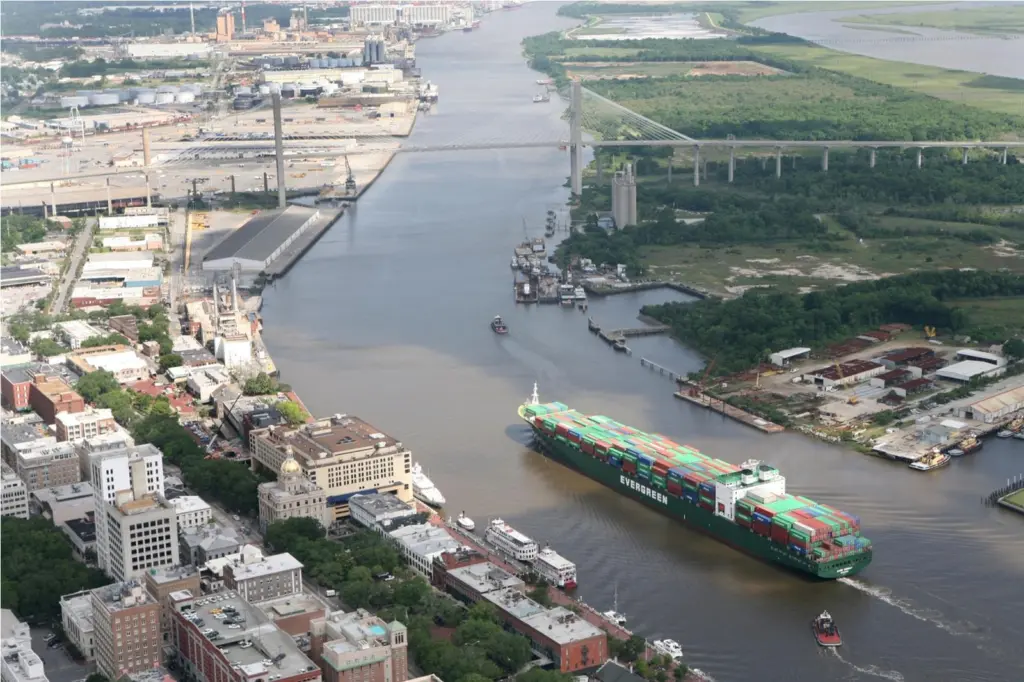
Nobody is opening up the floodgates, but all the container lines are optimistic and predicting a slight increase in volumes this year, says Roy Schleicher, senior director, trade development and global marketing, at Jacksonville Port Authority.
There is optimism at the Port of Baltimore, too, where overall volumes were up 12% year-on-year in March, vehicles were up a staggering 115% compared with March 2009, and containers are expected to show steady growth this year. However, Maryland Port Administration executive director James J. White puts things in perspective when he says: “Everybody feels good that we are seeing numbers turning round, but you have to realise that we are comparing volumes to the worst year we saw in 20 years – so I am not overly excited.”
American Association of Port Authorities (AAPA) figures for 2009 show that container volumes fell year-on-year by 10% in Savannah; 12% in New York/New Jersey; 16% in Hampton Roads; and 28% in Charleston. This year, East Coast ports are expected to import 10.6% more containers, measured in teu, than they did in 2009.
But apart from predicting better times this year and further ahead, it is another date, 2014, that the East Coast US ports have their eye on. That is when the expanded Panama Canal is due to open, and major investments are planned or under way as ports hope to cash in on the potential it will bring.
To quote Georgia Port Authority, responsible for Savannah and Brunswick, in a recent presentation: “The recovery is real. Being unprepared for growth is the new risk.”
Savannah’s container volumes for January-March certainly look healthier – rising from 528,065 teu in the first quarter 2009 to 656,268 teu in 2010 and taking the port close to the 2008 peak of 656,313 teu.
GPA’s “Focus 2020” $1.7bn investment programme includes berth upgrades, container storage, handling equipment, and intermodal and gate projects – some already under way – to double capacity at the Garden City Terminal in Savannah to 6.5m teu by 2018. The programme also includes a £588m Savannah harbour expansion.
“The Port of Savannah, recognised as the primary US southeast gateway, is within one to five days of major US inland hubs by rail,” says port relations manager Danica Grone. “Five of the top ten fastest growing states in population are better served via Savannah.”
Savannah handled a total 2.35m teu last year, with a balanced imports/exports ratio of 53.7% to 46.3%.
The Port of Baltimore decided to embark on its first ever public-private partnership project as part of its Panama Canal strategy. In the event, the deal, signed with Ports America last December, will deliver more than the Maryland Port Administration had even hoped for.
“Contractually, Ports America was to have the berth built and two container cranes located on the berth by July 2014; they weren’t planning to start the berths for another two years,” says James White. “However, they have already broken ground and ordered not two but four cranes, which will be here in 18 months, from ZPMC. Because the construction sector was so ‘rested’ due to the economic situation, they got a very good quote to start the berth. And they also received some very good prices for the cranes, so decided to order all four.”
As a result, Baltimore’s Seagirt Terminal should have its new 1,300 ft quay with 50 ft depth and four cranes alongside in operation two years before the Panama Canal project is complete, he says: “So we are really happy with this.”
The development, directly aimed at attracting containerships transiting the larger canal, will crucially offer 50 ft instead of the current 45 ft depth. The terminal already handles 6,800 teu Mediterranean Shipping Co vessels at its existing facility, but with the lesser depth, full loading can be an issue. “With the new berth, they will be able to be heavier,” says Mr White.
He says there has been a great deal of interest from the ports sector in Baltimore’s 3P project: “It has been described as a model and other ports are looking at it, because it is such a good deal for the State of Maryland.”
He admits he was not that optimistic when the port authority started out on the 3P path, especially in such challenging economic times “and having seen some of the leases here in the US not really shaking out to be a good deal”.
“There was a lot of apprehension about the timing of this, but it has worked out wonderfully for both parties and we will address this as a true partnership.”
Ports America paid $140m up front for the Seagirt’s existing assets, which the company was already operating. It is also committed to investing $105m into the new berths and cranes, and as part of the deal Ports America handed back to MPA a chunk of land elsewhere in the port, which will be redeveloped for automotive and ro-ro business and is said to be worth about $56m to the port authority.
As part of the 50-year lease, Ports America will also provide variable payments to the MPA on any containers handled over 500,000 a year.
Baltimore, at the worst point of last year, was down 13% on overall volumes but is seeing improvements this year. Car volumes, which went through the floor last year, totalled 71,615 in March, compared with 33,265 in March 2009, and BMW has just signed an agreement which will see the import of 50,000 cars a year over the next five years. The port is now hoping for a similar rebound in high-and-heavy ro-ro traffic.

Related Articles
 EXPANSION & DEVELOPMENT
 EXPANSION & DEVELOPMENT
 PORT & TERMINAL NEWS