




Robust US container trade faces uncertainty
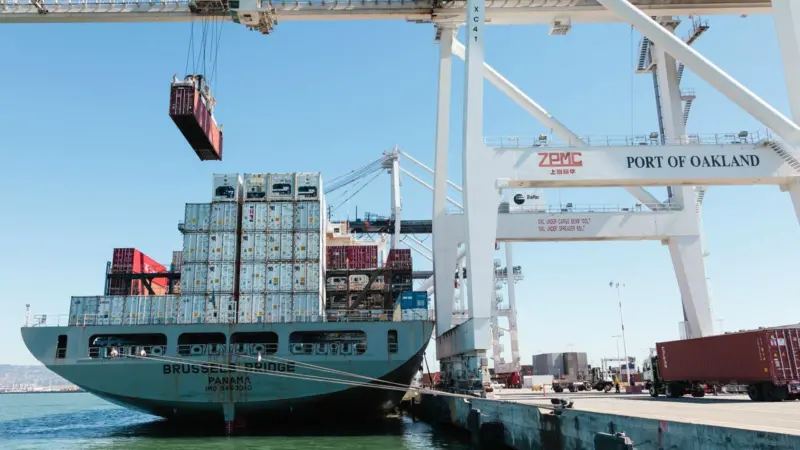
Record high levels of inbound laden containers were experienced on both US coasts in October, but BIMCO has warned uncertainty lies ahead due to US-China trade relations.
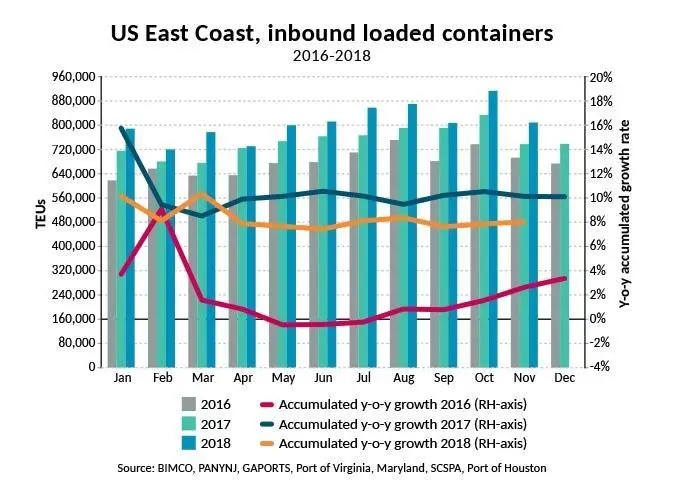
October data from BIMCO shows the US West Coast (USWC) at 1.09m teu and the US East Coast (USEC) at 0.91m teu. Container imports on both the USEC and USWC had a strong year in 2018, growing 3.7% and 8% respectively in the first 11 months of the year compared to the same period in 2017, but the future depends on how the US-China trade war develops with current and any subsequent tariffs.
Peter Sand, BIMCO’s chief shipping analyst, explained: “The record high levels in October can be explained by several factors, including improving port infrastructure and connections. Frontloading ahead of the then expected increase in tariffs on Chinese goods from 1 January 2019 has also been an important development.
“However, with container imports down in November on both coasts, the effects of full inventories and the result of the ongoing negotiations between China and the US will heavily influence what 2019 will have in store for container ports in the US.”
With many stocks full and uncertainty regarding the outcome of ongoing trade talks between China and the US, it seems doubtful that the levels of frontloading seen at the end of 2018 will continue into 2019, predicted BIMCO. Especially the unknown as to whether or not tariffs will be increased in March, which would happen if the negotiations fail, is a cause for concern for all companies affected, including the container shipping industry.
Currently 27.49 million tonnes of US containerized imports are affected by the tariffs which represents 14.2% of total US container imports or 24.7% of those imported on the West Coast based on data for the full year of 2017 and BIMCO’s own estimates.
Any future fall in container imports by the US and in particular the US West Coast, which is where most of the tariffed goods from China are discharged, will be particularly harmful for the container shipping industry. This is because the volume of containers will be reduced on the fronthaul leg of the transpacific trade lane. The fronthaul volumes are the capacity setters as they are much higher than those on the backhaul leg. Any lowering of volumes on the trade lane from the Far East to the US will reduce the shipping capacity needed.
“A decrease in fronthaul volumes would result in excess capacity leading to lower utilisation which would in turn reduce freight rates and earnings on the transpacific network,” Mr Sand said.
Related Articles
 PORT & TERMINAL NEWS
 PORT & TERMINAL NEWS
 OPERATIONS