![PortStrategy[GreenPort]](https://www.portstrategy.com/wp-content/uploads/2026/09/PortStrategyGreenPort.svg)






South America
The early arrival of Hamburg Suds Rio has South American ports in a giddy dance. Rob Ward reports
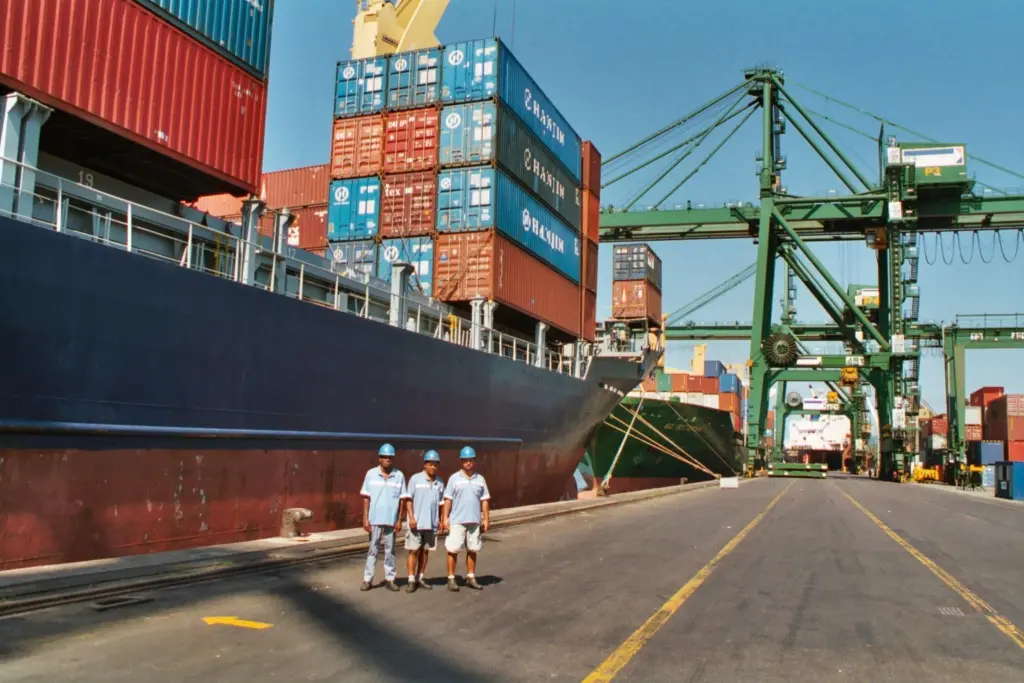
As the next generation of containerships for the East Coast of South America (ECSA) trades – the 6,300 teu Rio class ships from Hamburg Sud – get ready to enter the Mercosur trade region, Argentine container terminal operator Exolgan is busily preparing for their arrival in Buenos Aires. And with Julian Thomas, head of Hamburg Sud in the ECSA trades, confirming that the first Rio class will arrive in May, much earlier than the 2009 dates many South America watchers had been expecting, there’s an understandable urgency to completing terminal modifications.
Speaking to Port Strategy, Mr Thomas says: “The Rio class vessels have one additional bay to the Monte vessels, so have 286 m instead of 270 m, but they have the same beam. We are told Exolgan and the other key ECSA terminals where we call will be ready in time.
“Their arrival will mark another step showing our commitment to the region and showing the world that South American ports are ready for bigger vessels. We built the Rio class vessels so they would be able to call ECSA ports. The Monte class vessels are switching to the Asia trades.”
And so against this background a $100m investment plan is now underway in Buenos Aires following the takeover of Exolgan by Singapore-based PSA International and International Port Holdings (IPH), who now have, according to sources in Buenos Aires, 80% of the shares.
This development means that the world’s three leading box terminals now have a presence in Buenos Aires, with Hutchison already fully ensconced at BACTSSA, and DP World the owner of TRP, both in Puerto Nuevo. All four terminals in the Buenos Aires conurbation – including Exolgan – handled around 1.75m teu last year, up 20% over the 2006 figure. That shows a solid recovery since the nadir of 2002 when just 700,000 teu was handled.
PSA and IPH have taken over the majority shareholding from the Argentine Roman family, who control International Trade Logistics (ITL) of Argentina, itself the majority shareholder in Exolgan.
The new arrangement for the Exolgan terminal – which handled around 560,000 teu last year and has plans to nearly treble that up to 2m teu per annum – has been called a joint venture by the protagonists. However, three independent sources in Buenos Aires, say that ITL has been left with between 10% and 20% and that IPH and PSA have “equal shares of the rest”.
Global port operator PSA and IPH, a wholly owned subsidiary of Global Infrastructure Partners, are also taking a majority stake investment in ITL’s two other business: Exologistica, a logistics company and LPI, a warehousing company.
The rumour mill in Buenos Aires has been working overtime about a “potential large investor for Exolgan” for more than six months now but no-one could quite believe it would be a major player with the size and clout of PSA. Also Mr Roman went on the record stating that he would not sell more than 50% of his shares; if the inflated share sale claims are trues, something clearly swayed him from this position.
But many onlookers in Buenos Aires, including managers at rival terminals, are wondering why PSA did not take over ITL in its entirety and why it is working with an international partner (IPH) as well as an Argentine one.
“It doesn’t make sense,” says one terminal manager, who did not want to be named. “Why would PSA only want around 40% of a relatively small operation like Exolgan. Even if they double their throughput it won’t come to much more than 1m teu which is small beer for PSA. Also doubling capacity is expensive and I am not sure that sustained growth can be guaranteed for Buenos Aires.”
Roberto Murchison, the general manager for Terminal Zarate box terminal (located around 100 km to the north of Buenos Aires) adds: “If all the extra investment and expansion does come then it will exacerbate still further the road bottlenecks that plague Buenos Aires every weekday. The system creaks with 1.6m teu; it surely can’t cope with 4m teu.”
Mr Murchison says a better alternative is for the cargo to be handled away from the city centre, at ports to the south like La Plata and to the north like Zarate (where he concedes his family has an interest), Campana or Escobar.
But those working at Exolgan are very happy with what they believe will be an injection of cash for various infrastructural improvements. Managers there say that some $45m will now be spent over the next two years, with an extension of the terminal into an extra “eight to 15 acres” in land adjacent to the current terminal (giving it a total of 47 acres), two new super post panamax gantry cranes and 360 m of extra quay length, giving a total of 1,360 m.
Federico Polo Blas, the head of marketing at Exolgan, says: “This is a fantastic development for us and with exports out of Argentina increasing these are exciting times. Our goal is to move from 560,000 teu per year up to 2m teu over the next few years.”
With the new cranes, says Mr Blas, Exolgan will be able to host the next generation of 6,300-plus teu containerships, and steal ahead of their Buenos Aires rivals. The largest vessels currently calling at Exolgan, and indeed Buenos Aires, are the Monte class vessels of Hamburg Sud which can handle 5,500 teu but have to arrive and depart from Buenos AiresAwith draught restrictions. Further dredging of the channel could increase loading capacity, but new cranes will also be needed.
Meanwhile across the River Plate in Montevideo, Terminales Cuenca del Plata (TCP), is also pushing ahead with its expansion plan aimed at preparing for the arrival of the Rio class ships.
TCP opened in December 2001 and is majority owned by Belgian stevedoring company Katoen Natie, who has been the driving force behind these changes. In 2007, its volumes had risen to 360,360 teu and it handled well over half of Montevideo’s total throughput of 601,144 teu, with Montecon, working the public berths, handling the rest.
Ricardo Silva, operations manager at TCP, says that a new berth will be ready during the first half of 2009 and this will, along with the arrival of soon-to-be-ordered new super post-panamax gantry cranes, boost traffic substantially.
“Last year we grew 34% mainly thanks to reefer exports of fish and fruit, handled for Maersk, mostly coming from the south of Argentina,” Mr Silva tells Port Strategy. “We were very pleased as we were only expecting growth of around 16%. If we grow another 15%-20% this year, which could happen, we will be right up to our capacity.”
To prepare for future growth TCP is spending $140m on lengthening its main pier from 288m to 640m and increasing the yard area from 15 acres up to 29 acres.
“As well as allowing us to deal with the next generation of ships, including the Rio class vessels, it will almost double our capacity up to around 800,000 boxes per year,” adds Mr Silva.
And further to the north, in Brazil, a number of new developments are also paving the way for the arrival of the Rio class vessels, and the next generations of containership to follow on from them.
Portonave, South America’s newest container terminal, opened at Navegantes, across the river from the 750,000 teu per annum and severely congested port of Itajai, and this is helping the flow of containers considerably. Navegantes has a spot of labour trouble and might encounter a bit more as the year progresses, but is already forecasting throughput of around 210,000 teu for 2008, which is ahead of expectation.
In Santos, the continent’s leading box terminal operator, Santos Brasil, is ploughing ahead with its expansion scheme. After winning a legal battle against rival Libra Terminais, it has been allowed to expand into the Tecon 4 area, and its fourth own berth will be ready by November/December of this year, according to chairman Richard Klien. Santos Brasil (originally called Tecon One) also has use of the berth at the adjacent TEV car terminal, which is free for around half of every month.
As Mr Klien explains to Port Strategy: “We have a very aggressive programme in terms of capacity, with 22 more RTGs due to arrive and we will have 4.5 berths by the end of the year. We are blending in our new acquisition, the Mesquita logistics company, and it is all coming together nicely in terms of productivity.”
He add that Santos Brasil will definitely be ready to receive the Rio class vessels.
Ultimately Hamburg Sud will resolve many of its “Brazil problems” when it opens its own terminal, at Itapoa, near Sao Francisco do Sul. The company’s Mr Thomas says this 600,000 teu per annum facility is due to open in mid -2009 – some 18 months later than first envisaged – and will very quickly become the hub port for Hamburg Sud operations.
But all these developments in Brazil are currently being seriously hampered by the lack of dredging in the country. The country’s president Luiz Inacio Lula da Silva, has put by Reais1.4bn ($838.6m) to dredge deep enough for the 6,300 teu-plus containerships but it could be the end of the year before the dredging programme commences, and ships face diminishing depth in many of the channels, and draught restrictions until then.
Related Articles
 EXPANSION & DEVELOPMENT
 EXPANSION & DEVELOPMENT
 PORT & TERMINAL NEWS