![PortStrategy[GreenPort]](https://www.portstrategy.com/wp-content/uploads/2026/09/PortStrategyGreenPort.svg)






Trump’s tariffs hang heavy on US ports
Protectionist levies could have far reaching effects for America’s ports, finds Martin Rushmere
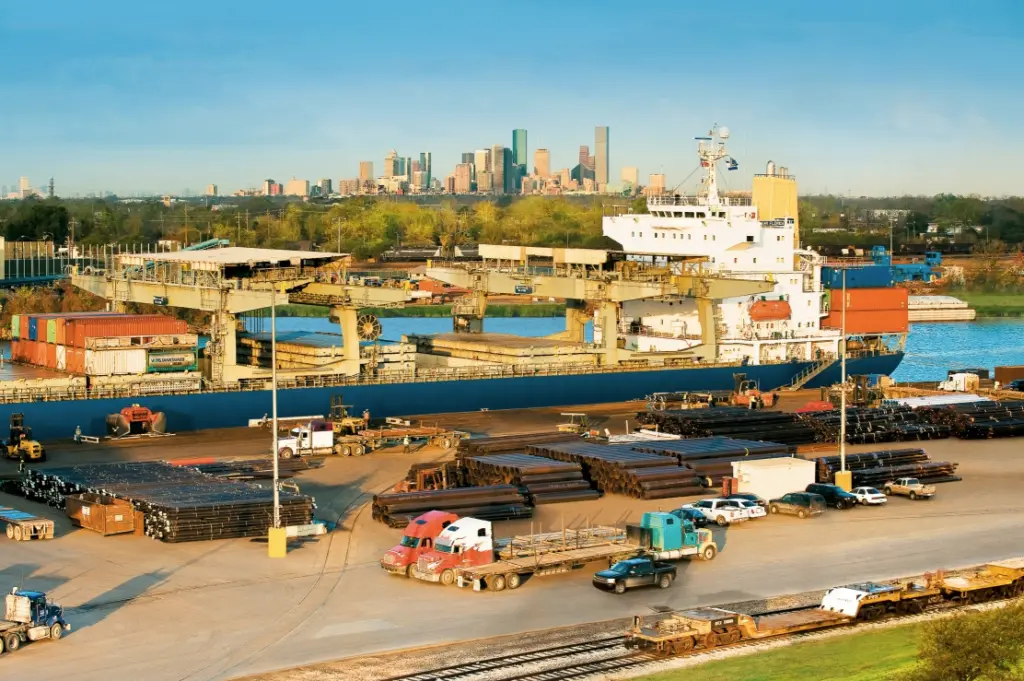
US ports are holding their breath that the White House will back down or change its mind about imposing a 25% surcharge on imported steel and 10% on aluminium.
The widespread consternation that greeted the initial announcement has quietened down to a general feeling that the administration has forced the issue to get better trading terms from its two North America Free Trade Agreement partners, Canada and Mexico. It is likely that both countries will be temporarily exempt from the surcharges.
All steel importing ports are pessimistic about the ramifications if blanket tariffs are imposed indefinitely. They mention “significant” effects, avoiding politically charged terms such as “disastrous”.
Two of the biggest, New Orleans and Houston, are nonetheless forthright in their assessments. Houston executive director Roger Guenther says the port is the biggest steel importer in the country.
“As a result, we are concerned that the proposed 25% tariff on steel cargo could decrease cargo volumes, creating a detrimental impact on local jobs and the economy. We urge that the matter continue to be reviewed.”
New Orleans adds: “Imposing and enforcing tariffs arbitrarily on imported steel and aluminium would negatively impact ports, the larger maritime community, manufacturers throughout the US and other steel-consuming industries. Port Nola supports the enforcement of all trade agreements, but an across the board action fails to recognise those countries playing by the rules.”
Prior form
Port Nola chief executive Brandy Christian said the port’s economy suffered considerably in 2002 when President George W Bush slapped on steel tariffs for specific countries, with a 46% decline in steel imports the following year. She says the law on which President Trump is relying “is far broader than the law used in 2002 and could result in far steeper tariffs on a wider variety of steel products from a longer list of countries”.
The president justifies his edict on the basis of national security, saying that vital institutions – particularly the armed forces – are becoming over-reliant on foreign steel.
Retaliation and counter retaliation are two of the more serious possibilities being mentioned. The Northwest Seaports Alliance, representing Seattle and Tacoma, says “higher tariffs will jeopardise jobs in Washington and raise costs for consumers in a much wider range of industries,” according to Courtney Gregoire, Port of Seattle commission president and co-chair of the alliance. “We support vigorous enforcement of fair trade laws and a level playing field, but this reckless approach puts too many people and industries in the economic crosshairs.”
The alliance says: “While the exact potential for retaliatory tariffs from impacted trading partners is unclear, major steel and aluminium importers are also significant Washington trading partners. For example, Canada, Mexico, China and the European Union account for 50% of the destinations for exports through the Port of Seattle seaport, 45% through Sea-Tac and 37% of the destinations through the Port of Tacoma.
“Just as concerning as these blanket tariffs is the potential for retaliatory tariffs on exports of Washington agricultural and manufactured goods,” added Don Meyer, Port of Tacoma commission president and co-chairman of the alliance. “As a state in which 40% of our jobs are tied to international trade, we are risking jobs and quality of life by levying blanket tariffs against some of our most important trading partners and opening the door to their retaliation.”
Expected fallout
Economists and consultants second these sentiments. “There is always a wider fallout than expected in a trade war,” says Paul Bingham, lead economist with the EDR Group. “Farming exports are an obvious area of concern, which would lead to problems for even more ports.”
“Washington farmers export 80% to 90% of their wheat, and so we are deeply reliant on foreign markets to ensure the success of our state’s growers,” said Mike Miller, former chair of the Washington Grain Commission and current chairman of the US Wheat Associates. “Our product is an easy target for retaliatory tariffs, which not only have the potential to reduce sales to overseas partners, but also disrupt long-term relationships that have taken years to cultivate.”
Of the ports, New Orleans could be affected the most, because steel makes up 15% of its imports. Other major ports have similar volumes, but other goods would make up for any losses.
At Houston, total foreign steel cargos, which include exports, were up 65% in 2017 to 3.3m tonnes.
A more sanguine view of the outcome is taken by Adam Wasserman, managing partner of Global Logistics Development Partners: “With tariffs impacting substantial steel imports, the US steel industry would likely gain, causing increases in rail and port-related bulk shipments of iron ore, etc. This may impact smaller, bulk-oriented ports, especially the inland waterway/Great Lakes ports.
“The impacts to sectors of manufacturing in the US will largely affect production which was dependent on lower-cost steel imports,” says Mr Wasserman, “some of which can be replaced by domestic production with modest to medium-impact end product cost ramifications. Product costs would largely increase and the effects ripple throughout the economy.”
Mixed outcomes
Mr Wasserman is not completely convinced that the cost increases would be substantial across the board, but instead believes they would likely be felt by some high-volume producers that have fewer alternatives to replace their offshore suppliers, including those that are not near to a US production centre.
“For higher-end steel,” he says,” the effects may be different again, with the easy ability to replace those products with cost-effective and supply chain proximate product. This could cause higher costs and domestic logistics changes that might end-up precipitating some production facility relocations.
“For coastal ports, the impacts could be meaningful but would again depend on which countries (Asia, Europe) would be impacted most. Beyond port volumes, the impact would be felt by both trucking and rail services carrying cargo from port to production centres. Theoretically, this kind of action if sustained could cause increased steel production over time in the Western US.”
Jimmy Lyons, director and chief executive officer of the Alabama State Port Authority, has also warned of a backlash and echoed the prevailing wisdom that there are no winners in a trade war. Likewise, the National Retail Federation’s vice president for supply chain and customs policy, Jonathan Gold, said a trade war could quickly materialise.
“The immediate impact,” Gold said, “would be higher prices for American consumers that would throw away the gains of tax reform and put a roadblock in front of economic growth. But, in the long term, we could see a loss in cargo volume and all the jobs that depend on it, from dockworkers on down through the supply chain.”
Lack of support
Even hardcore congressional supporters of the president are getting nervous. “I appreciate the president’s goal of helping American steel manufacturers,” said Pete Olsen, a Texas member of the House of Representatives.” However, broad tariffs will have sweeping, negative impacts on consumers and businesses across the country. In the Houston area, they will also hinder growth in our booming energy, petrochemical and manufacturing industries, making it harder to expand and create new jobs in Texas.
He is also worried about the repercussions of this action on the Port of Houston, not only from the tariffs, but also potential retaliatory measures taken by its trading partners. “I urge the president to provide as much flexibility as possible during further negotiations and will work with my colleagues in Congress to develop options that protect our economic growth. Fair and free trade is critical to our prosperity in Texas and our nation,” he said.
The possible repercussions could affect ports that are undertaking related projects. Florida’s Tampa Bay last year signed a 25-year lease with Steelco Florida for 35 acres, to import, export and manufacture steel products.
The overall effect of such sudden and drastic economic policy decisions is given by Nobel prize winner Paul Krugman. Writing in the New York Times he says: “The US has already lost its reputation as a reliable negotiating partner”, a statement even more concerning for longer-term trade prospects for the nation’s ports.
Related Articles
 EXPANSION & DEVELOPMENT
 EXPANSION & DEVELOPMENT
 PORT & TERMINAL NEWS