



Sign of the times
ICTSI has taken the initiative and submitted its own detailed proposal of how to achieve the enlargement of container terminal capacity in Melbourne, a step in keeping with the times
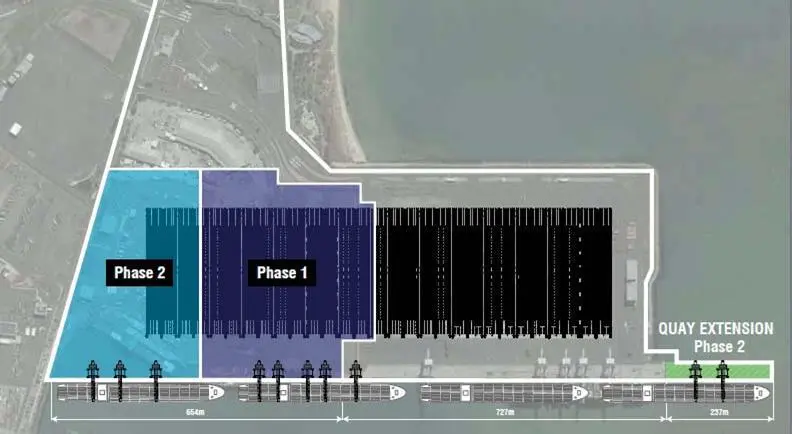
Against a background of the Port of Melbourne Pty Ltd planning for the expansion of container capacity, International Container Terminal Services inc. (ICTSI) has submitted its own proposal of how to achieve necessary expansion, based on the enlargement of its Victoria International Container Terminal (VICT) located in Webb Dock, the designated expansion area.
Some might see such a move as audacious but is it or is it just a sign of the times, an initiative which we can expect to see more of in the future?
Going back in time, the priority coupled with new container terminal development in Australia was to introduce a ‘third force’ into container handling. This is now in place with Hutchison establishing alongside the two existing incumbents, DP World and Patricks, terminals in Brisbane and Botany Bay, and VICT offering a fully automated solution in Melbourne, opening for business in 2017.
Not surprisingly, however, since this era the world has changed. New priorities are the order of the day, with the need to respond to a major upscaling in vessel size and to capture the economies of scale that go with this central to today’s challenges. Scale to deliver more competitive shipping and, in turn, lower pricing for importers and exporters.
In the 10 years since Maersk Line introduced its E class vessels, with a nominal capacity of just over 13,000TEU, containership capacity has experienced a decade of the strongest growth advancing today to over the 24,000TEU mark, as evidenced by Evergreen’s Ever Alot, introduced into service in mid-2022 with a capacity of 24,004TEU and featuring an LOA of 400m. In the rapid pursuit of bigger and bigger capacity vessels, the path to achieving this moved on from expanding vessel beam to extending LOA . To put it in context the Ever Alot is 20m short of being the length of four football pitches. At the same time, the host of new higher capacity vessels being introduced, with this trend never more pronounced than today, has accelerated the cascading of larger capacity vessels into secondary trade lanes where complementary port facilities have enabled this.
It is not just draught that has been a consideration here but equally important length of quay line and in particular the ability to simultaneously accommodate more than one vessel with a long LOA. Since 2020 Australian east coast container trade has seen the call of vessels in the 10,500 – 13,000TEU range with a length of up to 300+m, and it is clear that there is a desire among key lines to introduce the next generation of 15,000TEU to 18,000TEU vessels with LOAs in the range 360m to 400m.
Herein lies one of the inherent strengths of the ICTSI proposal – the phased development of VICT incorporating a continuous quay line that will ultimately offer four container berths able to service vessels of up to 367m in length with an overall capacity of 14,000TEU.
This is one of the main influential factors – the maximisation of terminal capacity incorporating a continuous quay line – upon which ICTSI has built and delivered a highly competitive proposal for consideration by the Port of Melbourne Pty Ltd and State Government of Victoria. It is a proposal that, ICTSI underlines, offers the lowest cost per TEU, provides for increased throughput across the quay from 3.3mTEU to 3.7mTEU, reduces environmental risk and has diverse operational benefits including for interfacing transport service providers.
Cost parameters are another major attraction. ICTSI has engaged multiple global firms to assess the merits of its proposal in comparison to current expansion designs for the Port of Melbourne. Jacobs Engineering undertook a detailed technical assessment, including estimates of construction costs, while Boston Consulting Group focused on market and economic assessments.
The external reports conclude that ICTSI’s proposal can deliver cost savings of more than AUD240 million (USD165 million) and spread the timing of spend over a longer time period while introducing significant capacity into the market sooner.
WIDER CONTEXT
The timing of the ICTSI submission can be seen to be appropriate in a wider context. The last decade has seen a rationalisation of the container terminal sector – the absorption of smaller entities as the preference for larger operating platforms has emerged. Similarly, the development of new larger container terminal facilities, including along secondary trade lanes, is rapidly becoming the established norm. A prime example today is in the port of Santos, Brazil where ANTAQ, Brazil’s national waterway and maritime transport authority, is preparing to offer a new concession – STS 10 – for a 46-hectare container facility with a 1200m berthing line and a design capacity to handle a volume of 1.9mTEU/year.
The ICTSI proposal effectively concurs with today’s development norms and aligned with this the requirements of independent industry bodies such as Australia’s Freight & Trade Alliance which continually voices the need for more cost competitive shipping systems to be introduced in Australia. Furthermore, the approach itself – an unsolicited bid – is not so unusual in that while this is for a larger than usual slice of new terminal capacity, terminal expansion is regularly achieved by agreement with the host port authority which in any case always has the opportunity to market test any such proposals.
Related Articles
 OPERATIONS
 OPERATIONS
 OPERATIONS