![PortStrategy[GreenPort]](https://www.portstrategy.com/wp-content/uploads/2026/09/PortStrategyGreenPort.svg)





CALLAO: TWO SPEED EXPANSION
Port of Callao has two global terminal operators, with both looking to raise capacity. AJ Keyes looks at the different plans and what the short-term holds for Peru’s largest container port.
The Port of Callao is eff ectively a proxy for the Peruvian economy because the overwhelming majority of volumes are directly connected to the local Peruvian market, and in particular the Lima capital region and hinterland. The port continues to handle around 90 per cent of Peru’s container market, with the balance moved via Paita in the north of the country.
Steve Wray, Associate Director, WSP Maritime Advisory, underlines the importance of the port. “Callao is by far the dominant container port in Peru and with the existing infrastructure in place is the premier port from a cargo catchment point of view. It serves the metropolitan area of Lima-Callao, which has a population of 9.9 million inhabitants and is where the national concentration of distribution centres are located. This competitive position is not going to change,” he explains.
The Lima region accounts for an estimated 51 per cent of Peru’s GDP, according to Proinversion, Peru’s Agency for the Promotion of Private Investment. The region, which includes Callao, has recorded GDP growth of 11 per cent per annum since 2010, far exceeding the national average (of five per cent per annum).
In terms of the wider regional context, Peru is the second largest market for container handling on the West Coast of South America (WCSA) after Chile. History shows strong container volume growth with an average increase of 9.7 per cent per annum between 2000 and 2019. In terms of numbers, a rise in annual volume from 462,000TEU to almost 2.68 million TEU in 2019.
PROTECTED FROM COVID-19
The country has been largely protected from the COVID-19 pandemic with the 2020 container volume estimated to be in the order of 2.64 million TEU, a small downturn compared to 2019 performance.
Informed sources particularly point out in this context: “You have to remember that Peru’s exports consist of a lot of foodstuffs and such products are always going to be needed, irrespective of whether there is a pandemic, in key export markets like North America and Europe.”
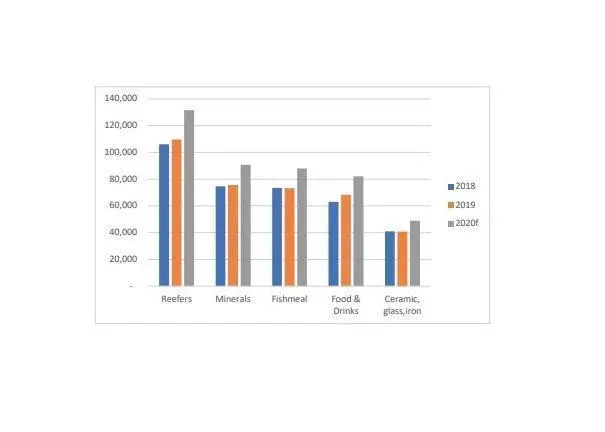
This explanation is supported by data from Autoridad Portuaria Nacional (APN), Peru’s National Port Authority. As Figure 1 shows, the volumes of loaded export containers projected for 2020 highlights a growth in volumes over 2018 and 2019 and this is irrespective of the impact of COVID-19.
The largest single export classification is reefers, with avocados, grapes, citrus, frozen seafood and cranberries all known to be larger-volume items and required irrespective of a global pandemic, although the need to gain access to empty units is always going to be a logistical factor.
STRONG GROWTH AT CALLAO
The introduction of the two terminal operators in Callao has been a key driver behind container traffic growth at the port. DPW Callao operates the Muelle Sur (South) terminal, while APM Terminals Callao is based at the Muelle Norte (North) facility.
Collectively, these two terminals have seen growth of 6.2 per cent per annum between 2010 and 2019, as throughput increased from 1.35 million TEU to 2.31 million TEU over this period. Given the importance of Callao to national demand it is unsurprising that the impact of COVID-19 has been small, reducing the average growth to 5.2 per cent per annum, according to projected data from APN.
Yet there is a difference between the performance of the two facilities, as Wray explains. “The DP World terminal has generated strong increases since 2010, with an average of 13.7 growth per annum, whereas at APM Terminal’s multipurpose facility the growth was a lower 0.2 per cent per annum.”
In 2006, DP World Callao signed a 30-year concession to operate the South Terminal, with operations commencing by the end of 2010. Growth in volumes meant that 1.42 million TEU passed through the facility during 2014 and while this level of activity has been largely maintained, there is a need for expansion and investment to take advantage of future growth potential. Current plans will see an expansion to 2.1 million TEU, as part of a total projected investment in this facility over the 30-year concession in the order of US$615 million.
The second facility at the port, the North Terminal, is operated by APM Terminals Callao under a 30-year concession, which it has held since 2011. The concessionaire is a consortium formed by APM Terminals (51 per cent) and MSC (49 per cent). Unlike at the South Terminal, the North Terminal has struggled to generate sizeable improvements in overall demand, with the 2010 total of 910,79 TEU not surpassed until 2016 when 915,741TEU was recorded. For 2019, 927,700TEU was recorded, although this was down on both 2017 and 2018 when over 1 million TEU was handled.
During the concession, APM Terminals is required to invest around US$885 million to modernise the infrastructure, with each stage of the process triggered by a throughout threshold being reached, to at least 1.5 million TEU per annum.
However, with the terminal operator and port authority still reportedly negotiating an addendum to the existing concession, the future development of the facility is not fully known. Yet with only a limited amount of land and space at the terminal, there may be a need in the future to consider displacing some non-container activity, such as bulks, to make space for box demand.
OFFERING ADDED LOGISTICS INCENTIVES
DP World has expanded into a fully-integrated maritime and logistics operation that goes beyond the gates of the terminal in Callao. In 2018, the company acquired Cosmos Agencia Maritima (CAM) for US$316 million, one of the larger logistics agencies in Latin America and which owned fully integrated logistics services providers, Neptunia and Triton Transport. CAM also retains a 50 per cent stake in the Port of Paita (see panel).
The value of CAM to DP World is that it gave immediate and established access to freight services, transport, storage and distribution at the very centre of the logistics providers in the Lima region in line with a key corporate strategic objective.
“The acquisition supports our recent strategy of extending our core business into complementary sectors,” said Sultan Ahmed Bin Sulayem, group chairman and CEO of DP World, at the time of the acquisition.
By comparison, AP Moller has inland service facilities in six locations across Peru, at Cajamarquilla, Callao, Chao, Paita, Sullana and Villa el Salvador. A fleet of almost 100 vehicles and 70 trailers provides transport services, leveraging regional logistics knowledge.
IS CHANCAY A THREAT?
Callao could be joined by a new port competing for Peru’s hinterlands. In mid-2019, Cosco Shipping Ports Limited and Peruvian mining company Volcan signed an agreement to build the $3bn Chancay Multipurpose Port Terminal, located 80km to the north of Callao. Despite a target date for initial operations of 2020, construction is yet to start.
So, is it a threat to Callao? Wray does not think so. “Even with the support of Cosco Shipping Ports, the Chancay development is behind its original schedule and has major obstacles to overcome. For example, for serving imports, almost all warehousing and logistics infrastructure is in the Callao and Lurin areas, thereby dictating that Callao will always be the dominant import location, representing the lowest cost option and most efficient logistics route.” The other major port in Peru is Paita to the north, but it is not a competitor to Callao, as discussed in the box story.
Paita – Northern Peru export focus
Paita is a key export gateway for northern agri-business and future growth in shipping vegetables, crops and foodstuff s is expected to be supported through a large number of irrigation projects in Paita’s hinterland.
The port serves the Piura region and is just 56km from the city of Piura, which has a population of around 400,000 people. Other areas within Paita’s catchment are Amazonas, Cajamarca, Lambyeque, Tumbes and San Martin.
Terminales Portuarios Euroandinos – Paita SA (TPE-Paita) has been operating the container terminal under a 30-year concession since 2009. It is owned by a joint-venture consortium consisting of Peruvian Cosmos Agencia Maritima (part of DP World) and Tertir – Terminais de Portugal SA (owned by Yilport Holding).
Containers are the dominant cargo activity, representing around 65 per cent of total port throughput. Within this share, exports account for a larger 60 per cent share compared to imports. This is not surprising, based on the export of foodstuffs, fruit and agriculture from the region, especially in reefer units.
The Muelle Espigon terminal was expanded in 2014 and further investment is planned beyond the current throughput levels of 300,000TEU per annum.
“TPE is gearing up to meet future growth expectations,” explains Wray, adding that there is a modernisation plan that involves development of a second berth with dredging to allow larger vessels.
“Paita has a unique position, it is the most competitive port to meet the export demands of the agri-business coming out of the North of Peru and it will retain this specialist niche moving forward,” he underlines.
Related Articles
 SOUTH AMERICA
 PORT & TERMINAL NEWS
 PORT & TERMINAL NEWS