



ITAJAI BACK ON TRACK
After several years of ups and downs and funding setbacks, the Brazilian portof Itajai may finally be fully back on track. Rob Ward investigates.
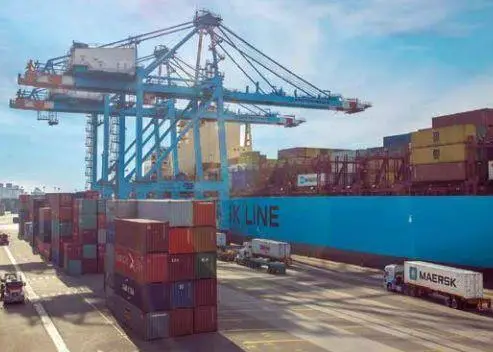
Itajai is finally entering a new era with a deeper draft and expanded turning basin that will allow the berthing of the largest of vessels currently plying their trade along the East Coast of South America of between 12,000 and 14,500 TEU.
The Itajai Port Complex – which includes AP Moller Terminal Itajai on the right bank and Portonave (backed by MSC), on the left bank – is Brazil’s second largest for containers, after Santos, but has been in danger of losing that ranking due to various draft restrictions and a narrow channel allowing vessels only with a maximum length of 303m while other ports can handle ships of more than 335m LOA.
Having faced periodical setbacks due to heavy flooding and raging currents (in 1983 and 1984, in 2008 and then again in 2011), the port community has come through it all with a positive result and can now look forward to also cementing its role as “Chicken Export Capital of the world”, which it shares – on and off over the years – with nearby rival Paranagua, located some 70 nautical miles away. It will also hope to add to the 1.23 million TEU it handled last year (up 10% over the 2018 figure).
Final, final tests
Marcelo Salles, the commercial director for the Itajai Port Authority (IPA), told Port Strategy, that the pilots in the port are carrying out the “final, final tests” on the Reais170 million ($33.35 million) turning basin during the month of March and by mid-April it will be “all systems go” for vessels as large as 12,000 TEU to start calling at the Itajai Port Complex (IPC), whereas the largest, fully loaded, today are just 8,000 TEU.
With phase one completing in April, or early May at the latest, vessels of up to 336m long will be able to berth and in the future Phase Two, and an even wider turning basin and draft, will allow vessels of up to 366m LOA to call. April 30, plus May 7, 13 and 20 have already been set by for ships of up to 336m LOA to berth at Itajai, marking a historic ramp up of the port’s capacity.
“It is a dream come true for all those connected with the port of Itajai,” enthused Salles, who has been with the IPA, on and off, for more than 25 years, before explaining further. “Despite all the setbacks and all the delays [since extensive dredging was promised by the federal government almost a decade ago], we are once again back in the game of attracting the biggest vessels now calling ECSA, and therefore even more services. With our new turning basin and increased draft of 14m at high tide, we can increase maximum capacity by 50% and this is a massive improvement for our operations.”
Preparing an open tender
At the same time, Salles and his team at the IPA have now completed the construction of a new berth adjacent to the APMT Itajai facility (leased to APMT/Maersk Line from the port authority) and so are preparing an open tender for that 70,000m2 area as well as a huge 230,000m2 adjacent public port area that has been used in recent years as an overflow outlet.
The APMT Itajai lease runs out in the next year and the new tender will be for a 1.8 million TEU per annum capacity terminal (treble the existing capacity of 600,000 TEU per annum because it combines the two areas mentioned above) with more than 1 km of quay, consisting of 2 x 500m, which can simultaneously handle two large container ships of up to 400m in length, or four smaller units.
The winner of any new tender will have to commit to spend an extra Reais1billion ($198 million ) on new equipment and infrastructure over the course of the first 35-year concession contract. There will be options to renew for another 35 years.
Salles said he “really hopes” that APMT Itajai will renew its concession (along with the addition of the new extension) but if not, there is no shortage of willing bidders with DP World, China Merchants Port Holding Company (CMPort) and Terminal Link (which is itself a joint venture between CMA CGM and CMPort).
It is still not known whether or not Portonave – which is now 100% owned by TIL after it bought out start-up partner Triunfo three years ago – will be allowed to bid.
The Brazilian government watchdog, the Tribunal de Contas de Uniao (TCU), will have to decide whether or not TIL, which is the terminal company part of MSC, and already has outlets in Santos and Rio de Janeiro in Brazil will be allowed to bid.
It will first need to have a close look at the competition in the region which includes Porto Itapoa, TRP in Paranagua, Imbituba, in the south of Santa Catarina and the Wilson, Sons operation in Rio Grande do Sul.
Good time to invest
Now is a good time to invest in the port of Itajai, argues Salles and others, because throughput is on the rise, especially at the APMT Itajai facility (from 397,774 TEU in 2018 up 23% to 489,202 TEU in 2019), and it handles lucrative refrigerated cargoes.
Salles said that several regular services have returned to APMT Itajai in recent years and that the volumes have increased “by 150%” over the past three years. Last year APMT Itajai handled around 100,000 TEU of reefer cargo and Portonave around 120,000 TEU.
The latest IPA figures show that in January 2020, chicken exports were up by 13.3% to 180 million tonnes compared to 2019, and pork was up by a substantial 60%, to 113.7 million tonnes thanks to huge demand from China which has been suffering from Swine Flu. Brazil exports around 5 million tons of chicken every year and has been the world’s leading exporter of the white meat since 2004.
Due to the swine flu in China, Brazilian pork exports are expected to grow by at least 15% this year, up to 850,000 tons, with the vast majority passing through Itajai and Navegantes. Three of the world’s largest white meat exporters – BRF, JBS and Aurora – ship produce through the IPC.
The IPA executive added that Itajai port complex has “a $3 trillion dollar economy” as its hinterland including, the three wealthy southern states of Rio Grande do Sul and Parana as well as Santa Catarina, and its extensive reefer warehousing units (with more than 10,000 plugs) is the “best and most extensive in the world”.
Grit and Resilience of Itajai
Robert Grantham, a director with the Solve Shipping consultancy based in Navegantes (on the left bank of the IPC) considers the new turning basin as a “historic” moment for Itajai and displays the “grit and resilience” of the local port community.
“The new ships sailing on the Brazilian coast are now 336m so something urgently had to be done, or the port will be would have been out of the game,” asserted Grantham, who was himself commercial director for IPA between January 2009 and January 2012 and was also country manager for China Shipping between 2005 and 2008.
“Indeed January 16, 2020 will be recorded in the history of this port as another mark in its long history of success and overcoming adversity,” declared Mr Grantham. “On this date, the first experimental manoeuvre of the new turning basin, located very close to the entrance of the river, was carried out.
“When I joined the Board of the Port Authority of Itajai between 2009 and 2012, we received the visit of the Director for the Americas of APM Terminals and at the time he was very emphatic, either the port was preparing to receive the new ships that were entering the traffic in South America or we would be out of the game.
“The warning of this executive and others was understood by the port community and, as usual, a movement of political, economic and social forces began in order to enable the construction of a new Turning Basin that would allow Itajai to handle the bigger vessels, in a first phase of development, of ships up to 336m in length and in a second phase (still to come) for the operation of ships with 366m.”
And, as they say, the rest is history, and now Itajai has bigger volumes, more options for shippers and an expanded box terminal on its right bank – possibly with APM Terminal Itajai running it – to look forward to
Related Articles
 SOUTH AMERICA
 PORT & TERMINAL NEWS
 PORT & TERMINAL NEWS