![PortStrategy[GreenPort]](https://www.portstrategy.com/wp-content/uploads/2026/09/PortStrategyGreenPort.svg)




MULTIRIO MULTI GAINS
MultiRio container terminal in Rio de Janeiro has a new terminal operating deal and is gearing up to handle the largest box ships in the East Coast of South America (ECSA) trades, as Rob Ward discovers.
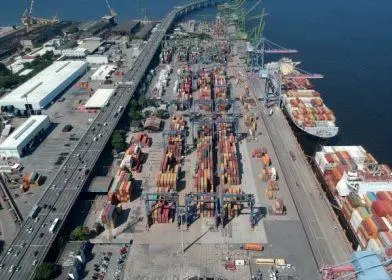
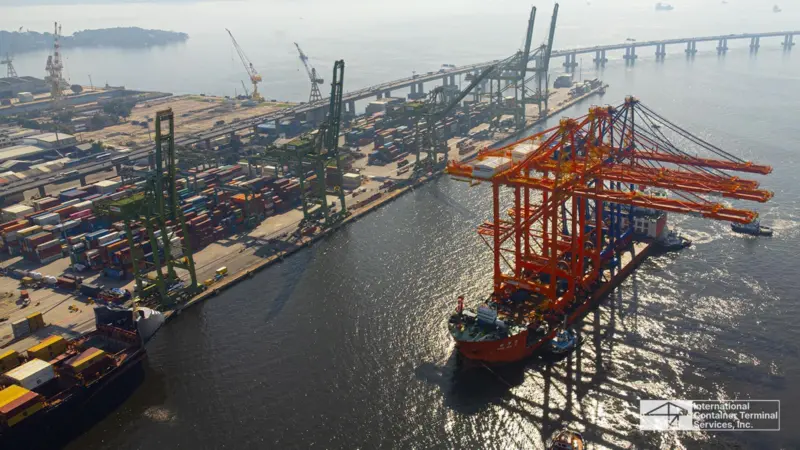
The arrival, just before Christmas, of a new super post panama crane – costing US$9.3million from ZPMC in Shanghai, China – was just the latest step in the bid by the MultiRio owners to compete with “the big boys” who are dominating container handling in Brazil to the detriment of the once profitable and prolific local Brazilian operators.
To some extent MultiRio has been following the maxim: “If you can’t beat them, join them.” Of all the Brazilian owned container terminal operators in key Brazilian ports only Santos Brasil (in Santos and Vila do Conde), Wilson, Sons (in Salvador and Rio Grande) plus the two mavericks in the jungle port of Manaus (Superterminais and Chibatao), are still independent of foreign ownership.
PANDEMIC AND EXCHANGE RATE PAIN
MultiRio is having to deal with potentially plummeting imports due to both the pandemic and the poor exchange rate of the Brazilian currency. (The Real has gone from Reais3.0 to Reais5.3 to the US dollar over the past 18 months, making imports much more expensive).
In 2020, MultiRio handled 232,180TEU, which was eight per cent higher than the 215,105TEU it handled in 2019, (218,079TEU in 2018) and ICTSI Rio 1 handled 186, 783TEU (up from 131,855 TEU the year before after adding new services).
A recovery during Q4 2020 saw MultiRio finish with a decent rise last year considering all the pandemic pitfalls but the drop in imports – down 16 per cent to 37,540TEU in 2020 – hurt the bottom line, despite exports, transshipment and empties all showing good growth.
“The problem is that most of our revenue comes from handling import boxes and these were down significantly compared with 2019,” Luiz Henrique Carneiro, President of MultiRio, explained to Port Strategy.
He adds that, with an average import storage time of one week, import boxes bring in at least five-times more revenue compared to export containers. “It is because here in Brazil the tradition is to charge almost zero for export boxes and to keep fees low but compensate with import fees,” said Carneiro. “So maybe now we will have to look closer at that system and increase the handling costs of export boxes little by little. It’s a process that may be inevitable as this year progresses.”
Sepetiba Tecon, which competes for the same cargoes in the Rio de Janeiro conurbation, saw throughput of 277,431 TEU in 2019, significantly down from the 417,561TEU in 2018, due to carrier calls reducing and switching to Rio de Janeiro with its deeper draft.
GROWING PARTNERSHIP WITH MSC & TIL
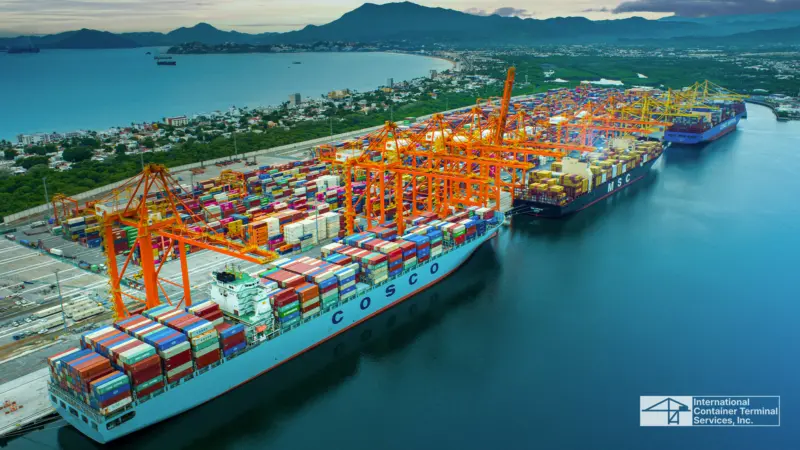
Part of the reason for MultiRio’s current expansion is a growing partnership with the European liner shipping company MSC Line and its stevedoring arm, Terminal Investment Limited (TIL).
MSC has been a long-standing customer of MultiRio since the terminal operator – majority owned by the Klien family – took up the franchise of an initial 25-year concession back in 1998 (since renewed early, in 2011, it will now run until May 2048).
Luiz Henrique Carneiro, is President of MultiRio as well as Multi-Car, the ro-ro operation that operates out of the same, close to downtown Rio de Janeiro site, and has been with the company for more than 20 years. He believes the container facility is on the threshold of becoming a major player in the ECSA trades with more chance of gaining transshipment cargoes now that it has boosted its capacity to 700,000TEU per annum and improved both draught and night-time manoeuvring.
“Rio de Janeiro is not seen as a transshipment port yet, as it is more of a gateway port, but we have seen an increase in transshipment cargo over the past few months, since October 2020, and some of that is with MSC, with whom we are seeing a growing and blossoming relationship. We hope that they will continue with those transshipment volumes in 2021 and our aim is to pick up even more transshipment cargo, especially now with our greater capacity,” Carneiro explains.
MultiRio hosts four MSC liner services, to North Europe, US East Coast, US Gulf and the Mediterranean. MSC’s Asia service does not call Rio de Janeiro but Carneiro is “trying to convince them to come but it’s a question of market and strategies”.
Now, with the new gantry crane – bringing the total equipment roster up to five Ship-to-Shore (STS) cranes and three mobile harbour units – Carneiro expects MultiRio to start plugging the gap significantly between current throughput and its theoretical maximum capacity of one million TEU per annum capacity, which would need deployment of two more STS units.
Carneiro explains the logic: “We decided to buy it [the gantry crane] to improve our productivity and we had to move fast to beat the deadline for the removal of the Reporto incentives. The new crane has an out-reach of 24 rows and helps us prepare ourselves to receive the New Panamax class vessels.”
The Reporto legislation, which expired on December 31, 2020, allowed port equipment to be imported without paying the hefty 40 per cent import taxes that are normally due on such purchases. Carneiro said that the purchase was split between TIL and saved MultiRio US$3.7m and was operational during February 2020.
EXCELLENT CO-OPERATION
The Rio de Janeiro terminal has also been boosted by an improved draught – down to 13.8m at low tide and 14.6m at high tide – and, much improved night-time manoeuvring for vessels through the Guanabara Bay entrance channel, which can save up to eight hours of idle vessel time.
“We were limited to just 12.6m at the entrance channel with night-time manoeuvres but achieved a major breakthrough earlier last year, in April, when that was improved down to 13.8m draught,” explains Carneiro.
This was brought about by “excellent co-operation between MultiRio, ICTSI Rio, the Brazilian Navy and pilots plus the president of the Rio port authority, CDRJ, Admiral Francisco Antonio de Magalhães Laranjeira,” who between them invested in new control systems and buoys, etc.
“This has been very good news for both terminals and the port as a whole,” enthused Carneiro. He is also optimistic that Brazil – which has kept working throughout the pandemic – would ride through the pandemic crisis and register a 10 per cent increase in container throughput, with imports picking up 15 per cent over 2020 and exports (already strong from last year) rising by around five per cent.
The Deal with MultiRio & MSC
MSC’s port terminal related company, Terminal Investment Limited (TIL), signed an agreement with Multiterminais to take a 50 per cent share in the operations of one of the two berths of MultiRio, the equivalent to 25 per cent of the whole operation.
Luiz Henrique Carneiro, the President of MultiRio, says the Special Company Participation, or SCP, is very similar to a joint venture and has benefits for both parties. MSC has the security of knowing that it has a dedicated berth for its vessels in the East Coast South America trade lanes and MultiRio is guaranteed regular liner calls and volumes.
“We have been providing services for MSC since we started container operations back in 1998 and more recently we made a partnership with TIL for half of our terminal and it is working out very well for both of us,” said Carneiro, who is keen to emphasise that neither TIL nor MSC had bought shares in MultiRio, and that it was “just an operational joint venture”.
Part of the agreement is that TIL and Multiterminais – which is 87.5 per cent owned by the Klien family and 12.5 per cent by the Gavea Investment Fund – will share the cost of equipment and infrastructure investments in the terminal, such as with the purchase of the new Super Post Panamax Gantry crane.
The Brazilian Monopolies Watchdog, Cade (Council of Economic Defense), took a close look at the arrangement as giving MSC, via TIL, “vertical integration” into Rio de Janeiro may have caused some monopoly issues.
However after looking at the percentage market share of the various competing carriers in 2017, Hamburg Sud group had 30-40 per cent, Maersk had 10 per cent, CMA CGM with 10-20 per cent and both MSC and Hapag Lloyd were deemed to have 20-30 per cent, Cade deemed there was no problem of a monopoly developing.
Related Articles
 SOUTH AMERICA
 PORT & TERMINAL NEWS
 PORT & TERMINAL NEWS