



South American coping mechanismss
Three ports on South Americas Pacific coast have had to overcome their own adversity in recent times. Alex Hughes reports.
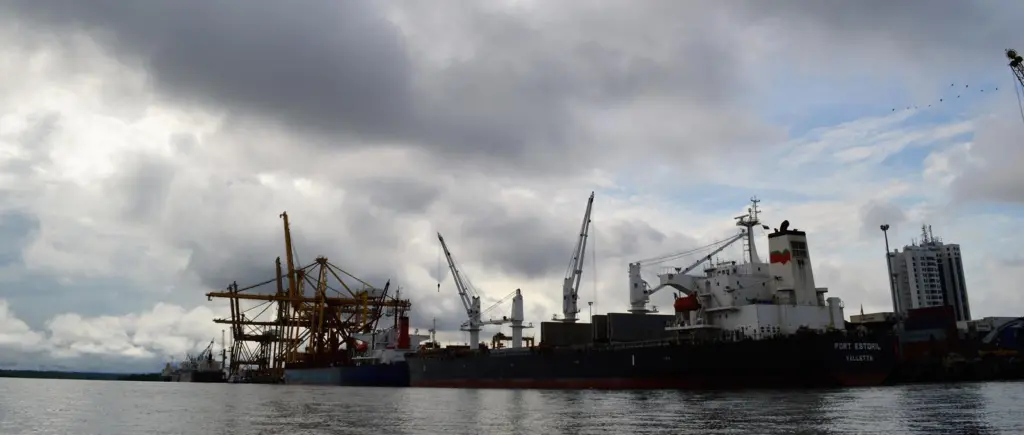
Between 2000 and 2017, the northern Chilean Port of Iquique saw the traffic it handled increase by 83.68%, despite dramatic earthquakes causing massive damage to infrastructure when they struck in April 2014.
It was only in 2016 that the first stage of reconstruction was completed, allowing the berth on Molo Terminal No. 1 to become operational once again. It was entirely rebuilt with anti-seismic technology through the installation of 1,284 steel micropiles, costing $30m.
Alfredo Leiton, managing director of Iquique Port Company (EPI), notes that the redevelopment will not stop there: port is currently in the middle of a second stage of rebuilding work involving the alignment of the berthing line through the installation of a slab mounted on pre-excavated concrete piles, which will also naturally increase the draft alongside the quay.
To expand operational capacity, reinforcement will also be incorporated to allow the installation of gantry cranes to serve larger ships. This work will last a further year and involve investment of a further $15m.
In 2017, traffic increased by 11% compared with 2016, reaching 2.45m tonnes, according to Mr Leiton, and up to August this year, the port had handled 1.58m tonnes, a slight decrease of 1.2%. Import-export traffic accounted for 76.5% of total volume handled last year, with 51.8% being imports to the adjacent Free Zone (Zofri) and the Andean Macro Region (Bolivia, Paraguay, Peru and the Argentine northwest). The 24.7% exported was mostly copper and fishmeal.
Box boom
However, it is box traffic that has dominated the port over the past 12 years, handled by the specialist Iquique International Terminal (ITI), and prospects for the future are positive.
“In the longer term, container traffic should continue to improve, driven by the extension of Berth No. 4, which is operated by ITI,” says Mr Leiton. “This can accommodate vessels of up to 366 meters in length, which are the largest currently deployed in the Chilean market. Work will start shortly and the extension will become operational by 2022.”
In terms of competition, Iquique goes up against the ports of Arica and Antofagasta for Bolivian cargo. Unlike the other two ports, Iquique was not part of the 1904 Treaty between Bolivia and Chile, granting significant warehousing rights to the former. Nevertheless, EPI does grant Bolivian cargo an 80% discount for storage, compared to Arica, for example, where import storage is free for one year and export is free for 60 days.
“Only traffic that enters Zofri can be considered captive as such to Iquique,” points out Mr Leiton.
He adds that Iquique is well placed to serve the central area of South America, with an average of 1.5 vessel calls a day linking the port to the Asia Pacific region.
While the hinterland of the port could be expanded through the development of either road or rail connections, it only makes sense if the investment produces lower costs for importers and exporters over those available in competing ports, he says.
Draft is not seen as a limiting factor in attracting traffic. In the past three years, for example, Iquique is one of five Chilean ports that can accommodate the largest vessels now capable of passing through the expanded Panana Canal. At present, port draft is 11.5 meters, which is sufficient since Chile is usually the end or start point for most vessels, meaning that they are not fully loaded and therefore do not require deeper draft.
The challenge for the port is to enable Terminal One to receive these large vessels. There are a number of projects in the pipeline to address this. Meanwhile, the extension of Berth No. 4 will deepen draft there to 14 meters.
Current investment in the port is aimed at delivering the maximum operational capacity to absorb future demand for cargo and to accommodate larger vessels. Once that reconstruction stage is concluded, Mr Leiton says that the port plans to undertake a demand study to identify future needs and how to best satisfy these. This will likely be through public/private partnership.
Expansion of backup areas will also continue through infilling on the coast off Serrano Island.
Contamination backlash
Another Chilean port facing its own challenges is Antofagasta. Andrónico Luksic, head of the Luksic Group, which operates both Antofagasta Terminal Internacional (ATI) and the Antofagasta Bolivia Railway, reacts angrily to press reports suggesting that the Port of Antofagasta should have its environmental license revoked because of contamination.
“If the Port of Antofagasta is contaminated,” he says, “it should have already been closed by the government.” Although the port is publicly owned, it is operated by ATI as a concession.
The vast majority of its traffic is in the form of heavy metal concentrates, which are being blamed for contamination in the surrounding city.
Mr Luksic says: “Before the concession, the ore was stored in the open. Today, not only are the operations of the port 100% hermetically sealed, but so are those of hauliers, mining companies and the Port Company of Antofagasta.”
A study published in April by Peerj noted that copper, zine and arsnic concentrates in the port are the highest in the world, while the city of 360,000 people has one of the world’s highest rates of lung cancer.
Mr Luksic counters arguing that this has been a historical problem, as has the link between heavy metals and cancer, so recent traffic at the port is not entirely to blame. Indeed, thanks to new measures introduced by the port to prevent environmental contamination, it could be argued that ATI is doing all that it can to stamp out this problem.
“To think that eliminating the port would be the end of pollution problems in Antofagasta is short-sighted, even more so when there is an unfortunate long-standing and complex multi-factor problem that goes far beyond a company,” he says.
Striking problems
Adversity is not just a problem of Chilean ports. In recent months, the Colombian Port of Buenaventura has been staring down its own issues too. A crippling 15-day strike only ended there after the personal intervention of the Under Secretary of State for Work, Carlos Alberto Baena.
A collective bargaining agreement is now in place, which should result in labour peace going forward, with the Sindicato Nacional De Trabajadores De Rama (SNTT) port union issuing a statement praising the resistance, willingness and persistence of all the port workers that had sustained the strike, as well as thanking Mr Alberto for his work in resolving the crisis.
And a veritable crisis it had been, too.
TCBuen, which is one of four terminals that comprise the Port of Buenaventura, effectively ground to a virtual halt during the strike, offering just minimum services. However, given the inter-relationship between the box terminals and other port installations, everybody at the port was negatively impacted.
At the height of the strike, it was estimated that the port was losing around $550m a day, meaning that the whole dispute could have cost in the region of $8bn because of lost traffic.
Significantly, 18 months ago, APM Terminals bought a 61% stake in the terminal from existing TCBuen shareholders, with the other 39% remaining with Colombian shareholders. According to Félix Villadiego, one of SNTT’s main negotiators, the reason why talks took such a long time to resolve the impasse was because of “a conflict of interest between the partners of TCBuen” who disagreed as to how the dispute could be resolved.
The most difficult issues centred around contracting workers, especially as to what constituted their exact working day. A holiday bonus sought by the workers also turned out to be a major sticking point.
Given the low percentage of SNTT workers used by TCBuen, it appeared that the company thought it could win the dispute by toughing it out, although solidarity across all dock workers surprised many people. After a period when the SNTT rejected all offers put on the table, labelling them insufficient, it contacted members at the ports of Santa Marta, Barranquilla and Cartagena, threatening a nationwide ports solidarity strike, which is allowed under Colombian law, with a ballot to have been held on September 21.
Fortunately, the government intervened, common sense prevailed, and a resolution was found.
Related Articles
 SOUTH AMERICA
 PORT & TERMINAL NEWS
 PORT & TERMINAL NEWS