




Troubles down south
Spats in Argentina and Uruguay detract from the business of terminal operating, finds Alex Hughes
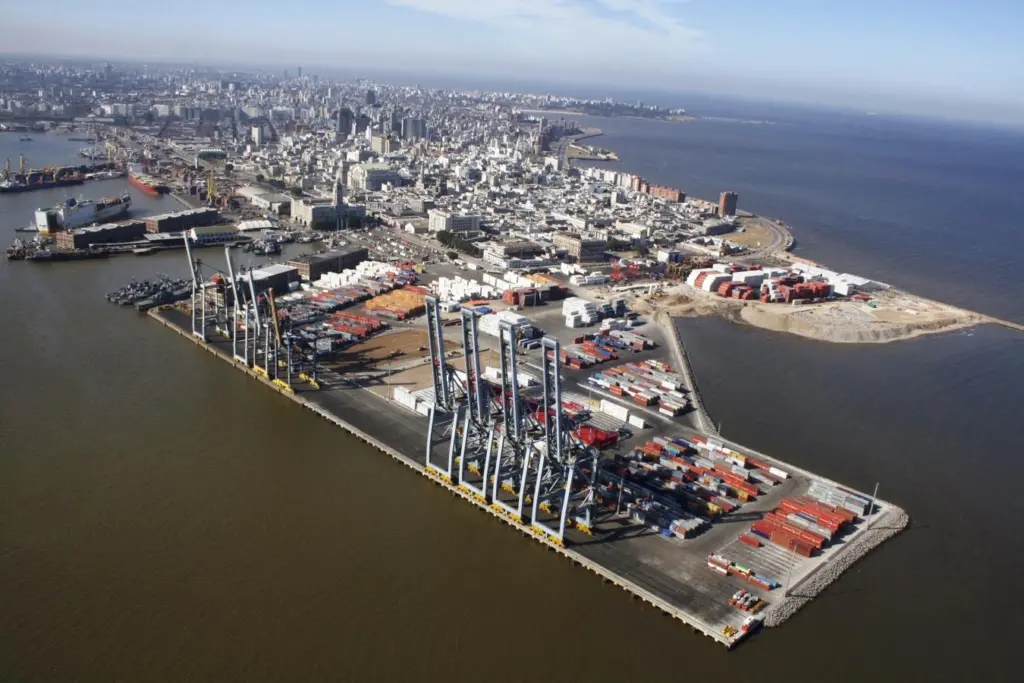
Governments and terminal operators in both Argentina and Uruguay have resorted to legal challenges to regulate competition in a market that is slowly being eroded by the regional economic downturn.
In Montevideo, for example, there is much debate as to whether there is enough room for two specialist container terminals to compete for business or not. Terminal Cuenta del Plata (TCP) is adamant that its concession agreement effectively means that it alone has the right to deploy quayside gantry cranes to handle containers and objects strongly to government initiatives to allow rival Montecon to use these on public quays.
The latest development has seen TCP write directly to Tabaré Vázquez, the Uruguayan president, to denounce perceived “irregularities” which it believes favours Montecon and to demand an investigation be undertaken by the National Ports Administration (ANP).
TCP, which is owned jointly by Belgium’s Katoen Natie (80%) and, more controversially, by the ANP (20%), accuses Montecon of using larger parts of the port area than it declares to the ANP. Under the existing arrangement, Montecon makes use of public quays, paying a monthly fee to the ANP based on actual space used.
in the same communication, TCP points out that, in July 2015, it had been forced to issue a complaint objecting to the laying of electrical cabling to enable Montecon to install a series of reefer plugs in the port. After a review, the ANP revoked the permit in December, but only after part of the work had been undertaken.
War of words
As far as the port authority is concerned, however, the latest war of words between Montecon and TCP is down to “economic strains” and it intends to keep out of the arguments. Nevertheless, in early February, it issued a tender governing the provision of refrigeration technology for the public quays, albeit that this would be for the period of just one year and that either Montecon or TCP could bid. ANP vice president Daniel Montiel explained that the contract was so short because future provision of these services would eventually be provided by a Spanish-Uruguayan consortium.
Katoen Natie regards the 12-month contract as financially non viable, given that nobody could amortise the investment required in infrastructure is so short a time. It has therefore reached the conclusion that the tender has been issued deliberately to favour Montecon.
Montcon’s managing director, Juan Olascoaga is said to be studying the terms and conditions of the tender, but has yet to make a decision on whether to bid for it or not. From his side, he points out that the original ruling by the ANP to allow Montecon to provide power for reefer plugs had been for an indeterminate period of time and not just for one year. The company is said to be exploring the legal situation against ANP to claim the financial redress it had incurred when having to remove the infrastructure it had put in place previously for its reefer installations.
The tension between the two operators was made substantially worse in recent years by the effective Argentinian embargo on its exporters making use of Uruguayan ports. The original Decree 1108 had a palpable negative impact on container traffic at Montevideo, with Argentinian businesses forced to scramble around to seek alternative outlets for containers, many of which were picked up by substantially more expensive terminals in Buenos Aires.
However, that embargo has now been lifted, and TCP has advertised for additional personnel to operate gantry cranes, straddle carriers and reachstackers in expectation of a major traffic upswing.
According to the Argentinian president, Mauricio Macri the original embargo was not well received and “affected the development of ports in Uruguay, as well as those in Argentina”. In its place, both Mr Macri and Mr Vásquez, promised to put a new bilateral port strategy that would “generate new opportunities for both communities”.
Argentina moves
But there are other events taking place at the heart of the Argentinian container market that threaten to make more waves.
TecPlata, the brand new container terminal operated by Philippines-based ICTSI at the Argentinian port of La Plata, is struggling to attract traffic.
The original project was heavily backed by Daniel Scioli, the former governor of the Province of Buenos Aires, vice-president in the recent Néstor Kirchner administration, and latterly unsuccessful as the candidate to replace her as president. Despite the heavyweight support, construction was subjected to an endless stream of delays, although the terminal eventually opened for traffic during the 2015 presidential campaign, with Mr Scioli undertaking the official inauguration.
However, it probably wasn’t the best time for a new container terminal to open in Argentina, which had already begun to see a major contraction in its overseas trade.
Port Strategy asked Eduardo Zabalza, TecPlata chief executive, about the volume of traffic handled in 2015 and what the prospects were for 2016. He declined to put a figure on the traffic levels, stating: “After several years of a continuous fall in foreign trade, we are seeing a transition year for Argentina in 2016. The recent instalment of the new government with a different economic view gives ground to expect a fast recovery in container volumes. However, it will take some period of time to reach the previous container volume levels. Because of that, we are cautious about prospects for 2016.”
In fact, it is perhaps not so much events in the port of La Plata that will dictate its eventual success, but rather developments among the terminals in nearby Buenos Aires, where short term concessions across several container terminals are all on the verge of expiring. Last year, much of Mr Zabalza’s time was taken up by trying to prevent the Terminal 5 concession at Buenos Aires from being renewed. The terminal, which had been operated by HPH’s BACTSSA on a short term concession, was not expected to be renewed. However, a new tender was issued and, this time, for a 4-year concession.
TecPlata argued that the concentration of so many box terminals in Buenos Aires’ Puerto Nuevo harbour contributed much of the traffic congestion suffered by the city, whose container trade would clearly, it intimated, be better served by being channelled through La Plata. Furthermore, a 40-year concession would, it was argued, distort competition. A legal challenge was then launched.
“The ideal situation would be for Buenos Aires to keep two terminals,” said Mr Zabalza. The comment, which was made at a time when the local economy was moving into downturn, prompted Roberto Coria, secretary general of the Guincheros union to say: “We are not going to allow a multinational to play with the stability and with jobs.”
Bidding opens
Although the tender process was delayed throughout 2015, and terms and conditions were amended, on January 19, 2016, AGP opened the financial bids for the concession to operate Terminal 5. BACTSSA’s $17m bid easily beat out the $11.7m offered by TecPlata.
The construction of TecPlata, along with associated dredging works, was completed by the end of 2015, although the terminal officially opened in early 2015. In its initial phase, capacity is 450,000 teu annually, although this could eventually be expanded to 900,000 teu per year. The terminal can handle two super post-panamax container vessels simultaneously and has quayside lift consisting of four super post-panamax gantry cranes capable of working ships with 20 rows of stowed containers. Back-up land extends over 150,000 square metres and incorporates more reefer plugs than any other Argentinian port.
Asked why ICTSI chose to invest in La Plata, given that nearby Buenos Aires already has several container terminals, Mr Zabalza says that Tecplata has several advantages, such as lower navigation tolls and port fees, deeper draft, the possibility for cargo to bypass congestion at Buenos Aires, and at the same time cater to industrial zones north of the Argentinian capital, while having better connectivity to the hinterland.
Tecplata’s location is ideal for cargoes both to and from the northern and southern regions, and also provides, through the newly renovated Route 6, the possibility to bypass the congested Buenos Aires urban centre altogether,” he says.
Related Articles
 SOUTH AMERICA
 PORT & TERMINAL NEWS
 PORT & TERMINAL NEWS